Lobuche Peak Climbing

Trip Fact:
  • Duration 18 Days
  • Difficulty Level Challenging
  • DestinationNepal
  • Max Altitude6119 m/20075 ft (Lobuche Peak Summit)
  • AccommodationComfortable Hotels in Kathmandu, Tea Houses during the trek, and Tented Camps at high altitudes.
  • MealsNutritious and delicious meals provided throughout the trek.
  • Trip Start/EndLukla
  • Group Size1-30 pax
  • Best SeasonMarch to May and September to November are best months to climb

Many trekkers first discover Lobuche Peak while planning the Everest Base Camp Trek. At first glance, it seems like a natural extension of the journey. After leading numerous Lobuche Peak expeditions over the years, however, we have learned that it offers something entirely different. While Everest Base Camp celebrates reaching one of the world's most famous destinations, Lobuche Peak introduces you to the skills, challenges, and rewards of real Himalayan climbing.

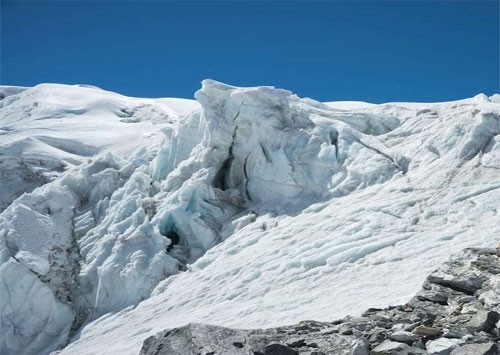
Standing at 6,119 meters (20,075 feet), Lobuche Peak is one of Nepal's most rewarding trekking peaks, combining the classic Everest Base Camp route with a genuine mountaineering experience. The journey follows the legendary Khumbu Valley through Sherpa villages, ancient monasteries, glacier landscapes, and some of the most spectacular mountain scenery on Earth before leading to an exciting summit climb using crampons, an ice axe, a climbing harness, and fixed ropes under the guidance of experienced climbing leaders.

One thing we continue to notice is that success on Lobuche Peak has very little to do with being the strongest person in the group. The climbers who enjoy the experience most are usually those who respect the altitude, maintain a steady pace, prepare well before arriving in Nepal, and trust the guidance of their climbing team. For this reason, our itinerary is carefully designed with proper acclimatization while also including Everest Base Camp and Kala Patthar before the summit attempt, giving your body valuable time to adapt and increasing the likelihood of a safe and enjoyable climb.

Every day on the trail offers something different, from the dramatic flight into Lukla and the lively atmosphere of Namche Bazaar to the peaceful villages above the tree line and the icy slopes rising above Lobuche High Camp. Along the way, you will experience breathtaking views of Mount Everest, Lhotse, Nuptse, Ama Dablam, Pumori, and many other Himalayan peaks before standing on the summit of Lobuche Peak with one of the finest panoramic views in the Everest region.

Whether you are looking for your first Himalayan trekking peak or preparing for more challenging mountains in the future, Lobuche Peak offers an unforgettable balance of trekking, climbing, and high-altitude adventure. Our experienced local climbing team is committed to helping you enjoy that experience safely through careful planning, responsible guiding, and genuine knowledge gained from years of leading expeditions in the Everest region.

How Difficult Is Lobuche Peak?

Lobuche Peak is considered one of Nepal's more challenging trekking peaks, not because it requires advanced mountaineering experience, but because it combines high-altitude trekking with a genuine alpine summit climb. Reaching the summit demands good physical fitness, careful acclimatization, determination, and the willingness to learn basic climbing techniques under the guidance of experienced climbing leaders.

One thing we often explain before every expedition is that there is no single reason why people find Lobuche Peak difficult. Instead, the challenge develops gradually throughout the journey. Several days of trekking above 4,000 meters, thinner air, changing mountain conditions, and the final summit climb all contribute to making this a rewarding but demanding Himalayan adventure.

For most climbers, altitude is the biggest challenge rather than the climbing itself. As the expedition progresses through the Khumbu Valley, the reduced oxygen at higher elevations naturally makes walking slower and recovery more difficult. This is why our itinerary includes gradual acclimatization together with visits to Everest Base Camp and Kala Patthar before moving towards Lobuche High Camp and the summit.

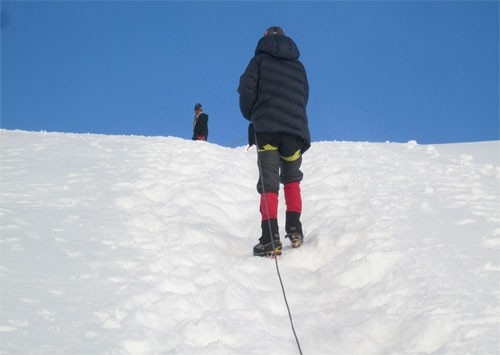
The summit day is physically and mentally the most demanding part of the expedition. After an early start in the dark, climbers ascend rocky terrain before continuing onto snow and ice where crampons, a climbing harness, fixed ropes, and a jumar are used under the supervision of our climbing guides. Although these techniques are straightforward to learn, they require concentration, steady movement, and confidence at high altitude.

Over many seasons, we have found that success rarely depends on who walks the fastest. The climbers who usually enjoy the experience most are those who conserve their energy from the very beginning of the trek, remain patient throughout the expedition, and trust the gradual pace designed for high-altitude climbing. By summit day, that consistent approach often proves far more valuable than speed or previous athletic ability.

With proper preparation, a well-planned itinerary, experienced local climbing guides, and respect for the mountain environment, Lobuche Peak is an achievable objective for many fit trekkers looking to take their first step into Himalayan mountaineering.

Do You Need Previous Climbing Experience for Lobuche Peak?

This is one of the questions we answer most often before every Lobuche Peak expedition. The simple answer is no. Previous mountaineering experience is not essential for many climbers. However, previous high-altitude trekking experience is highly recommended, as it gives you a much better understanding of how your body responds after several consecutive days above 4,000 meters.

After leading Lobuche Peak over many climbing seasons, we have found that first-time Himalayan climbers are often more capable than they initially believe. Many arrive in Nepal concerned about using crampons or fixed ropes, but with proper instruction and guidance, most become comfortable with the climbing equipment much sooner than expected. The greater challenge is usually adjusting to the altitude and maintaining enough energy throughout the expedition rather than learning the basic climbing techniques themselves.

Trekkers who have previously completed routes such as the Everest Base Camp Trek, the Annapurna Circuit Trek, the Manaslu Circuit Trek, or other high-altitude multi-day treks often arrive with realistic expectations about long walking days, changing mountain conditions, and life in remote tea houses. That experience does not make the climb easier, but it usually helps them feel more confident and relaxed as the expedition progresses.

Before the summit attempt, our climbing guides provide practical training on the correct use of climbing equipment, allowing every participant to become familiar with the techniques before heading onto the mountain. We introduce each step gradually, answer questions, and make sure everyone understands the process before the climb begins.

In our experience, the people who enjoy Lobuche Peak the most are not necessarily those with an extensive climbing background. They are the ones who arrive well prepared, remain patient throughout the journey, respect the mountain environment, and embrace the experience with a willingness to learn. With the right mindset, proper acclimatization, and professional guidance, Lobuche Peak is an excellent choice for trekkers looking to take their first step into Himalayan mountaineering.

Lobuche Peak Climbing Itinerary

Your Lobuche Peak expedition begins as soon as you arrive at Tribhuvan International Airport in Kathmandu, where a member of the Dream Heaven Adventure team will welcome you and transfer you to your hotel. After a long international journey, today is intentionally unhurried. It gives you time to recover from your flight, settle into Nepal, and begin adjusting to a completely different environment before heading into the Himalaya.

Later, we meet for an expedition briefing to introduce your climbing guide, review the itinerary, confirm equipment, and discuss the days ahead. Over many years of organising Lobuche Peak expeditions, we have found that taking time to answer questions and prepare properly before leaving Kathmandu helps climbers begin the journey with greater confidence. Although the summit still lies many days away, today's preparation forms the foundation for everything that follows.

  • Hotel
  • 1400m

Today combines two important parts of every Himalayan expedition. The morning offers an opportunity to explore several of Kathmandu Valley's UNESCO World Heritage Sites, providing a deeper understanding of Nepal's history, culture, and spiritual traditions before travelling into the Everest region. For many climbers, this cultural introduction becomes an important part of the overall Himalayan experience.

In the afternoon, our attention turns entirely to the expedition. Together with your climbing guide, we carefully check personal equipment, review technical climbing gear, discuss altitude management, and explain what to expect during each stage of the journey. Any remaining equipment can be rented or purchased in Kathmandu before departure. From our experience, climbers who begin the expedition well prepared enjoy the journey far more than those worrying about equipment once they reach the mountains.

  • Hotel
  • Breakfast
  • 1400m

Early this morning, we fly into the heart of the Khumbu region, landing at Lukla after one of the world's most memorable mountain flights. After meeting our porters, making final adjustments to our equipment, and enjoying a relaxed start, we begin walking towards Phakding alongside the Dudh Koshi River, passing traditional Sherpa villages, prayer wheels, mani walls, and suspension bridges that have connected mountain communities for generations.

Although today's trek is relatively short, it plays an important role in the success of the expedition. One lesson we continue to share with every climber is that Lobuche Peak begins with patience rather than speed. We deliberately keep the first day comfortable, allowing everyone to settle into a steady walking rhythm and begin adapting naturally to the altitude. After leading countless expeditions in the Everest region, we have found that climbers who respect this gradual start usually feel stronger and more comfortable as the journey progresses towards the higher mountains.

  • Tea House
  • Breakfast/Lunch/Dinner
  • 2652m

Today's journey follows the Dudh Koshi River through forests of pine and rhododendron, crossing a series of suspension bridges before reaching Monjo, the gateway to Sagarmatha National Park. From here, the trail gradually becomes steeper as it climbs towards Namche Bazaar, the historic trading centre of the Khumbu. On clear days, many climbers catch their first distant glimpse of Mount Everest during the final ascent, making this one of the most rewarding moments of the lower trek.

Although today's climb is one of the longest before reaching the higher mountains, our priority is never to reach Namche as quickly as possible. After leading countless expeditions in the Everest region, we have found that climbers who settle into a comfortable rhythm from the very beginning usually acclimatize more naturally over the following days. Reaching Namche feeling comfortable and well hydrated is far more valuable than arriving early with unnecessary fatigue.

  • Tea House
  • Breakfast/Lunch/Dinner
  • 3440m

Today is one of the most important days of the entire expedition. Rather than spending the day resting indoors, we gradually gain altitude on an acclimatization hike before returning to Namche Bazaar for another night. Depending on the group's pace and weather conditions, the hike may include Hotel Everest View, Syangboche, or another nearby viewpoint with panoramic views of Everest, Lhotse, Ama Dablam, Thamserku, and the surrounding Himalayan peaks.

Many first-time climbers wonder why we hike higher instead of taking a complete rest day. The answer comes from years of experience on this trail. Giving the body a chance to experience higher altitude before sleeping lower has consistently helped our guests adjust more comfortably before continuing above 4,000 metres. This additional day is one of the reasons our itinerary progresses gradually towards Lobuche Peak instead of rushing into the upper Khumbu.

  • Tea House
  • Breakfast/Lunch/Dinner
  • 3440m

Leaving Namche behind, the trail contours high above the Dudh Koshi Valley before descending to the river and climbing steadily through forest towards Tengboche. Throughout the day, the mountain scenery changes constantly, with Everest, Lhotse, Nuptse, Ama Dablam, and Thamserku becoming increasingly prominent as the valley opens ahead. By afternoon, we arrive at Tengboche, home to the region's most respected monastery and one of the most significant cultural landmarks in the Khumbu.

From our experience, today often marks the point where the expedition begins to feel truly Himalayan. The forests become quieter, the air noticeably cooler, and the surrounding peaks feel much closer than they did in the lower valleys. Many climbers remember their first evening in Tengboche as the moment they realise they are no longer simply trekking—they are gradually entering one of the world's great mountaineering landscapes.

  • Tea House
  • Breakfast/Lunch/Dinner
  • 3860m

After descending through forest to cross the Imja Khola, the trail passes the traditional Sherpa village of Pangboche before continuing into the wide Imja Valley. As the altitude increases, dense forests gradually disappear, replaced by alpine meadows, stone-built villages, grazing yak pastures, and spectacular views of Ama Dablam, Island Peak, and the surrounding Himalayan giants. By afternoon, we reach Dingboche, where we spend the next two nights preparing for the higher stages of the expedition.

Arriving in Dingboche marks an important turning point. Above this altitude, the expedition becomes less about covering distance and more about allowing the body to adapt naturally to the thinner air. Walking at a steady pace, eating well, staying hydrated, and sleeping properly all become increasingly important. After many seasons leading Lobuche Peak, we have learned that climbers who arrive in Dingboche feeling strong and relaxed usually enjoy the rest of the expedition far more than those who try to push beyond their natural pace.

  • Tea House
  • Breakfast,Lunch,Dinner
  • 4410m

Today is one of the most important acclimatization days of the entire expedition. Rather than continuing directly towards Lobuche, we spend several hours gaining altitude on the climb to Chhukung Ri before returning to Dingboche for another night. From the summit, the views stretch across Ama Dablam, Lhotse, Nuptse, Makalu, Island Peak, and the surrounding glaciers, but today's objective extends well beyond the scenery.

After leading Lobuche Peak expeditions over many years, we have found that spending time above 5,000 metres before sleeping lower gives climbers valuable physical and mental preparation for the days ahead. Just as importantly, today's hike allows our guides to observe how everyone is adapting to the altitude before we enter the more demanding stages of the expedition. Returning to Dingboche for the night follows the proven principle of climbing high and sleeping low, helping the body adjust naturally before moving deeper into the upper Khumbu.

  • Tea House
  • Breakfast/Lunch/Dinner
  • 4410m

Leaving Dingboche behind, we gradually enter a harsher alpine landscape where vegetation becomes increasingly sparse and the mountains dominate every direction. After a steady climb to Thukla, we pause at the memorial ridge, where monuments honour climbers and Sherpas who lost their lives on Everest, Lhotse, Nuptse, and other Himalayan peaks. It is a quiet reminder of the respect these mountains deserve and a place where many climbers naturally take time to reflect before continuing higher.

Beyond the memorials, the trail follows the edge of the Khumbu Glacier towards Lobuche. At this altitude, even gentle climbs require more controlled breathing than before, and our guides continue encouraging a steady pace, regular hydration, and good nutrition throughout the day. After many seasons on this trail, we have learned that arriving in Lobuche with energy still in reserve is far more valuable than trying to gain ground too quickly before the climbing phase begins.

  • Tea House
  • Breakfast/Lunch/Dinner
  • 4910m

Today's journey follows the Khumbu Glacier to Gorak Shep before continuing to Everest Base Camp, one of the world's most recognised mountaineering destinations. Walking across this rugged glacial landscape offers a completely different experience from the lower valleys, with towering peaks, shifting ice formations, and the immense scale of the Khumbu Glacier becoming increasingly apparent with every step.

During the spring climbing season, Everest Base Camp is alive with international expeditions preparing for summit attempts on Mount Everest and neighbouring Himalayan peaks. Watching these teams organise equipment and prepare for climbs above 8,000 metres offers a fascinating insight into high-altitude mountaineering. After spending time at Base Camp, we return to Gorak Shep for the night. Although reaching Everest Base Camp is a memorable achievement, our guides continue encouraging everyone to conserve energy, as the most important climbing days of the expedition are still to come.

  • Tea House
  • Breakfast/Lunch/Dinner
  • 5180m

Before beginning the climbing phase of the expedition, we make an early morning ascent of Kala Patthar, one of the finest viewpoints in the Everest region. From the summit, Mount Everest, Nuptse, Pumori, and the Khumbu Glacier appear at their closest, offering a final opportunity to appreciate the landscape that has gradually unfolded throughout the trek. After returning to Gorak Shep for breakfast, we retrace our route to Lobuche before continuing to Lobuche Peak Base Camp, where the expedition takes on a very different character.

From this point onward, our focus shifts completely from trekking to climbing. During the afternoon, our climbing guides carefully check each climber's equipment, adjust harnesses and crampons where necessary, and provide practical instruction on using the jumar, descending devices, helmets, and fixed ropes. We also discuss the weather forecast, expected departure time, climbing strategy, and the importance of maintaining a steady pace throughout summit day. After many years of leading Lobuche Peak expeditions, we have learned that careful preparation at Base Camp often contributes more to a successful climb than trying to recover mistakes once the ascent has already begun.

  • Tented Camp
  • Breakfast/Lunch/Dinner
  • 4910m

Summit day normally begins shortly after midnight, although the exact departure time depends on weather conditions, snow conditions, and the climbing plan established by your guide. Before leaving Base Camp, every climber's harness, helmet, crampons, headlamp, and climbing equipment are checked one final time. These final preparations may seem routine, but they are among the most important parts of the entire expedition, helping ensure that everyone begins the climb safely and with confidence.

As the route gradually steepens, we move carefully across rocky terrain, snow slopes, and fixed rope sections while maintaining a steady rhythm that allows everyone to climb efficiently at high altitude. Throughout the ascent, our guides observe far more than the route ahead. Walking pace, breathing pattern, energy levels, and how each climber responds to the altitude all help shape decisions on the mountain. If conditions require us to slow down, adjust the plan, or even turn around, those decisions are always made with the safety of the entire team in mind.

Reaching the summit of Lobuche Peak is the result of many days of gradual acclimatization, careful preparation, and teamwork rather than a single difficult climb. On clear days, the summit offers magnificent views across Everest, Lhotse, Nuptse, Makalu, Ama Dablam, Cho Oyu, and countless surrounding Himalayan peaks. After taking time to appreciate the achievement, we descend carefully to Base Camp, knowing that a successful expedition is measured not only by standing on the summit but by every member of the team returning safely from the mountain.

  • Tented camp
  • Breakfast/Lunch/Dinner
  • 4910m

With the summit behind us, we leave Base Camp and descend through Lobuche and Thukla, gradually returning to the greener valleys of the Khumbu. Losing more than a thousand metres of altitude during the day is something many climbers notice immediately, as breathing becomes easier and energy levels begin to return. After several demanding days in the high mountains, today's descent allows both the body and mind to relax while reflecting on everything achieved during the climb.

By the time we reach Pangboche, the atmosphere of the expedition has changed completely. The pressure of summit day has passed, conversations become more relaxed, and attention naturally turns towards the journey already completed rather than the climb still ahead. After guiding Lobuche Peak for many seasons, we have found that this quieter stage of the expedition often becomes one of the most rewarding, giving climbers time to fully appreciate the experience before returning to everyday life.

  • Tea House
  • Breakfast/Lunch/Dinner
  • 4000 meters

Today's walk retraces the familiar trail through Tengboche before descending into the Dudh Koshi Valley and climbing gently back to Namche Bazaar. Walking this section after the summit feels remarkably different from the journey uphill. Without the pressure of gaining altitude, climbers often notice details they passed quickly on the ascent, from quiet forests and mountain villages to the daily life of the Sherpa communities that call the Khumbu home.

Returning to Namche also marks the beginning of the final stage of the expedition. With the technical climbing now behind us, there is time to relax, enjoy a comfortable evening, and celebrate the achievement together with the team. Looking back over the previous two weeks, many climbers realise that the expedition has been about far more than reaching a summit. It has been a journey of gradual progress, shared effort, and learning to move confidently through one of the world's most remarkable mountain landscapes.

  • Tea House
  • Breakfast/Lunch/Dinner
  • 3441 meters

Today is the final day of trekking as we follow the familiar trail back through the Dudh Koshi Valley to Lukla, where the expedition first began. Walking this route after successfully climbing Lobuche Peak feels very different from the journey uphill. Without the pressure of gaining altitude or preparing for summit day, there is time to appreciate the villages, forests, rivers, and Sherpa communities that may have passed by almost unnoticed during the ascent.

After leading Lobuche Peak expeditions for many years, we have noticed that today is often one of the most relaxed days of the entire journey. Conversations become longer, the pace naturally slows, and everyone begins reflecting on how much they have experienced since arriving in Lukla. This evening is also an opportunity to celebrate the expedition together with the guides and porters whose knowledge, hard work, and support have been an important part of the journey from beginning to end.

  • Tea House
  • Breakfast/Lunch/Dinner
  • 2800m

Today is the final day of trekking as we follow the familiar trail back through the Dudh Koshi Valley to Lukla, where the expedition first began. Walking this route after successfully climbing Lobuche Peak feels very different from the journey uphill. Without the pressure of gaining altitude or preparing for summit day, there is time to appreciate the villages, forests, rivers, and Sherpa communities that may have passed by almost unnoticed during the ascent.

After leading Lobuche Peak expeditions for many years, we have noticed that today is often one of the most relaxed days of the entire journey. Conversations become longer, the pace naturally slows, and everyone begins reflecting on how much they have experienced since arriving in Lukla. This evening is also an opportunity to celebrate the expedition together with the guides and porters whose knowledge, hard work, and support have been an important part of the journey from beginning to end.

  • Tea House
  • Breakfast/Lunch/Dinner
  • 2800m

We intentionally include an additional day in Kathmandu because mountain weather can never be predicted with complete certainty. Although Lukla flights usually operate as planned, delays are a normal part of travelling in the Everest region. This extra day provides valuable flexibility, helping reduce the risk of missing your international flight should weather temporarily affect the flight schedule.

If everything has gone according to plan, today is free to enjoy Kathmandu at your own pace. You may wish to visit places you missed before the expedition, shop for souvenirs, or simply relax after your time in the mountains. After organising Everest region expeditions for many years, we have found that this additional day gives the journey a much more comfortable conclusion, allowing climbers to reflect on their achievement without feeling rushed from the Himalaya directly to the airport.

  • Hotel
  • Breakfast
  • 1400m

Your Lobuche Peak expedition comes to an end today as a representative from Dream Heaven Adventure transfers you to Tribhuvan International Airport for your onward flight. We recommend arriving at the airport at least three hours before your international departure, allowing plenty of time for check-in and immigration procedures.

Although your journey in Nepal ends here, we hope the experience stays with you long after returning home. Over the past eighteen days, you have travelled through Sherpa villages, stood at Everest Base Camp, watched sunrise from Kala Patthar, and successfully climbed Lobuche Peak. More importantly, you have experienced the rhythm of life in the Himalaya, worked together as part of an expedition team, and discovered what careful preparation, patience, and determination can achieve. On behalf of our entire team, we sincerely thank you for choosing Dream Heaven Adventure and hope to welcome you back to Nepal for another Himalayan adventure in the future.

  • Breakfast

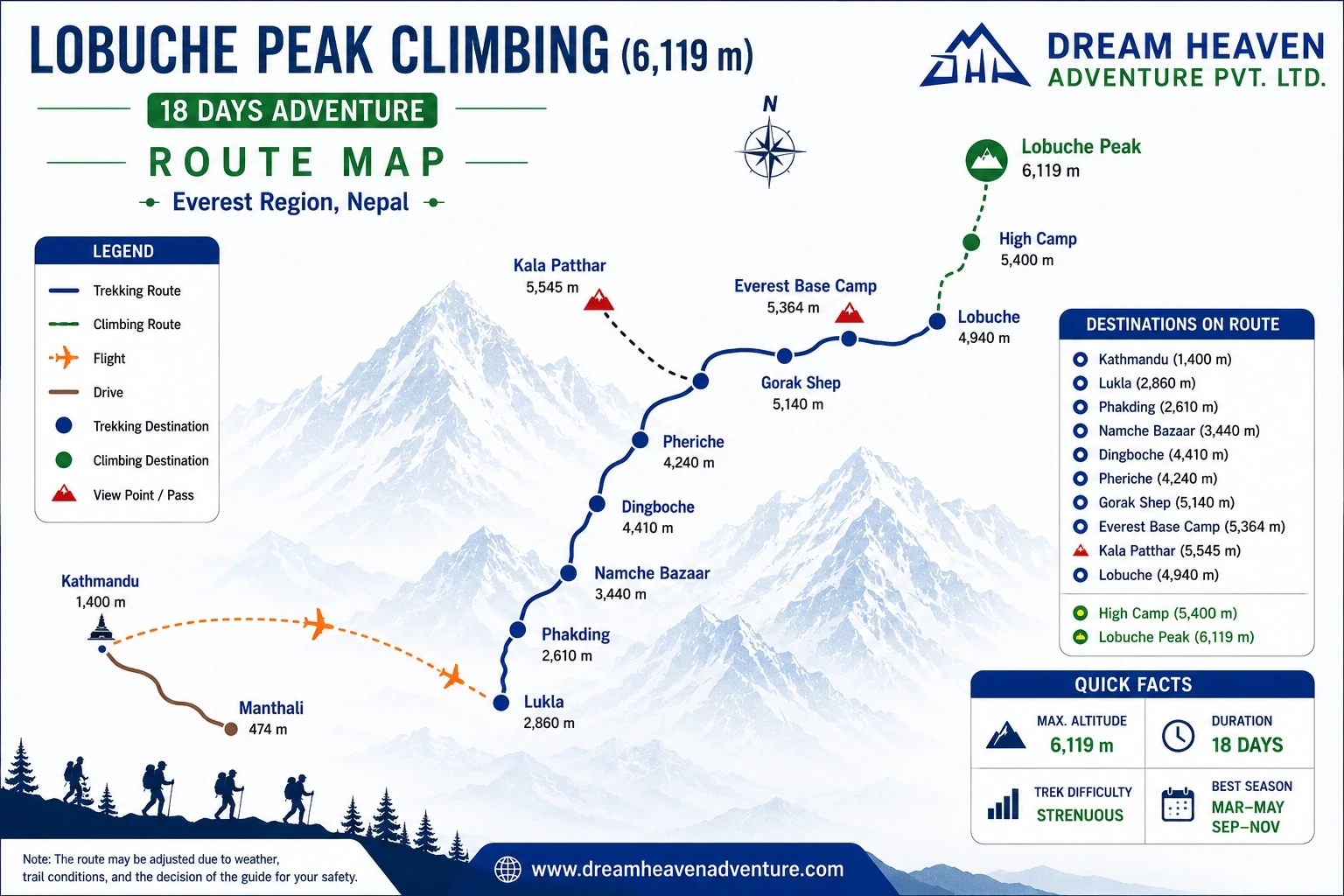
Lobuche Peak Climbing Map

Lobuche Peak Climbing map

Cost Details

Includes

  • All airport transfers
  • 4 nights in Kathmandu hotel ( including breakfast)
  • Full day Kathmandu sightseeing ( including professional tour guide and private tourist car)
  • All accommodations in the mountain ( 13 nights)
  • All meals ( Breakfast/Lunch/Dinner) as per itinerary
  • Round trip Kathmandu-Lukla-Kathmandu flight
  • Climbing and Trekking Guide, Cook, Assistant Climbing Leader, Sherpa
  • Necessary porters, and other helpers as per requirement
  • All necessary trekking and climbing permit.
  • Group climbing and camping equipment for climbing
  • Necessary equipment and all government and local taxes
  • Necessary ground transport

Excludes

  • Lunch/dinner in Kathmandu
  • Travel insurance
  • All Personal expenses
  • Altitude chamber (PAC) or oxygen
  • Personal climbing equipment
  • Tips for Climbing Staff
  • All kind of drinks
  • Any others kinf of expenses

Good to Know

What Makes a Successful Lobuche Peak Expedition

Every Lobuche Peak expedition follows the same route, but no two climbing seasons are ever exactly alike. Snow conditions change, weather windows shift, and every group brings its own pace, experience, and personality. After leading Lobuche Peak expeditions over many years, however, we have noticed certain patterns that remain remarkably consistent.

One of the biggest surprises for first-time climbers is that Lobuche Peak is not simply an extension of the Everest Base Camp Trek. While reaching Everest Base Camp is a rewarding achievement, the climb above Lobuche High Camp introduces a completely different environment where careful footwork, climbing equipment, and teamwork become just as important as physical fitness. This is often where trekkers truly discover the difference between high-altitude trekking and Himalayan climbing.

We have also found that the strongest climbers are not always the ones who reach the summit feeling the most comfortable. More often, it is those who remain patient throughout the journey, maintain a steady pace from Lukla onwards, and enjoy each stage of the expedition without rushing. By the time they reach High Camp, they are usually both physically stronger and mentally better prepared for summit day.

Another lesson we continue to see is that confidence develops gradually throughout the expedition. Many guests arrive in Nepal feeling uncertain about climbing above 6,000 meters, but after several days of trekking through the Khumbu Valley, visiting Everest Base Camp, standing on Kala Patthar, and completing climbing practice with our guides, that uncertainty often grows into quiet confidence. Watching that transformation is one of the most rewarding parts of leading this expedition.

For us, a successful expedition is never measured only by standing on the 6,119-meter summit. It is the result of careful preparation, sensible decisions, teamwork, patience, and respect for the mountains throughout the entire journey. That philosophy has guided every Lobuche Peak expedition we have led, and it continues to shape how we organize and lead this climb today.

Transportation for the Lobuche Peak Expedition

Transportation to Lobuche Peak is an important part of the overall expedition and begins with the spectacular mountain flight to Lukla, the gateway to the Everest region. Although the flight itself takes only around 30 to 35 minutes, travelling in the Himalaya requires flexibility, careful planning, and an understanding of how mountain weather influences daily flight operations. After organising Everest region expeditions over many years, we always remind our guests that the journey to Lukla is not simply transportation—it is the first stage of the Himalayan adventure.

Kathmandu or Ramechhap ( Understanding Lukla Flights )

One of the questions we receive most frequently is why some Lukla flights depart from Kathmandu while others leave from Manthali Airport in Ramechhap. Outside the main trekking seasons, flights usually operate directly from Kathmandu. During the busy spring climbing season (April and May) and the peak autumn trekking months (October and November), however, most flights are transferred to Ramechhap to reduce congestion at Kathmandu's international airport and improve the efficiency of flight operations.

Because this has become the standard operating procedure during the busiest months of the year, our team plans these logistics well in advance. When Ramechhap departures are required, we arrange the overnight transfer from Kathmandu so you arrive at the airport early the following morning, making the entire process as smooth and straightforward as possible.

Mountain Weather and Flight Delays

Unlike conventional domestic flights, Lukla flights operate in one of the world's most challenging mountain environments. Weather conditions can change quickly, and even clear skies in Kathmandu do not necessarily mean conditions are suitable for landing or taking off in Lukla. Cloud cover, wind, visibility, and mountain conditions are all carefully assessed before every flight, which is why delays or cancellations occasionally occur during every trekking season.

After managing Everest region expeditions for many years, one recommendation has never changed. Whenever possible, allow one or two additional days after your trek before your international flight home. This extra flexibility provides valuable peace of mind should weather conditions temporarily delay flights from Lukla.

Helicopter Alternatives

When weather conditions improve but scheduled flights remain heavily delayed, shared or private helicopter services may sometimes become available. Shared helicopter flights are often organised by combining passengers from different trekking and climbing groups whenever seats are available. Because availability depends on weather, aircraft operations, and passenger demand, this option can never be guaranteed. Whenever suitable opportunities arise, our operations team closely monitors the situation, explains the available options, and assists guests in arranging helicopter transfers if they choose to use this alternative.

Baggage Allowance

Lukla flights are operated by small aircraft with limited carrying capacity. The standard baggage allowance is generally 15 kg per passenger, including approximately 10 kg of checked baggage and 5 kg of hand luggage, although airlines may occasionally adjust these limits depending on operational requirements. Before your departure, we provide detailed packing guidance to help you stay within the permitted allowance and avoid unnecessary complications at the airport.

How We Manage Your Travel

Our support begins well before your flight to Lukla. We confirm flight reservations, organise airport transfers, arrange transportation to Ramechhap whenever required, and continue monitoring airline operations throughout your expedition. During the busy Everest climbing seasons, our operations team remains in regular contact with airlines, airport representatives, and our trekking staff on the trail so we can provide timely updates and help coordinate the most practical solution whenever weather affects flight schedules.

One lesson we have learned after organising countless Everest region expeditions is that flexibility is just as important as planning. Mountain weather will always remain beyond anyone's control, but careful preparation, clear communication, and experienced local support help ensure your journey continues as smoothly as possible from your arrival in Nepal until your return from the mountains.

Permits Required for Lobuche Peak Climbing

Every Lobuche Peak expedition requires several official permits before entering the Everest region and attempting the summit. One of the questions we receive most often is whether climbers need to arrange these permits themselves after arriving in Nepal. The answer is no. Once your booking is confirmed, our team prepares the required documentation, completes the permit application process, and makes sure everything is ready before your expedition begins, allowing you to focus entirely on preparing for the climb.

Lobuche Peak Climbing Permit

The Lobuche Peak Climbing Permit is mandatory for every climber attempting the summit of Lobuche East. Issued by the Nepal Mountaineering Association (NMA), this permit officially authorises climbing activities on the mountain and helps regulate Nepal's trekking peak expeditions. Without this permit, climbing above Lobuche High Camp towards the summit is not permitted.

Sagarmatha National Park Entry Permit

As Lobuche Peak lies within Sagarmatha National Park, every visitor entering the Everest region must also obtain a national park entry permit. This permit supports the protection of one of the world's most remarkable mountain environments, helping maintain trails, conserve wildlife and forests, and preserve the unique natural heritage of the Khumbu region for future generations.

Khumbu Pasang Lhamu Rural Municipality Permit

All trekkers and climbers visiting the Everest region also require the Khumbu Pasang Lhamu Rural Municipality Permit. Revenue from this local permit contributes directly to trail maintenance, waste management, local infrastructure, and community development throughout the Khumbu. It has become a standard requirement for visitors travelling in the Everest region.

How We Arrange Your Permits

Before every expedition, our office carefully reviews each climber's documents to ensure all permit requirements have been completed correctly. We obtain every necessary permit before the trek begins, so you do not need to visit multiple government offices or worry about the application process after arriving in Kathmandu. Throughout the expedition, our guides carry the required permits and present them at the official checkpoints along the route whenever necessary.

To prepare your permits, we normally require a clear copy of your passport, a recent passport-sized photograph, and your confirmed travel details before your arrival in Nepal. Once we receive these documents, our team takes care of the remaining administrative process and keeps you informed if any additional information is required.

All permits required for the Lobuche Peak expedition are included exactly as outlined in the Cost Includes section of this package. If permit regulations are updated by the relevant authorities in the future, we will arrange the latest requirements on your behalf and ensure your expedition continues in full compliance with current regulations.

Accommodation and Meals During the Lobuche Peak Expedition

Accommodation during the Lobuche Peak expedition changes naturally as you climb higher into the Everest region. The journey begins in comfortable Sherpa villages with welcoming family-run tea houses and gradually transitions into the more remote alpine environment where simplicity becomes part of the Himalayan experience. After leading Lobuche Peak over many years, we have found that this gradual change is something many climbers remember just as fondly as the summit itself, offering a genuine insight into mountain life beyond the climbing route.

For most of the expedition, you will stay in locally operated tea houses that have hosted trekkers and climbers for generations. Rooms are generally twin-sharing with comfortable beds, mattresses, pillows, and blankets, while the dining hall becomes the heart of each evening. As the altitude increases, accommodation naturally becomes more basic because every building material, food supply, and fuel source must be transported into the mountains by porters, yaks, or helicopters. Rather than viewing this as a compromise, we encourage our guests to see it as an authentic part of life in one of the world's highest mountain regions.

The final night before the summit is usually spent at Lobuche High Camp in a fully equipped expedition tent. Unlike the tea houses below, High Camp is established specifically for the climb, allowing the team to begin the summit ascent during the early morning hours while remaining close to the route. Although facilities are naturally more limited at this altitude, the atmosphere is unique, as climbers gather to prepare equipment, discuss the weather, and make their final preparations before summit day.

Meals throughout the expedition are freshly prepared by experienced local cooks using ingredients carried into the mountains through the traditional Himalayan supply network. Lower on the trail, the menu is surprisingly extensive, with favourites including Dal Bhat, fried rice, noodles, pasta, potatoes, Tibetan bread, pancakes, eggs, soups, porridge, seasonal vegetables, and hot drinks. As the expedition moves higher, the menu becomes more focused on simple, nourishing meals that are easier to prepare and digest at altitude while still providing the energy needed for long trekking and climbing days.

One thing we consistently notice after many Lobuche Peak expeditions is that appetite often decreases as altitude increases, even though the body requires more energy than ever. For this reason, our guides regularly encourage climbers to continue eating balanced meals and staying well hydrated throughout the journey. Good nutrition is one of the most overlooked parts of successful acclimatization and plays an important role in maintaining energy, supporting recovery, and helping climbers feel stronger as they approach High Camp and the summit.

Many of our guests tell us that some of their favourite memories were made not on the summit itself, but during the evenings spent inside the tea house dining rooms. Sharing stories with fellow trekkers and climbers from around the world, enjoying a hot meal after a rewarding day on the trail, and watching the mountains change colour outside the window all become part of the experience that makes a Lobuche Peak expedition far more than simply climbing another Himalayan mountain.

Summit Day: What to Expect

Summit day is undoubtedly the most demanding and memorable part of the Lobuche Peak expedition. It is the day when weeks or even months of preparation come together, but it is also the day that requires the greatest patience, concentration, and teamwork. Although reaching the summit is the goal, our focus from the moment we leave High Camp is always on making safe, well-informed decisions throughout the climb.

The day usually begins well before sunrise while the mountains are still quiet and temperatures are at their coldest. After a light breakfast and a final equipment check, we leave High Camp wearing headlamps and begin climbing steadily towards the upper slopes of Lobuche Peak. Rather than rushing, our guides encourage a slow, consistent pace that allows everyone to conserve energy as the altitude increases.

As the terrain becomes steeper, climbing equipment comes into use. Depending on the conditions, sections of the route involve fixed ropes where climbers use their harness, jumar, crampons, and ice axe under the close supervision of our climbing guides. For many first-time climbers, this is the most exciting part of the expedition. Once they settle into a steady rhythm, confidence usually grows with every step.

One thing we continue to notice after leading many Lobuche Peak expeditions is that summit day is rarely won through speed. The climbers who reach the top feeling strongest are usually those who remain patient from the very beginning, focus on one step at a time, and trust the pace set by their guides instead of looking towards the summit too often. At this altitude, consistency almost always proves more valuable than haste.

Standing on the 6,119-meter summit is an unforgettable reward for the effort invested throughout the expedition. On a clear day, the panorama stretches across Mount Everest, Lhotse, Nuptse, Makalu, Ama Dablam, Pumori, and countless other Himalayan peaks surrounding the Khumbu Valley. After enjoying the summit and taking photographs, the journey is only half complete. We descend carefully back to High Camp before continuing lower, because in Himalayan climbing, returning safely is always the true measure of a successful expedition.

How to Prepare for Lobuche Peak Climbing

Preparing for Lobuche Peak is not about becoming an elite athlete. It is about arriving in Nepal with the endurance, confidence, and consistency needed for nearly two weeks of trekking and climbing at high altitude. After preparing climbers for Lobuche Peak over many seasons, we have found that those who train gradually and consistently almost always enjoy the expedition more than those who try to reach peak fitness only a few weeks before departure.

The most valuable preparation is regular hiking. If possible, spend time walking on uneven trails while carrying a light daypack, as this closely reflects the rhythm of the expedition. If mountains are not available where you live, long walks, stair climbing, hill training, cycling, and steady cardiovascular exercise are all excellent ways to build the endurance needed for consecutive days on the trail.

One thing we consistently notice is that many people prepare by trying to walk faster, while the mountain rewards something completely different. Lobuche Peak is climbed at a slow, steady pace from the day you leave Lukla until the day you reach the summit. Climbers who learn to conserve energy, settle into a comfortable rhythm, and remain consistent throughout long training sessions usually adapt much more naturally to the pace of the expedition.

Strength training also has its place, particularly for the legs, core, and overall stability, but it should support your endurance rather than replace it. You do not need to train like a professional mountaineer. The goal is to feel comfortable walking for several hours on consecutive days without excessive fatigue, allowing you to arrive at High Camp feeling prepared rather than exhausted.

Equally important is preparing with realistic expectations. Himalayan climbing is influenced by altitude, weather, and mountain conditions that cannot be controlled. The guests who enjoy Lobuche Peak the most are usually those who arrive with an open mind, remain flexible throughout the expedition, and focus on the overall journey rather than thinking only about the summit.

Finally, begin your preparation early. Building endurance over several months is far more effective than intense training shortly before departure. Combined with our carefully planned itinerary, proper acclimatization, and guidance from experienced local climbing leaders, good preparation gives you the best opportunity to enjoy a safe, rewarding, and memorable Lobuche Peak expedition.

Why We Designed This Lobuche Peak Itinerary

Over the years, we have refined our Lobuche Peak itinerary many times, but the philosophy behind it has never changed. Every adjustment has been made with one objective in mind: helping our guests arrive at the summit well acclimatized, well prepared, and still enjoying the journey. In our experience, a successful Lobuche Peak expedition is not created by reaching High Camp as quickly as possible. It is created by making the right decisions long before summit day.

One of the questions we are asked most often is why we include both Everest Base Camp and Kala Patthar before attempting Lobuche Peak. Some climbers assume they are simply additional highlights, but they serve a much more important purpose. By the time you reach these destinations, your body has already spent several days adapting to higher elevations while you gain valuable experience walking in the terrain, weather, and thinner air that define the upper Khumbu. We have consistently found that this gradual progression helps climbers approach Lobuche High Camp feeling more confident and better prepared for the climb ahead.

Another important decision is resisting the temptation to rush. We understand that shorter itineraries can look attractive, especially for travellers with limited time. However, after leading Lobuche Peak for many years, we have learned that saving a day on the itinerary rarely improves the overall experience. A well-paced expedition gives your body more time to adjust, allows you to recover properly after long trekking days, and helps you arrive at the summit attempt with energy still in reserve rather than simply trying to reach it.

We also introduce climbing practice only after trekkers have settled into the altitude. From our experience, people learn more effectively when they are comfortable, rested, and able to focus on the techniques instead of the effects of rapid altitude gain. This approach creates a calmer learning environment and gives climbers greater confidence before leaving for High Camp.

Perhaps the biggest lesson we have learned is that the itinerary should work with the mountain, not against it. Weather, trail conditions, and individual acclimatization can never be controlled, so our schedule is designed to provide the flexibility needed to make sensible decisions when conditions require it. That philosophy has guided our Lobuche Peak expeditions for many years and continues to shape every climb we lead today.

Safety on Lobuche Peak

Safety on Lobuche Peak is not determined on summit day alone. It begins from the moment the trek starts in Lukla and is shaped by hundreds of small decisions made throughout the expedition. After leading Lobuche Peak for many years, we have learned that successful climbs are rarely the result of pushing harder. More often, they come from maintaining the right pace, allowing enough time for acclimatization, and making sensible decisions every day on the trail.

One of the first things our climbing guides pay attention to is how each person is adapting to the altitude. We are not only watching how quickly someone walks. Small changes such as reduced appetite, unusual tiredness, slower recovery after a day's trek, or a noticeable change in energy often provide valuable insight into how the body is responding to higher elevations. These daily observations help us make informed decisions long before minor issues have the opportunity to become more serious.

Mountain conditions also require constant judgement. Good weather does not always mean ideal climbing conditions, and a cloudy morning does not automatically make the mountain unsafe. Snow conditions, wind, temperature, trail conditions, and the overall condition of the climbing team are all considered together before important decisions are made. Years of guiding in the Everest region have taught us that flexibility is one of the most important parts of mountain safety.

Throughout the expedition, our guides encourage a steady and consistent pace rather than unnecessary speed. We have found that climbers who conserve their energy from the beginning of the trek usually feel stronger during the summit attempt than those who try to move too quickly in the lower sections of the trail. This patient approach not only improves the overall experience but also supports better decision-making at higher elevations.

Perhaps the most important principle we follow is that the summit is never the only goal. Every climbing decision is made with the complete journey in mind, including the return to lower altitude. If conditions on the mountain are not suitable or a climber is not adapting well, choosing to turn around is sometimes the safest and most responsible decision. After many seasons on Lobuche Peak, this philosophy has remained unchanged: a successful expedition is one where every member of the team returns safely with an experience they can be proud of.

Best Time to Climb Lobuche Peak

The best time to climb Lobuche Peak is during spring (March to May) and autumn (late September to November), when the Everest region offers the most stable weather, clearer skies, and the safest climbing conditions. These are also the seasons when the majority of Nepal's major Himalayan expeditions, including Mount Everest, Lhotse, Makalu, Ama Dablam, and other 6,000 to 8,000-meter peaks, are organized. This is no coincidence. These months provide the most reliable combination of weather, visibility, snow conditions, and climbing opportunities throughout the Himalaya.

After guiding Lobuche Peak through different seasons over many years, we have found that every season offers a different experience. Choosing the right time is not only about finding clear weather but also about understanding what conditions you are most comfortable climbing in.

Spring (March to May) The Best Season for Lobuche Peak Climbing

Spring is widely regarded as the finest season for climbing Lobuche Peak and is our preferred time for most expeditions. As winter gradually comes to an end, temperatures become more comfortable while the mountains usually retain enough snow to create classic Himalayan climbing conditions. The glaciers and surrounding peaks often look at their most spectacular, and the longer daylight hours make the overall expedition more comfortable.

Another advantage of spring is the presence of Everest climbing expeditions. Base Camp becomes lively with international climbing teams preparing for Mount Everest, Lhotse, and Nuptse, creating a unique atmosphere that few other seasons can offer. For many climbers, witnessing this activity adds another memorable dimension to the journey.

Among the spring months, April and early May usually provide the most consistent climbing conditions. March can still feel quite cold at higher elevations, while late May occasionally becomes warmer with increasing afternoon cloud cover as the monsoon gradually approaches.

Autumn (Late September to November) Stable Weather and Outstanding Mountain Views

Autumn is another excellent season for Lobuche Peak. Following the summer monsoon, the air is generally cleaner, visibility is exceptional, and the mountain landscapes appear remarkably crisp. This is the season many photographers prefer because distant Himalayan peaks are often visible for many kilometres.

October is typically the busiest month, offering stable weather, comfortable daytime temperatures, and reliable climbing conditions. November remains an outstanding choice for experienced trekkers and climbers who prefer quieter trails. Although mornings and evenings become noticeably colder, the skies are often exceptionally clear, and the mountain views can be among the best of the entire year.

Winter (December to February)

Lobuche Peak can still be climbed during winter, but the expedition becomes significantly more demanding. Temperatures at higher elevations often fall well below freezing, snow accumulation may increase, and strong winds can make summit conditions considerably more challenging. Shorter daylight hours also leave less flexibility during climbing days.

For experienced mountaineers seeking a quieter Himalayan experience, winter can be rewarding under favourable conditions. However, it is generally not the best choice for a first Himalayan climbing expedition.

Monsoon (June to Early September)

The summer monsoon is generally considered the least suitable season for Lobuche Peak. Heavy rainfall at lower elevations, frequent cloud cover, slippery trails, and limited mountain visibility can all affect the overall experience. Flights to and from Lukla are also more likely to experience weather-related delays during this period.

Although climbing is still occasionally possible when favourable weather windows develop, we normally do not recommend planning a Lobuche Peak expedition during the monsoon unless you have considerable flexibility and previous Himalayan experience.

Our Recommendation

If you are looking for the highest chance of stable weather and enjoyable climbing conditions, we recommend planning your Lobuche Peak expedition between April and early May or during October and early November. These periods consistently provide the best balance of weather, mountain conditions, visibility, and overall climbing experience. After many years of guiding in the Everest region, these remain the seasons we confidently recommend to climbers attempting Lobuche Peak for the first time as well as those returning for another Himalayan adventure.

Climbing Equipment for Lobuche Peak

One of the most common concerns we hear before every Lobuche Peak expedition is whether climbers need to buy a full set of mountaineering equipment before travelling to Nepal. In most cases, the answer is no. After preparing climbers for Lobuche Peak over many years, we have found that most trekkers already own the clothing needed for the trek, while the specialised climbing equipment required for the summit can easily be rented in Kathmandu at a reasonable cost.

The most important piece of personal equipment is a comfortable pair of trekking or mountaineering boots that fit well and have already been worn on longer hikes. We always recommend arriving with boots you trust rather than using brand-new footwear for the expedition. Good footwear, proper layering, and clothing that keeps you warm, dry, and comfortable throughout changing mountain conditions will have a much greater impact on your overall experience than expensive technical gear.

For the summit climb, essential mountaineering equipment includes crampons, an ice axe, a climbing harness, a helmet, a jumar (ascender), locking carabiners, safety slings, and other technical climbing gear used on fixed rope sections. Before leaving for High Camp, our experienced climbing guides provide practical instruction on how to use this equipment correctly, giving every climber the opportunity to become familiar with the techniques before stepping onto the mountain.

If you do not already own technical climbing equipment, there is no need to purchase everything for a single expedition. Kathmandu has several reliable outdoor gear shops where high-quality equipment can be rented before the climb. Our team is happy to recommend suitable rental shops and help you select equipment that fits properly and is appropriate for the conditions.

One lesson we continue to see after many Lobuche Peak expeditions is that successful climbers are rarely the ones carrying the newest or most expensive equipment. Climbers who arrive with well-fitting boots, practical clothing, and equipment they understand how to use almost always feel more confident than those relying solely on premium brands. Our priority is making sure every climber begins the summit attempt with equipment that fits correctly, functions properly, and inspires confidence on the mountain.

Why Climb Lobuche Peak With Dream Heaven Adventure?

Lobuche Peak is much more than reaching a summit at 6,119 meters. It is a journey through the Everest region that combines high-altitude trekking, mountaineering, and careful decision-making over many days. We believe the experience should never feel rushed or commercial. Every expedition we organize is built around responsible guiding, proper acclimatization, and helping each climber enjoy the journey with confidence from the first day in Lukla until the final descent.

Our itineraries are shaped by practical experience rather than fixed schedules. Over many years of guiding in the Everest region, we have continued refining every stage of the expedition to create a natural progression from trekking to climbing. Proper acclimatization, realistic walking days, climbing practice before the summit attempt, and flexibility when mountain conditions require adjustments are all part of how we approach every Lobuche Peak expedition.

We intentionally keep our climbing groups small because every climber adapts to altitude differently. Smaller groups allow our climbing guides to spend more time with each participant, answer questions throughout the journey, observe how everyone is adjusting to the altitude, and adapt the pace whenever necessary. In our experience, this creates a more enjoyable expedition and a stronger team on summit day.

Preparation begins well before arriving in the mountains. Before every expedition, we help our guests understand the itinerary, equipment requirements, physical preparation, and what to realistically expect during the climb. Once on the trail, our guides continue supporting each climber through practical advice, climbing instruction, and daily observations that come from leading Lobuche Peak over many seasons rather than following a standard itinerary.

Perhaps the biggest difference is our philosophy towards Himalayan climbing. We never measure success only by standing on the summit. We measure it by making good decisions throughout the expedition, respecting the mountain environment, supporting one another as a team, and returning safely with an experience that remains memorable long after leaving Nepal. That philosophy continues to guide every Lobuche Peak expedition we lead.


Lobuche Peak Climbing FAQs

  • Q1. Do I need previous mountaineering experience to climb Lobuche Peak?

    Previous mountaineering experience is helpful but not essential for many climbers with a strong level of fitness and prior high-altitude trekking experience. Before the summit attempt, our climbing guides provide practical training on using crampons, harnesses, fixed ropes, and other technical equipment. The most important requirements are good physical preparation, a positive attitude, and a willingness to follow your guide's instructions.

  • Lobuche Peak is generally considered more technically demanding than Island Peak. The summit route involves steeper terrain, more sustained climbing, and greater exposure on some sections. Climbers looking for a more challenging first Himalayan trekking peak often choose Lobuche, while those seeking a slightly less technical introduction may consider Island Peak.

  • Summit success depends on weather conditions, proper acclimatization, physical fitness, and sound decision-making on the mountain. We have found that climbers who arrive well prepared, follow a gradual itinerary, and listen to their guides have an excellent chance of reaching the summit when conditions are favourable.

  • We believe visiting Everest Base Camp and Kala Patthar adds much more than famous viewpoints. The additional time spent at higher altitude supports acclimatization while allowing climbers to experience two of the Everest region's most iconic destinations before beginning the climbing phase of the expedition.

  • Our guides provide guidance on the technical climbing equipment required for the summit and conduct a full equipment check before the ascent. You should bring your own personal trekking clothing, boots, and essential outdoor gear. If you need specialised mountaineering equipment, quality rental options are available in Kathmandu before the expedition begins.

  • Temperatures vary with the season and altitude. Summit day often begins well below freezing, particularly before sunrise, while daytime temperatures during the trek are generally much more comfortable. Proper layering, insulated clothing, and suitable gloves are essential for staying warm throughout the expedition.

  • Like any high-altitude expedition, there is always a risk of altitude sickness above 3,000 metres. Our itinerary is designed to reduce that risk through gradual altitude gain, scheduled acclimatization days, and careful pacing. Our guides monitor every climber throughout the expedition and will always prioritise health and safety over reaching the summit.

  • Mountain weather can change quickly in the Himalaya. If conditions become unsafe because of strong winds, heavy snowfall, poor visibility, or other factors, our climbing guides may delay, modify, or cancel the summit attempt. These decisions are never taken lightly, but they are made to protect every member of the team.

  • Yes. Kathmandu has several reputable outdoor equipment stores where climbers can rent high-quality mountaineering gear before the expedition. We are happy to recommend reliable rental shops and help you choose equipment that fits properly.

  • Most tea houses offer charging facilities and Wi-Fi for an additional fee, although both services become less reliable as altitude increases. Weather conditions and local power supply can occasionally affect availability, so we recommend carrying a fully charged power bank for backup.

  • Yes. We strongly recommend comprehensive travel insurance that specifically covers trekking and climbing activities up to the maximum altitude of this expedition, including emergency helicopter evacuation and medical treatment if required.

  • Spring (March to May) and autumn (late September to November) consistently offer the most favourable conditions for climbing. Spring is Nepal's main mountaineering season, while autumn is known for exceptionally clear mountain views and stable weather.

  • For the comfort and safety of both our staff and guests, one porter normally carries luggage for two climbers, with a combined maximum load of approximately 20–25 kg. We encourage all climbers to pack only what they genuinely need for the expedition.

  • If continuing the expedition is no longer safe, our guides will assess the situation immediately and recommend the most appropriate course of action. Depending on the circumstances, this may involve descending with a guide, arranging additional support, or organising emergency helicopter evacuation if medically necessary. Your safety always comes first.

  • Lobuche Peak is an expedition where experience matters. Our approach is built on careful acclimatization, realistic pacing, thorough preparation, and responsible decision-making throughout the climb. From planning your expedition in Kathmandu to supporting you on summit day, our goal is not simply to help you reach 6,119 metres, but to give you the confidence, knowledge, and support to complete the journey safely while experiencing the Everest region in the way it deserves to be explored.

  • Climbing Lobuche Peak is usually done during pre-monsoon (spring) and post-monsoon (autumn) seasons. April to May and September to November are considered the most favorable periods for climbing, when the weather is generally stable and clear skies offer better visibility.

  • Lobuche Peak is a renowned trekking destination located in the Everest region of Nepal. It features two main summits: Lobuche East, standing at 6,119 meters, and Lobuche West, slightly higher at 6,145 meters. This peak is situated near the Khumbu Glacier and the famous Everest Base Camp trekking route.

  • Indeed, climbing Lobuche Peak demands prior experience in mountaineering. Potential climbers should possess basic skills in both ice and rock climbing and be competent in handling climbing gear such as crampons, ice axes, and ropes. Furthermore, being physically robust and mentally ready for high-altitude conditions is essential.

  • Typically, an expedition to climb Lobuche Peak lasts about 18 to 20 days. This period includes the trek to Everest Base Camp, time for acclimatization, and the actual ascent. However, the schedule might change depending on the tour operator and prevailing weather conditions.

  • Climbing Lobuche Peak necessitates two permits: a climbing permit and an entry permit for Sagarmatha National Park. These can be acquired through a registered trekking agency in Nepal, which will manage the required documentation for you.

  • Climbers are required to have various specialized mountaineering equipment, including crampons, ice axes, harnesses, helmets, climbing boots, insulated jackets, and sleeping bags designed for extreme cold. It's usual for climbers to either rent some equipment in Kathmandu or participate in a guided expedition that provides the necessary gear.

  • Absolutely, there are inherent risks involved in climbing Lobuche Peak, like other high-altitude mountaineering endeavors. These risks include altitude sickness, harsh weather conditions, avalanches, and crevasses. However, these risks can be mitigated with proper acclimatization, guidance from experienced professionals, and adopting appropriate safety measures.

  • Climbing Lobuche Peak is categorized as strenuous, necessitating a high level of physical fitness. To prepare, climbers should undertake physical training before the trip to build strength, stamina, and endurance needed for long hikes and the ascent.

  • The expense of a Lobuche Peak climbing expedition can vary significantly based on factors like the tour itinerary, group size, included services (like gear rental, meals, accommodations), and the trekking agency. Generally, the cost could range between USD 2,000 and USD 3,000 per person.

Suggested Itineraries

Ask a Question