Trail and Walking Conditions on the Annapurna Ghandruk Trek
The trail on the Annapurna Ghandruk Trek is well established, but it is rarely flat for long. Much of the walking follows old village paths through the lower Annapurna hills, with a mixture of stone staircases, packed-earth trails, forest paths and tracks between cultivated terraces.
The stone steps are one of the most noticeable features of the route. Some are broad and regular, while older sections have uneven heights and worn surfaces. Climbing them is usually a matter of finding a comfortable rhythm, but the descents can be harder on the knees, particularly later in the day. This is why we do not judge a walking day here only by distance. A few kilometers with a substantial descent followed by another climb can feel very different from the same distance on level ground.
The trail changes as you move between villages. Open sections pass through terraced farmland and cultivated hillsides before entering quieter forest, while around the settlements you walk on stone paving, steps and narrow paths between houses and fields. These are working village trails, so local people, livestock and mule traffic may share the same path. When animals are approaching on a narrow section, we normally find a secure place to wait and give them room to pass.
Rain also changes the walking conditions quickly. Stone that provides good footing when dry can become slippery when wet, particularly in shaded sections that take longer to dry. Forest paths may become muddy and loose ground requires more attention on descents. In these conditions, we let the trail determine the walking pace rather than trying to maintain the same speed as on a dry day.
One thing that often surprises first-time trekkers is how misleading distance can be in the Annapurna foothills. Two villages can appear quite close across a valley, yet walking between them may require descending toward a river or stream and then climbing the opposite hillside. The distance on a map therefore tells only part of the story; the amount of elevation lost and regained often determines how the day actually feels.
After many trips on these lower Annapurna trails, our approach is simple. We keep a comfortable rhythm on the climbs, take more care on long or wet descents, and adjust the pace to the people walking with us and the condition of the trail. There is no benefit in rushing a short trekking day simply because the next village looks close.
Ghandruk Village and Gurung Life
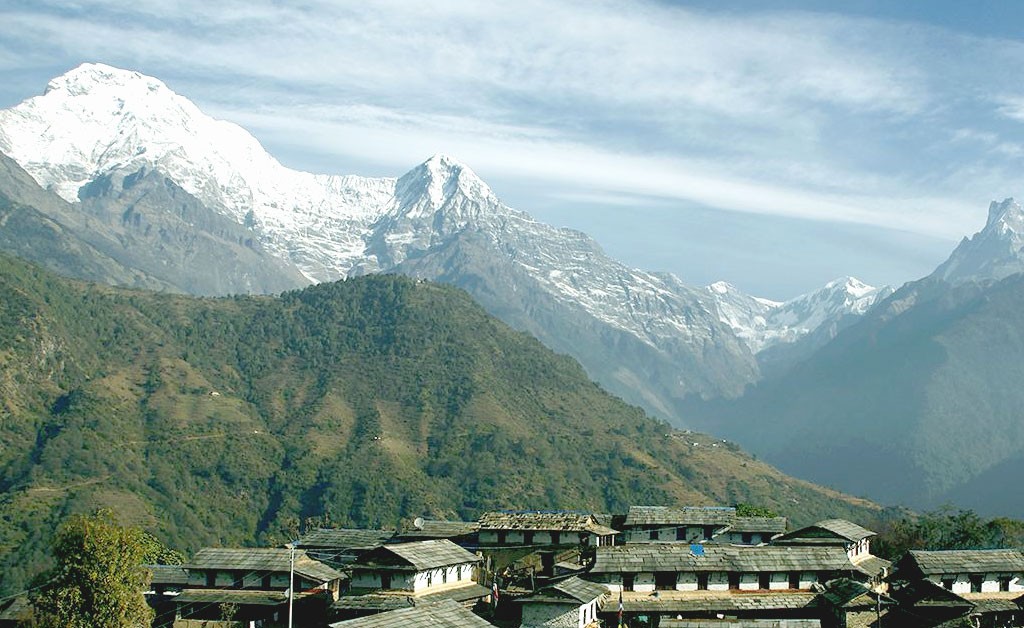
Ghandruk is the main village experience of the Annapurna Ghandruk Trek, but we prefer not to describe it simply as a traditional Gurung village or a place to stop for mountain photographs. It is a lived-in hillside settlement where local homes, farming and Gurung community life now exist alongside trekking lodges, cafés and other businesses that have developed with tourism.
When guests first arrive, they often notice the stone houses and mountain setting. Spend more time walking through Ghandruk, however, and the village becomes more interesting. Stone-paved lanes connect family homes, lodges, small courtyards and cultivated terraces, while older parts of the settlement sit alongside newer buildings created as Ghandruk has grown as a trekking destination.
The Gurung community has a long connection with Ghandruk and the surrounding hills. That connection is visible not through one staged cultural experience, but through the settlement itself, its homes, agricultural land, community spaces and the families who continue to live here. Depending on available time and opening hours, visitors can also explore local cultural displays or museums in the village.
We do not describe Ghandruk as untouched by tourism. It isn't. Trekking has become an important part of the local economy, and during the main spring and autumn seasons the village can be busy with trekkers and other visitors. What makes Ghandruk interesting today is precisely this coexistence of village life and tourism, rather than an image of a Himalayan settlement that has remained unchanged.
The character of the village also changes through the day. During the busier hours, the main walking areas can feel active with trekkers, lodge activity and people moving through the settlement. Earlier in the morning and later in the day, particularly after visitors passing through have moved on, it can feel quite different. Staying overnight gives you more opportunity to experience Ghandruk beyond a short daytime visit.
When walking through the village, we remind guests that homes, courtyards and agricultural land are private spaces even when they sit beside the trekking trail. Ask before entering private areas or photographing people closely, and follow your guide when you are unsure. Ghandruk is someone's home first and a trekking destination second.
For us, that is the value of spending a night here rather than treating Ghandruk simply as the point where you take a photograph and turn around. You have time to walk beyond the lodge, see how tourism and everyday village life share the same hillside, and experience Ghandruk when you are no longer simply passing through it
Annapurna Ghandruk Trek Difficulty and Physical Preparation
The Annapurna Ghandruk Trek is manageable for most reasonably active travelers, including first-time trekkers, but being short and relatively low does not mean you can arrive completely unprepared. The main physical demand comes from walking uphill and downhill for several hours and then being ready to walk again the following morning.
Previous trekking experience in Nepal is not necessary. From our experience on this route, regular walking fitness and being comfortable with repeated descents are more useful than previous high-altitude experience. Someone who regularly walks, hikes, cycles, runs or stays active will usually find the three trekking days manageable at a sensible pace.
Altitude is not the main concern on this itinerary. Ghandruk is around 1,980 meters, so the trek does not require the acclimatization schedule needed for Annapurna Base Camp or the higher sections of the Annapurna Circuit. We still encourage guests to drink enough water, eat properly and mention any unusual discomfort to the guide, but we do not treat this as a high-altitude trek.
You also do not need an intensive training program specifically for Ghandruk. If you already exercise regularly, maintaining your normal routine and adding a few longer walks before arriving in Nepal is usually enough. If you are not normally active, we recommend beginning three to four weeks before departure with regular walking and gradually increasing the time you spend on your feet.
Whenever possible, include hills or stairs in that preparation. The purpose is not to walk as fast as possible. It is to become comfortable climbing for a sustained period, controlling your legs on the way down and recovering well enough to repeat the effort the next day.
A simple readiness test is more useful than a complicated training schedule. If you can comfortably complete several hours of hilly walking, finish without completely exhausting yourself and feel capable of walking again the following morning, you are generally well prepared for this trek.
When we have guests with different fitness levels, we do not expect everyone to walk at the same speed. We normally settle into a pace that the group can maintain comfortably throughout the day. For a three-day trek to Ghandruk, arriving first at the next lodge has no advantage. Arriving with enough energy to enjoy the village and walk comfortably again the next morning matters much more.
Best Time for the Annapurna Ghandruk Trek
The best time for the Annapurna Ghandruk Trek is generally October to November and March to April, but the better season depends on what you want most from these three days of walking. Because the route remains in the lower Annapurna foothills, we are usually choosing a season for mountain visibility, rainfall, walking temperature and the character of the hills, rather than worrying about whether a high pass is open.
If clear mountain views are the main priority, October and November are usually our first choice. After the summer monsoon, the air is often cleaner and mornings can reveal sharp views of Annapurna South, Hiunchuli and Machhapuchhre. The trade-off is that this is also a popular trekking period. Around Ghandruk, October in particular can feel noticeably busier than quieter times of the year.
March and April are our other preferred months, but we choose them for a slightly different experience. The days are generally warmer, and spring changes the forest and lower hills as rhododendrons and other vegetation become more active. Clear mountain mornings are still possible, but we pay more attention to cloud development later in the day. If the peaks are completely open after breakfast, we enjoy that view then rather than assuming it will still be there in the afternoon.
May can still be a good trekking month, especially earlier in the month, but we expect warmer conditions and an increasing possibility of afternoon cloud and showers as the season moves toward the monsoon. For someone whose main priority is consistently sharp mountain photography, we would normally choose October, November, March or April ahead of late May.
Winter is also more practical here than on many high-altitude Annapurna routes. December and January bring colder mornings and evenings, but Ghandruk's lower elevation means winter does not normally end the trekking season. On a clear winter morning, mountain visibility can be excellent. The important difference is that trekkers need to be comfortable with colder starts and cooler evenings rather than prepare for a high snowbound pass.
The summer monsoon from roughly June through August is our least preferred period for this trek if mountain views are the priority. Cloud can hide the Annapurna range for long periods, rainfall is more frequent and humidity is higher. On the other hand, the lower hills and cultivated terraces are at their greenest. We would consider these months for someone whose dates are fixed, but we would set expectations differently from an autumn departure.
One pattern we have learned not to ignore around Ghandruk is the difference between morning and afternoon visibility. The mountains can be completely open early in the day and disappear behind cloud surprisingly quickly as the foothills warm. When we wake to a clear view, we encourage guests to enjoy and photograph it rather than waiting for a supposedly better opportunity later.
If you ask us to choose without any other preference, October and November are our first recommendation for clearer post-monsoon mountain conditions, while March and April are excellent for travelers who prefer warmer spring walking and the seasonal character of the forests. If avoiding the busiest periods matters more than having the statistically safer weather window, we can choose outside those months and plan around the conditions instead.
Accommodation and Meals on the Annapurna Ghandruk Trek
During the Annapurna Ghandruk Trek, we stay in local tea houses along the trekking route. We normally arrange twin-sharing rooms, with beds, mattresses, pillows and blankets provided by the lodge. The accommodation is comfortable for a short trek, but we do not expect exactly the same room facilities at every overnight stop.
This difference is most noticeable between the smaller villages and Ghandruk, where there is a wider choice of trekking lodges. Attached bathrooms may be available at some properties, particularly where better rooms are available, but we do not promise an attached bathroom for every trekking night. If a private bathroom is important to you, let us know before the trek and we will arrange the best available option where possible.
During the busier trekking periods, lodge availability can change quickly. We prefer to confirm the night's accommodation in advance rather than arrive late and assume our preferred rooms will still be available. For us, a clean room, reliable lodge management and a practical location matter more than choosing a property simply because it offers more facilities.
Meals are prepared at the tea houses where we stop during the trek. The menus are fairly broad for a lower Annapurna route, with dal bhat, noodles, fried rice, soups, potatoes, momos, eggs, Tibetan bread, pancakes and simple pasta dishes commonly available. Not every lodge prepares every item equally well, so our guides can suggest what is working well at a particular stop.
Dal bhat is especially common after a longer walking day because it provides rice, lentil soup, vegetables and accompanying dishes in one meal. But there is no expectation that guests eat Nepali food throughout the trek. On a three-day route, there is usually enough choice to vary meals comfortably.
Vegetarian food is straightforward to arrange. If you are vegan, have a food allergy or follow a specific diet, tell us before leaving Pokhara. This gives our guide time to communicate your requirements at the overnight stops rather than discovering them only when the kitchen begins preparing dinner.
One thing we do not promise is identical food or room standards from village to village. These tea houses are independently operated mountain lodges, not branches of the same hotel or restaurant. Menus may look similar, while room facilities, portion sizes, preparation and available services can differ.
Hot drinks and drinking water are available along the trekking route. Additional drinks and personal lodge services may cost extra depending on your package inclusions, so we explain what is covered before departure and recommend carrying some Nepali rupees for personal expenses on the trail.
For a short trek like Ghandruk, accommodation and meals are generally straightforward. What matters to us is that you have a suitable place to sleep, enough food for the following day's walk, and realistic expectations about what changes between one village lodge and the next.
Transportation for the Annapurna Ghandruk Trek
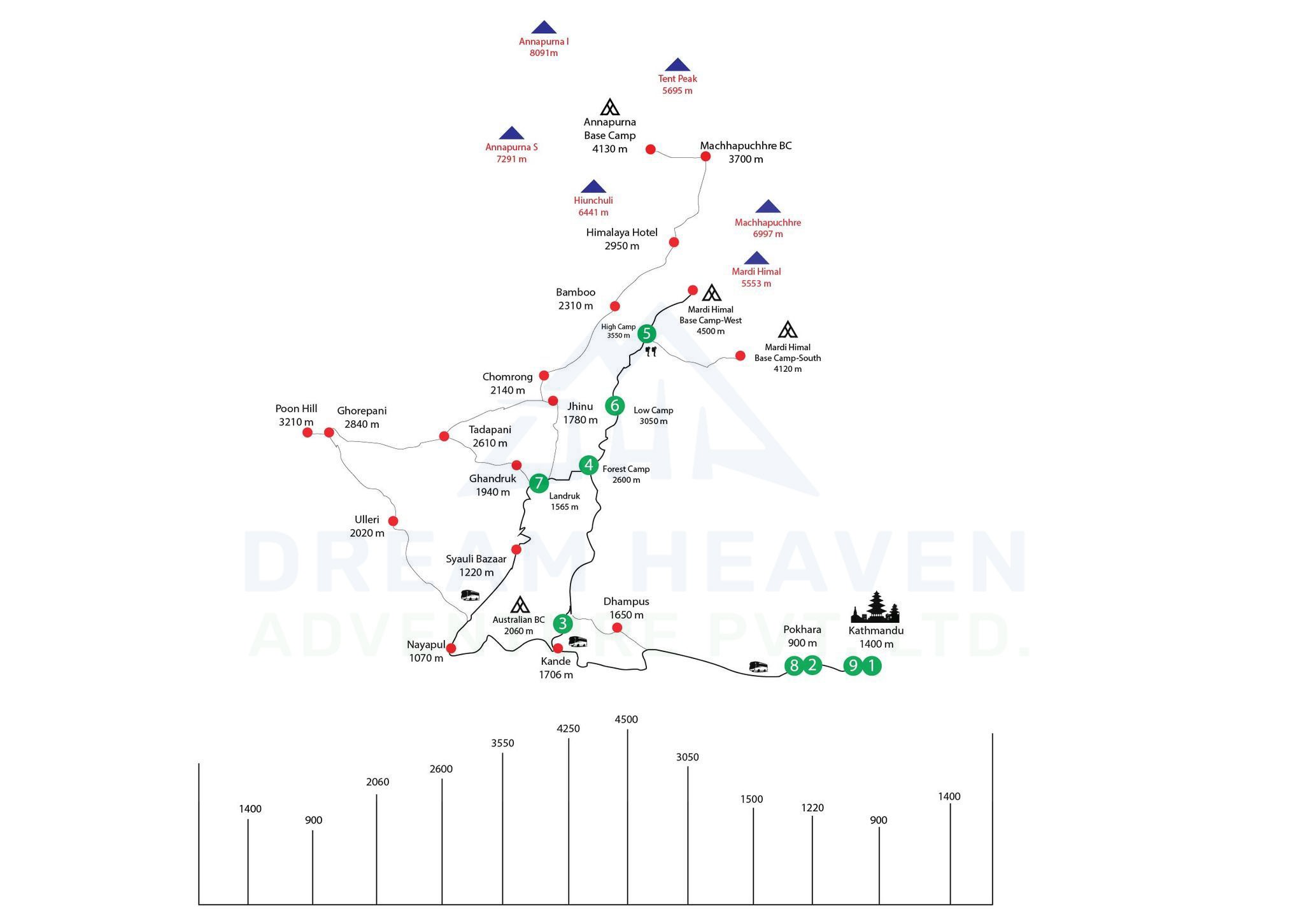
Transportation for the Annapurna Ghandruk Trek is arranged around the three trekking days, with overland travel between Kathmandu and Pokhara and private transfers connecting Pokhara with the trail.
In our standard 8-day package, we travel from Kathmandu to Pokhara by tourist bus. We keep this as a separate travel day rather than arriving in Pokhara and immediately heading onto the trail. After reaching Pokhara, you stay overnight and have time to prepare the smaller amount of clothing and equipment you actually need for the trek.
On the first trekking morning, we provide a private vehicle from Pokhara to Phedi, where we leave the road and begin walking toward the Annapurna foothills. This transfer is relatively short compared with the Kathmandu to Pokhara journey, and there is no reason to carry your main suitcase onto the trail.
We recommend leaving unnecessary luggage at your hotel in Pokhara and trekking only with what you need for the three walking days. This keeps your trekking bag lighter and avoids sending city clothes and other travel items through the villages when you will not use them.
At the end of the trek, we walk out through the Birethanti and Nayapul side, where our private road transfer takes us back to Pokhara. We do not recommend building a tight onward connection around the expected arrival time because walking pace, traffic and road conditions can all affect when we reach the hotel.
The standard package later returns from Pokhara to Kathmandu by tourist bus. If you prefer to fly between Kathmandu and Pokhara, require private transportation, plan to remain in Pokhara after the trek, or are already staying there before the trip begins, we can adjust the transport arrangement accordingly.
One detail we make clear before departure is where vehicle travel finishes and trekking actually begins. The complete package lasts eight days, but the mountain walking is concentrated into three trekking days. The Kathmandu and Pokhara travel days are part of the complete Nepal itinerary rather than additional trekking days.
Transportation for the Annapurna Ghandruk Trek
Transportation for the Annapurna Ghandruk Trek combines the Kathmandu to Pokhara journey with private road transfers between Pokhara and the trekking trail. In our standard 8-day package, tourist bus transportation between Kathmandu and Pokhara is included, while the shorter transfers at the beginning and end of the trek are by private vehicle.
We travel from Kathmandu to Pokhara by tourist bus and stay overnight in Pokhara before beginning the trek. We prefer keeping this as a separate travel day rather than reaching Pokhara after a long road journey and immediately starting to walk.
On the first trekking morning, we drive by private vehicle from Pokhara to Phedi, where the road journey finishes and the walking begins. From here, we continue on foot toward Tolka for the first trekking night.
You do not need to take your main suitcase through the mountains. Clothing and other belongings that are not required during the three trekking days can be left at your hotel in Pokhara, allowing you to carry only what you need for the trail.
At the end of the trek, we descend through Kimche, Shauli Bazaar and Birethanti toward Nayapul. From the trekking end point, private transportation is included for the return to Pokhara.
The standard package later returns from Pokhara to Kathmandu by tourist bus. If you prefer to fly between Kathmandu and Pokhara, travel by private vehicle, remain in Pokhara after the trek, or begin the trip directly from Pokhara, we can adjust the transport arrangement accordingly. The included standard option, however, is the tourist bus between Kathmandu and Pokhara.
One distinction is worth making clear before booking: the complete itinerary is eight days, while the actual trekking is concentrated into three days. The Kathmandu and Pokhara travel days are part of the complete Nepal itinerary rather than additional days on the walking trail.
Permits for the Annapurna Ghandruk Trek
The Annapurna Ghandruk Trek lies within the Annapurna Conservation Area, so an Annapurna Conservation Area Permit (ACAP) is required for the trek. Ghandruk and the surrounding trekking routes fall within the permit system managed by the National Trust for Nature Conservation.
When you book the trek with us, we arrange the required ACAP permit before you leave for the trail. We collect the necessary traveler details during the booking process and complete the permit arrangement, so you do not need to visit the permit office yourself in Kathmandu or Pokhara.
The permit should remain accessible during the trek rather than being left with your main luggage in Pokhara. Conservation-area permits must be carried during the trip and shown if requested by the responsible personnel.
Unlike Nepal's restricted-area treks, Ghandruk does not require a special restricted-area permit. The permit process for this itinerary is straightforward, and our team makes sure the required documentation is prepared before the trek begins.
Guide and Porter Support on the Annapurna Ghandruk Trek
A licensed trekking guide and porter support are included in our Annapurna Ghandruk Trek package. Although the mountain section lasts only three days, we use the same principle as on our longer treks: the guide manages the trekking day while the porter carries the main trekking luggage.
On this route, the guide's job is less about simply finding the trail and more about making the day work properly. Your guide coordinates departure times, walking breaks, lunch stops, tea-house arrangements and communication with lodge owners while keeping track of how everyone in the group is doing.
This becomes particularly useful when guests walk at different speeds. We do not expect everyone to stay together step for step. The guide manages the group so that slower walkers are not pressured to rush and faster walkers do not become separated without a clear plan. With only a few days on the trail, there is little reason to turn the trek into a race between villages.
The guide also handles practical matters that travelers may not notice until they need them. This includes confirming the night's accommodation, communicating dietary requests, checking local conditions and adjusting the day's timing when necessary. If something changes during the trek, you have someone on the trail who can make the immediate decision while remaining in contact with our team when required.
For porter support, we normally provide one porter for every two trekkers. The porter carries the main trekking luggage, while you walk with a small daypack containing the things you may need during the day, such as water, a waterproof layer, sun protection, camera and personal essentials.
Because the actual trek lasts three days, we do not recommend sending your entire Nepal travel bag with the porter. Leave your suitcase and unnecessary city clothing at the hotel in Pokhara and pack only what you need for the trekking nights. This keeps the porter load reasonable and makes luggage management much simpler.
For us, support on Ghandruk is straightforward: the guide looks after the day's organization and decisions, the porter handles the main trekking luggage, and you carry only what you need while walking. That division keeps a short trek simple without making the route sound more complicated than it really is.
Yes, this is the version I would publish. It is better than the previous draft because it removes repeated discussion of stone steps, wet descents and walking technique. It answers the heading through actual operations rather than generic claims about “professional and experienced guides.”
What to Pack for the Annapurna Ghandruk Trek
Packing for the Annapurna Ghandruk Trek should be relatively simple. The trekking section lasts only three days and stays at lower elevation, so you do not need the amount of clothing or technical equipment required for Annapurna Base Camp, the Annapurna Circuit or Nepal's high-pass treks.
For clothing, we recommend packing in light layers rather than relying on one heavy jacket. A moisture-wicking trekking shirt, comfortable walking trousers, a warm fleece or light insulated layer, waterproof jacket and a change of clothes for the evening are enough for most departures. The exact combination should be adjusted for the season, particularly during colder winter mornings or wetter summer conditions.
Your footwear matters more than carrying a large amount of equipment. Use comfortable hiking shoes or lightweight trekking boots that you have already worn before arriving in Nepal. Brand-new footwear is one of the easiest ways to turn a short trek into an uncomfortable one. Good grip is particularly useful when stone surfaces are wet.
A small daypack should carry the things you may actually need while walking: water, waterproof layer, sun hat, sunglasses, sunscreen, camera or phone, personal medication and a few small snacks. Your main trekking bag can travel with the porter, so there is no reason to carry your evening clothing and other overnight items throughout the day.
Trekking poles are optional rather than essential. We find them most useful for guests who already like walking with poles, want additional balance on descents or prefer to reduce some of the repeated load on their knees. If you have never used poles before, you do not need to buy expensive technical equipment specifically for Ghandruk.
For the trekking nights, bring your normal toiletries and personal items in small quantities. A reusable water bottle, compact power bank and headlamp are useful even on this developed route. Electricity may be available at the lodges, but carrying your own backup power is simpler than depending on charging whenever you need your phone or camera.
You do not normally need crampons, microspikes, an ice axe, mountaineering boots or other technical climbing equipment for the standard Ghandruk itinerary. This is a lower-altitude village trek, not a high-pass or glacier route.
The most common packing mistake on this trek is simply bringing too much. Because your suitcase can remain in Pokhara, pack specifically for the three trekking days rather than carrying clothing for your entire Nepal holiday through the mountains. A lighter trekking bag is easier for the porter to manage and makes packing and unpacking at the tea houses much simpler.
Our approach before leaving Pokhara is straightforward: take what you will realistically use on the trail, leave city clothing and unnecessary luggage behind, and adjust the warm and waterproof layers to the season you are trekking in. For Ghandruk, sensible footwear and useful layers matter considerably more than an extensive equipment list.