How Difficult Is the Everest Mini Trek? Fitness and Preparation
The Everest Mini Trek is an easy-to-moderate Himalayan trek that does not require technical climbing skills or previous mountaineering experience. However, “mini” should not be confused with effortless. Trekkers still walk for several hours on consecutive days, climb steep sections towards Namche Bazaar, cross suspension bridges, and follow uneven mountain trails with repeated ascents and descents.
The most physically demanding part of the outward journey is usually the walk from Phakding to Namche Bazaar. After following the Dudh Koshi Valley and crossing several bridges, the trail begins a sustained climb towards Namche. The elevation gain, stone steps, and continuous uphill walking make a steady pace more important than speed. For many first-time trekkers, this section feels considerably harder than the relatively gentle walk from Lukla to Phakding the previous day.
The return from Namche Bazaar to Lukla presents a different challenge. Although the route loses considerable elevation overall, it is not continuously downhill. Long descents are mixed with smaller climbs, stone steps, river crossings, and uneven sections, and the 6–7 hours of walking can make it one of the more tiring days of the trek. Trekking poles can be particularly useful for reducing strain on the knees during the longer descents.
How Fit Do You Need to Be?
You do not need to be an athlete to complete the Everest Mini Trek, but a reasonable level of cardiovascular fitness, leg strength, and walking endurance is important. Travelers who regularly walk, hike, cycle, swim, run, or do other aerobic exercise generally adapt more comfortably to consecutive trekking days than those arriving with little recent physical activity.
A useful preparation goal is to become comfortable walking for 4–6 hours, preferably on routes that include hills or stairs. If possible, complete some longer walks on consecutive days before traveling to Nepal. This helps prepare your legs for the repeated effort of trekking rather than just a single day of exercise.
Is the Everest Mini Trek Suitable for Beginners?
Yes, reasonably fit beginners can complete the Everest Mini Trek, and previous trekking experience in Nepal is not required. The route is established and does not involve ropes, climbing equipment, glacier crossings, or other technical mountaineering skills.
What matters more is arriving prepared for mountain conditions. Walking slowly on climbs, wearing well-broken-in trekking footwear, carrying only what you need during the day, and maintaining a comfortable pace can make a significant difference. Our guides do not expect everyone in a group to walk at the same speed; the aim is to maintain a sustainable pace appropriate to the individual and the trail conditions.
How Should You Prepare Before the Trek?
For most travelers, three to six weeks of regular preparation is more useful than an intensive training program immediately before departure. Walking, stair climbing, cycling, jogging, swimming, or similar cardiovascular exercise can build endurance, while squats, lunges, step-ups, and basic leg-strength exercises can help with the repeated climbs and descents.
Whenever possible, include some outdoor walks wearing the footwear and daypack you plan to use in Nepal. This is useful not only for fitness but also for identifying uncomfortable boots, socks, backpack straps, or other equipment before reaching the trail.
The Everest Mini Trek is therefore not technically difficult, but it still requires physical effort and preparation. In our experience, travelers often find the sustained climb to Namche and the longer return to Lukla more significant than the word “mini” suggests. Starting with realistic expectations, basic fitness, and a willingness to walk at a steady pace is more important than having previous high-altitude trekking experience.
Altitude and Acclimatization on the Everest Mini Trek
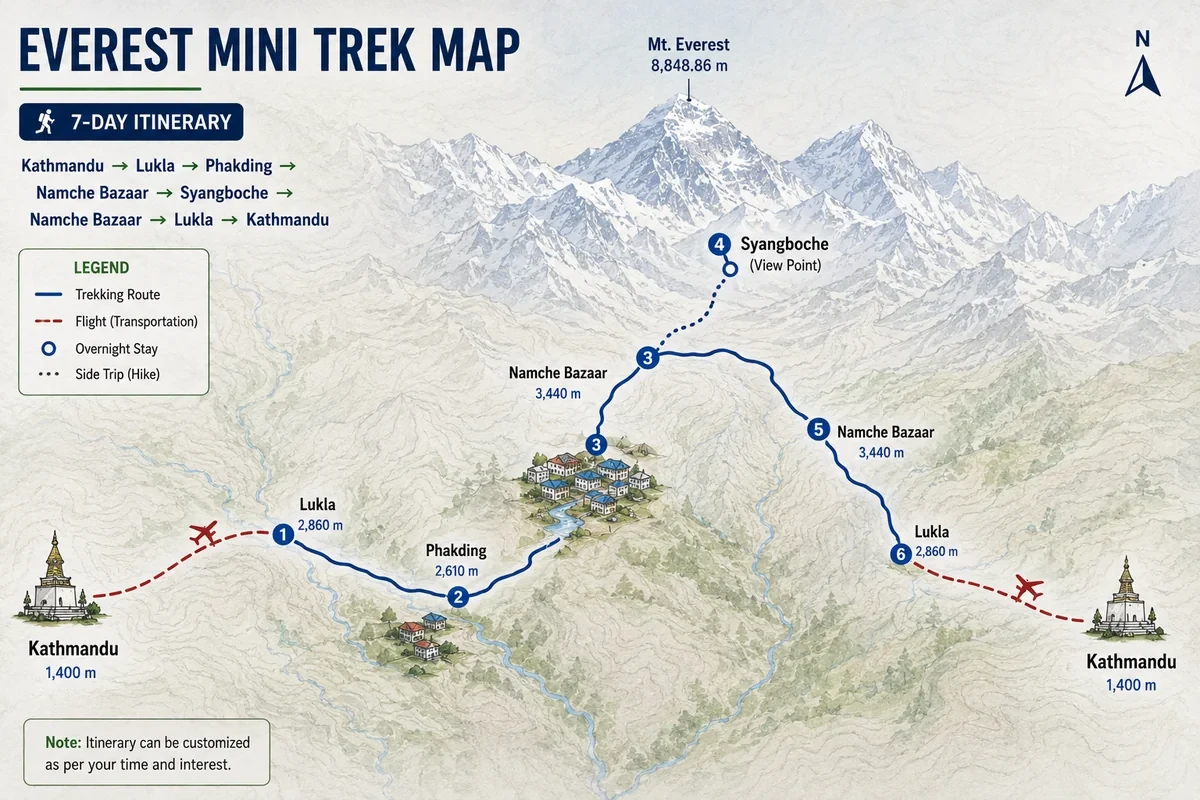
Although the Everest Mini Trek stays considerably lower than the Everest Base Camp route, altitude still needs to be taken seriously. The trek rises from Lukla at approximately 2,860 meters to Namche Bazaar at around 3,440 meters, with a higher daytime hike towards Syangboche. At these elevations, some travelers may notice the effects of thinner air even though the itinerary does not continue into the much higher Khumbu.
The biggest altitude gain comes on the trek from Phakding (approximately 2,610 m) to Namche Bazaar (approximately 3,440 m). Because this is a substantial increase in sleeping elevation, we encourage a slow and steady walking pace rather than trying to reach Namche quickly. Feeling stronger than other trekkers is not a reason to climb faster; individual responses to altitude vary considerably and are not determined by fitness alone.
Why Do We Spend Two Nights in Namche Bazaar?
The itinerary includes two consecutive nights in Namche Bazaar, with the Syangboche hike between them. This gives trekkers additional time at approximately 3,440 meters instead of immediately continuing to a higher sleeping elevation.
On the second morning, we hike above Namche towards Syangboche before returning to sleep at the same elevation in Namche. This follows the useful trekking principle of climbing higher during the day and sleeping lower afterward, while also allowing time to explore the higher surroundings above Namche.
The Syangboche hike should not be treated as a competition to reach the highest possible point. The purpose is to experience the higher terrain and Himalayan views at a comfortable pace before returning to Namche.
What Altitude Symptoms Should You Watch For?
Mild headache, unusual tiredness, dizziness, reduced appetite, or nausea can occur after gaining elevation. These symptoms should not be hidden from your guide or ignored simply to stay on schedule.
Our guides encourage trekkers to communicate how they are feeling, maintain a comfortable pace, drink regularly, eat properly, and avoid unnecessary exertion after reaching Namche. If symptoms develop, the appropriate response depends on their severity and whether they improve or worsen.
More serious or worsening symptoms require prompt attention. Continuing higher is not the priority when a trekker is becoming unwell, and descent may be necessary if the situation requires it. The guide's decision should be based on the person's condition and circumstances on the trail rather than pressure to complete the planned itinerary.
Does the Shorter Route Eliminate the Risk of Altitude Sickness?
No. A shorter trek and lower maximum elevation do not eliminate the risk of altitude sickness. They reduce exposure to the much higher elevations reached on longer Everest routes, but travelers can still experience altitude-related symptoms around Namche and during hikes above it.
Good physical fitness also does not guarantee protection from altitude sickness. A fit trekker can experience symptoms while another traveler may feel completely normal at the same elevation. For this reason, we focus on sensible pacing, communication with the guide, adequate rest, and paying attention to changes in how each trekker feels.
The Everest Mini Trek has a relatively moderate altitude profile compared with higher Everest itineraries, but we still treat acclimatization as part of the trek rather than something required only above 4,000 or 5,000 meters. The second night in Namche, combined with the daytime hike towards Syangboche, gives travelers additional time to adjust to the elevation while still experiencing higher terrain before returning to sleep at Namche.
Best Time for the Everest Mini Trek
The best time for the Everest Mini Trek is generally spring (March to May) and autumn (September to November), when conditions in the Khumbu are usually most favorable for trekking and mountain views. However, because this itinerary stays around Namche Bazaar and Syangboche rather than continuing into the much higher Everest Base Camp route, it can also be considered during winter by travelers who are comfortable with colder conditions.
There is no single “best” month for everyone. October usually offers an excellent overall balance of weather and visibility but is also one of the busiest periods on the Everest trail. November is colder but often attractive for clear mountain conditions, while April combines spring temperatures with the changing vegetation of the lower Khumbu. The right month depends on whether your priority is comfortable temperatures, clearer views, quieter trails, or avoiding the wetter summer period.
Spring: March to May
Spring is one of the main trekking seasons in the Everest region. March generally begins cooler, particularly in the mornings and evenings around Namche, before daytime temperatures become progressively milder through April and May.
April is often one of the better-balanced spring months for this short trek, combining milder walking conditions with the changing vegetation of the lower Khumbu. Forested sections of the trail can become more colorful as rhododendrons and other vegetation respond to the warmer season.
By May, conditions are generally warmer, but cloud can build more frequently as the pre-monsoon period approaches. Clear mountain views are still possible, particularly in the morning, but travelers choosing late spring should not assume that visibility will remain perfect throughout every day.
Autumn: September to November
Autumn is another excellent period for the Everest Mini Trek. As the summer monsoon withdraws, the Khumbu generally enters a drier trekking season with good opportunities for Himalayan views.
October is usually the busiest month on the route. The combination of favorable trekking conditions and international holiday schedules brings many trekkers to Lukla, Phakding, and Namche Bazaar. This creates a lively atmosphere but also means flights, lodges, and the main trail can be noticeably busier.
November becomes progressively colder, especially during mornings and after sunset in Namche, but it can be an excellent choice for travelers who prioritize mountain visibility and don't mind carrying warmer layers. Later in the month, temperatures fall further and trail traffic may begin to decrease.
Winter: December to February
The Everest Mini Trek can be possible in winter because it does not continue to the extreme elevations reached on the full Everest Base Camp route. December, January, and February, however, bring colder temperatures to Namche and Syangboche, with particularly cold mornings and nights.
One advantage of winter is that the lower Everest trail can be considerably quieter than during the main spring and autumn seasons. Clear winter days can also produce excellent mountain views.
The trade-off is cold. Snowfall can occasionally affect sections around and above Namche, and shaded paths may become icy. Trekkers considering winter should carry appropriate warm layers and be prepared for conditions to change rather than assuming that the lower altitude makes this a warm trek.
Monsoon: June to August
June through August is generally the least predictable period for the Everest Mini Trek. The summer monsoon brings more rain to the lower Khumbu, while cloud can obscure mountain views that are an important part of this short itinerary.
Wet trails can become muddy or slippery, and cloud and poor visibility can also disrupt flights to and from Lukla. Because this trek has a relatively short schedule, a flight delay can have a greater effect on the overall itinerary than it might on a traveler with several contingency days available.
There are advantages for travelers who deliberately choose this period: the landscape is greener, temperatures are generally warmer, and there are fewer trekkers on the trail. However, we would choose the monsoon primarily for travelers who accept uncertain mountain visibility and possible transport disruption rather than for someone whose main priority is seeing Everest.
Which Month Is Best for the Everest Mini Trek?
For most travelers, April, October, and November are among the strongest months to consider, but each offers a different experience.
| Month | What to Expect | Best For |
|---|
| March | Cooler start to spring with improving conditions | Trekkers who prefer earlier-season travel |
| April | Milder spring conditions and active trekking season | Strong all-round spring choice |
| May | Warmer days with increasing chance of cloud | Travelers prioritizing warmer conditions |
| September | Transition out of monsoon; conditions can vary early in the month | Early-autumn travelers comfortable with some uncertainty |
| October | Favorable trekking period but busiest trails | Strong overall conditions and lively trail atmosphere |
| November | Colder, generally drier feel and strong visibility opportunities | Mountain views and cooler trekking |
| December–February | Cold, quieter and possible snow or ice | Prepared travelers wanting fewer crowds |
| June–August | Wetter, cloudier and greater Lukla flight uncertainty | Flexible travelers prioritizing quieter, greener trails |
For travelers seeking the best overall balance, April and October are strong choices. Those who prioritize fewer trekkers over warmer temperatures may prefer November, while winter can suit experienced or well-prepared travelers who are comfortable with colder mornings and nights.
Whatever month you choose, Himalayan weather cannot be guaranteed. Conditions around Lukla and Namche can change quickly, and Lukla flights remain weather-dependent throughout the year. We therefore recommend choosing the season according to your priorities and keeping some flexibility in your wider Nepal travel schedule rather than relying on a particular month to guarantee clear skies.
Lukla Flights for the Everest Mini Trek: Kathmandu or Ramechhap?
The Everest Mini Trek begins and ends with a flight to Lukla, but the airport used for this flight can vary according to the trekking season, airline schedules, air traffic, weather, and current aviation arrangements. During quieter periods, flights commonly operate directly between Kathmandu and Lukla. During the busy spring and autumn trekking seasons, most Lukla flights commonly operate through Manthali Airport in Ramechhap instead. Current 2026 information continues to show this peak-season pattern.
Because Lukla flight arrangements can change, we do not recommend assuming several months in advance that your flight will definitely depart from Kathmandu or Ramechhap. Our team reconfirms the expected departure airport and flight arrangements closer to your trekking date.
What Happens if the Lukla Flight Operates from Ramechhap?
When flights operate from Ramechhap, trekkers first travel overland from Kathmandu to Manthali Airport before flying to Lukla. The drive normally takes approximately 4–5 hours, depending on traffic and road conditions, followed by a short flight of around 15–20 minutes from Ramechhap to Lukla.
Because mountain flights usually operate during the morning weather window, the road journey often requires a very early departure from Kathmandu. This is an important practical detail on a short Everest itinerary: the journey to Lukla may involve considerably more than the flight time shown on an airline ticket.
The same arrangement can apply after the trek, with a flight from Lukla to Ramechhap followed by the road journey back to Kathmandu.
Can Lukla Flights Be Delayed or Cancelled?
Yes. Lukla flights are weather-dependent, and delays or cancellations can occur in any trekking season. Cloud, visibility, wind, airport conditions, and other operational factors can affect whether flights operate as scheduled.
This matters particularly on a 7-day Everest Mini Trek because there is less spare time than on a longer Nepal itinerary. A delayed outbound flight can affect the trekking schedule, while a delayed return from Lukla can become a serious problem if an international departure is booked too soon afterward.
For this reason, we recommend keeping one or two contingency days in your overall Nepal travel schedule, particularly between your expected return from Lukla and your international flight home.
What Happens if Our Lukla Flight Is Disrupted?
If a scheduled flight is delayed or cancelled, our team checks the available options according to the weather, airline operations, remaining itinerary, and your wider travel schedule. Depending on the situation, this may mean waiting for the next available scheduled flight or adjusting the trekking plan.
A helicopter may sometimes be available as an alternative, but it should not be treated as a guaranteed backup. Helicopter flights involve additional cost and are also dependent on suitable weather, availability, and operational conditions.
We prefer to explain this possibility before the trek rather than promise that every Lukla flight will operate exactly on schedule. Some flexibility is a normal part of traveling by air in the Everest region.
How We Handle Your Lukla Flight Arrangements
Before the trek, we confirm whether your scheduled Lukla flight is expected to operate from Kathmandu or Ramechhap and provide the appropriate reporting and transfer information. When Ramechhap is required, the road journey is coordinated according to the scheduled flight and current operating conditions.
We also continue checking the flight situation for the return journey from Lukla. The important point is that Kathmandu and Ramechhap should not be treated as fixed year-round departure airports. Current 2026 sources show Ramechhap handling most peak-season Lukla traffic, while some direct Kathmandu services may still be available depending on airline schedules and circumstances.
For travelers booking the Everest Mini Trek well in advance, the most reliable approach is therefore to keep the itinerary flexible and follow the confirmed flight arrangement closer to the departure date rather than building the trip around an assumed airport.
Permits Required for the Everest Mini Trek
The Everest Mini Trek requires permits and trekking registration for the Lukla–Phakding–Namche Bazaar route. For our organized 7-day trek, the relevant requirements are the Sagarmatha National Park Entry Permit, Khumbu Pasang Lhamu Rural Municipality Trek-Card, and TIMS Card under the current Nepal Tourism Board rules.
Permit rules and fees can change, so our team checks the requirements again before each departure rather than relying on information from previous trekking seasons.
Sagarmatha National Park Entry Permit
The Everest Mini Trek enters Sagarmatha National Park on the way from Phakding towards Namche Bazaar, so a national park entry permit is required.
The current official entrance fees are:
| Traveler | Sagarmatha National Park Fee |
|---|
| Foreign nationals | NPR 3,000 per person |
| SAARC nationals | NPR 1,500 per person |
| Nepali citizens | NPR 100 per person |
Children below 10 years are currently exempt from the park entry fee. These rates are published by both Sagarmatha National Park and Nepal Tourism Board.
The permit is checked when entering the protected area on the trail towards Namche Bazaar.
Khumbu Pasang Lhamu Rural Municipality Trek-Card
Trekkers entering the Khumbu are also registered through the Khumbu Pasang Lhamu Rural Municipality Trek-Card system.
The municipality currently lists the following fees:
| Traveler | Trek-Card Fee |
|---|
| Other foreign nationals | NPR 3,000 per person |
| SAARC nationals and Chinese citizens | NPR 2,000 per person |
The municipality identifies its Tourist Information Center in Lukla as the service point and lists a passport as a required document.
Because the Everest Mini Trek begins walking from Lukla, this local registration forms part of the practical permit arrangements for the journey into the Khumbu.
What Documents Do You Need for the Permits?
We normally require your valid passport details and a recent photograph for the applicable trekking registrations. It is best to provide the requested information before the trek so that the necessary arrangements can be completed without delaying departure.
You should also carry your passport and trekking documents during the journey because permit or registration details may be checked along the route.
Do We Arrange the Everest Mini Trek Permits?
Yes. When trekking permits are included in your booked package, our team arranges the applicable permits and trekking registrations before or during the journey. We also check the requirements again before departure because government and local procedures can change.
This means guests do not need to work out separately which permits apply at each checkpoint. Our team handles the documentation required for the booked Everest Mini Trek itinerary, while your guide carries or manages the relevant trekking records on the trail.
Accommodation and Meals on the Everest Mini Trek
Accommodation on the Everest Mini Trek includes hotels in Kathmandu and local teahouses or mountain lodges in Phakding, Namche Bazaar, and Lukla. Because this itinerary stays in the lower Khumbu rather than continuing to the higher settlements of the Everest Base Camp route, the standard of accommodation and access to basic facilities are generally better than many first-time trekkers expect.
On the trail, rooms are usually simple and practical, with beds, mattresses, pillows, blankets, and access to a communal dining area. Bathroom facilities vary between lodges. Some properties offer attached bathrooms, while others have shared facilities, so a private bathroom should not be assumed unless it is specifically included in your booking.
What Are the Teahouses in Phakding, Namche and Lukla?
Phakding is the first overnight stop after trekking from Lukla. Lodges here are generally comfortable by mountain standards, with simple rooms, dining areas, and access to services such as hot showers, charging, and Wi-Fi at many properties.
Namche Bazaar offers the widest choice of accommodation on the Everest Mini Trek. Because the itinerary spends two nights here, trekkers have time to settle in rather than simply arriving and leaving the following morning. Namche has traditional trekking lodges as well as more comfortable properties, and some offer attached bathrooms and additional facilities.
Lukla is the final mountain overnight before the return flight. Lodges here are well accustomed to trekkers beginning or completing journeys in the Everest region and provide a practical place to rest before the morning flight.
Rooms in traditional trekking lodges should not be expected to have individual heating. The dining room is normally the warmer communal space in the evening, while bedrooms can become cold, particularly during winter and the colder parts of spring and autumn.
What Food Is Available During the Everest Mini Trek?
Food choices remain relatively varied along this lower-Khumbu route. Typical teahouse menus include dal bhat, momos, soups, noodles, fried rice, potatoes, pasta, eggs, porridge, pancakes, and other Nepali, Tibetan, and familiar international dishes.
Dal bhat is particularly popular with trekkers because it provides a filling combination of rice, lentil soup, vegetables, and accompaniments. However, there is no need to eat the same meal throughout the journey. Namche Bazaar in particular has a much broader choice of restaurants, cafés, and bakeries than smaller settlements on the trail.
Breakfast is normally eaten at the lodge before walking. Lunch is taken at a teahouse along the route, and dinner is generally eaten at the lodge where you stay that night. Your guide can help choose suitable lunch stops according to the day's pace and progress rather than requiring the group to reach a particular village at a fixed time.
Are Vegetarian and Vegan Meals Available?
Yes. Vegetarian meals are widely available on the Everest Mini Trek, with dal bhat, vegetable soups, noodles, fried rice, potatoes, momos, and other meat-free dishes commonly found on teahouse menus.
Vegan meals can also be arranged, although the selection may be more limited and ingredients should be confirmed when ordering. Travelers with food allergies or specific dietary requirements should inform us before arriving in Nepal so that the guide is aware before the trek begins.
For serious allergies, we recommend discussing ingredients at each lodge as well. Mountain kitchens may prepare different meals in the same cooking area, so complete separation of ingredients cannot always be guaranteed.
Are Hot Showers, Wi-Fi and Charging Available?
Hot showers, Wi-Fi, and device charging are available at many lodges between Lukla and Namche, but availability, reliability, and charges vary between properties. Unless specifically listed as included in your package, these should be treated as personal expenses.
Namche generally offers the best access to these services. Even there, however, internet speed and electricity should not be expected to work exactly as they would in a city hotel.
Carrying a small power bank is useful for keeping a phone or camera charged, particularly if local electricity is temporarily unavailable or charging is busy.
What Drinking Water Is Available on the Trek?
Safe hydration remains important even though the Everest Mini Trek is relatively short. Trekkers can obtain boiled drinking water or use an appropriate water-purification method, depending on the facilities available and personal preference.
We recommend carrying a reusable bottle rather than relying entirely on disposable bottled water. Your guide can advise you about suitable drinking-water options at the lodges and along the trail.
What Accommodation and Meals Are Included in the Package?
The exact services covered by your booking are shown in the Cost Includes and Cost Excludes sections of this package. Check these carefully rather than assuming that every meal, hot shower, Wi-Fi connection, charging session, or room upgrade is included in the advertised trek price.
Where trekking accommodation is included, the room standard follows the accommodation arrangements stated in your package. More comfortable room categories may be available in places such as Namche, but upgrades depend on availability and may involve an additional cost.
One advantage of this particular itinerary is that Phakding, Namche Bazaar, and Lukla are established trekking settlements with a relatively good range of lodges, food choices, and basic traveler services. You still experience traditional teahouse trekking in the Khumbu, but without reaching the much more basic accommodation conditions encountered on the highest sections of longer Everest routes.
What to Pack for the Everest Mini Trek
Packing for the Everest Mini Trek is relatively straightforward, but the short itinerary still involves changing mountain weather, several hours of walking each day, and elevations above 3,000 meters around Namche and Syangboche. The goal is to carry enough for cold, wind, rain, and strong sun without bringing heavy expedition equipment that this route does not normally require.
The exact clothing you need will vary by season. A trek in January requires considerably warmer layers than one in April or October, while summer departures need more attention to rain protection. Whatever the season, a layering system works better than relying on one heavy jacket because temperatures can change noticeably between a cold morning, a sunny climb, and an evening in Namche.
Essential Clothing for the Everest Mini Trek
For most departures, we recommend packing:
- Moisture-wicking base layers or trekking shirts
- Comfortable trekking trousers
- Fleece or lightweight insulating layer
- Warm insulated jacket
- Waterproof and windproof outer jacket
- Lightweight waterproof trousers
- Warm hat or beanie
- Sun hat or cap
- Lightweight gloves
- Trekking socks
- Comfortable clothes for evenings at the lodge
Avoid packing too many changes of clothing. This is a short trek, and carrying several unnecessary outfits adds weight without providing much practical benefit.
During colder winter departures, additional thermal layers, warmer gloves, and stronger insulation may be necessary. During the monsoon, reliable waterproof clothing and protection for equipment become more important.
What Footwear Should You Bring?
Wear comfortable, well-broken-in hiking boots or sturdy trekking shoes with good grip. The trail includes stone steps, dirt paths, suspension bridges, steep climbs, and long descents, so footwear should provide reliable traction and remain comfortable after several hours of walking.
Do not arrive with brand-new boots that have never been worn outdoors. Blisters caused by unfamiliar footwear can become a bigger problem on a short trek than a lack of expensive technical equipment.
A pair of lightweight shoes or sandals can also be useful for evenings in Namche and other overnight stops.
What Should You Carry in Your Daypack?
A comfortable 20–30 liter daypack is generally sufficient for the items you need while walking, although the appropriate setup depends on whether you are carrying all of your belongings yourself or using porter support.
During a normal trekking day, keep frequently needed items accessible:
- Drinking water
- Waterproof jacket
- Warm layer
- Sun protection
- Snacks
- Phone or camera
- Personal medication
- Small first-aid essentials
- Passport and important documents
- Money for personal trail expenses
A waterproof pack cover or dry bags inside the backpack are useful because mountain weather can change quickly.
Sun, Rain and Weather Protection
Even on cool days, the sun can feel strong at elevation. Carry UV-protection sunglasses, sunscreen, lip balm with sun protection, and a sun hat.
A waterproof shell should remain accessible rather than buried at the bottom of your luggage. Rain can occur outside the monsoon as well, and the same outer layer provides useful protection against wind around Namche and Syangboche.
Useful Trekking Equipment
A few simple items can make the journey considerably more comfortable:
- Trekking poles
- Reusable water bottle
- Water-purification method if preferred
- Headlamp with spare batteries
- Power bank
- Small personal first-aid kit
- Hand sanitizer
- Quick-drying towel
- Personal toiletries
- Small amount of toilet paper or tissues
Trekking poles are particularly useful on the descent from Namche towards the Dudh Koshi and during the longer return towards Lukla, where repeated downhill sections and stone steps can put additional strain on the knees.
Do You Need a Sleeping Bag?
A sleeping bag is useful, particularly during colder months, because traditional teahouse bedrooms are generally not individually heated. Lodges normally provide beds and blankets, but additional insulation can make nights more comfortable when temperatures fall.
The appropriate sleeping bag depends on the season rather than simply the maximum altitude of the trek. Winter departures require a warmer setup than spring or autumn trips.
What Documents Should You Carry?
Keep your essential travel documents accessible during the trek, including:
- Valid passport
- Trekking permits and registration documents as applicable
- Travel insurance details
- Emergency contact information
- Copies or digital backups of important travel documents
When your permits are arranged through us, your guide will help manage the trekking documentation required along the route, but you should still carry your passport as advised.
What Do You Not Need for the Everest Mini Trek?
The Everest Mini Trek is a non-technical teahouse trek, so under normal trail conditions you do not need mountaineering boots, climbing ropes, a harness, an ice axe, expedition tents, or other technical climbing equipment.
Microspikes or similar traction devices are not normally standard equipment for this itinerary. However, snow or ice can occasionally affect trails around and above Namche during colder periods. If unusual conditions are expected, we can advise you closer to departure rather than asking every traveler to carry equipment they are unlikely to use.
You also do not need an expedition-sized wardrobe. Packing lighter makes walking and luggage management easier, particularly on a short trek where most items are used repeatedly.
Our Practical Packing Advice
The most important items are not necessarily the most expensive. Comfortable footwear you have already tested, a reliable waterproof layer, suitable insulation, sun protection, and a manageable daypack will usually have a greater effect on your experience than specialized mountaineering equipment.
We recommend checking the expected conditions shortly before leaving for Nepal and adjusting your layers accordingly. If you are unsure about a particular item, ask us before purchasing it. Many common trekking items can be rented or purchased in Kathmandu, so there is little reason to invest in specialized equipment that this route does not normally require.