Should I Book the Helicopter Return Before Starting the Trek?
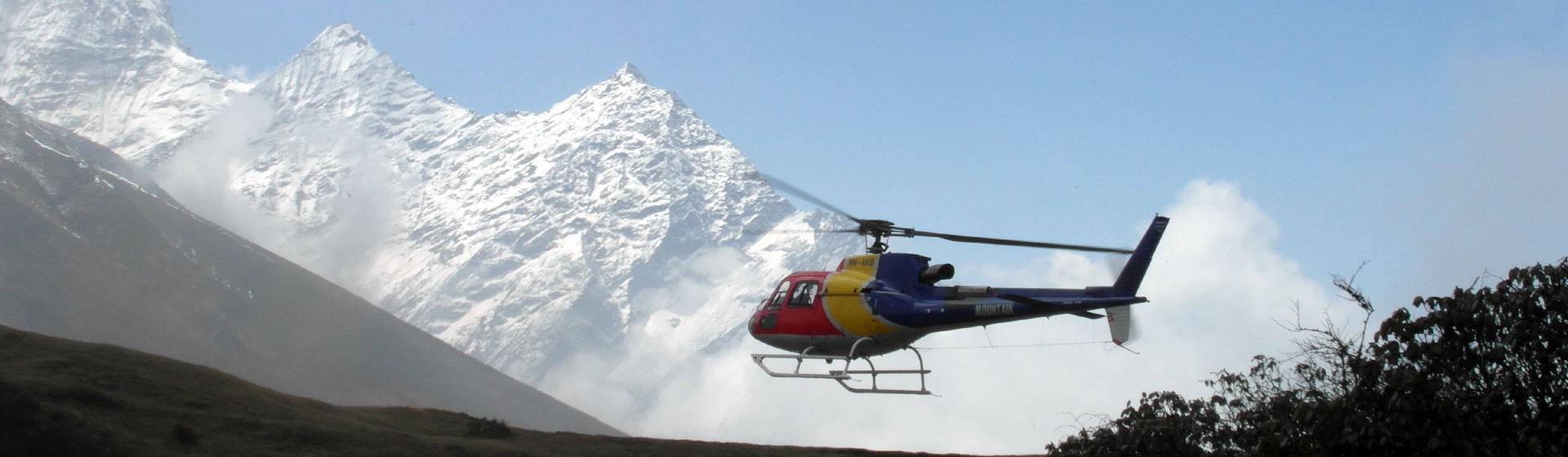
If the helicopter return is an important part of your Everest Base Camp itinerary, we prefer to arrange it before you leave Kathmandu. If it is only an option you might consider later, it can sometimes be arranged while you are already on the trail, subject to aircraft availability and conditions.
By the time you reach Dingboche, Lobuche or Gorak Shep, you are several days away from Kathmandu and your plans are much less flexible. Mobile coverage and lodge Wi-Fi are not something we would want to depend on for an important last-minute booking, and finding an available shared seat is not the same as having one planned as part of your trip.
When we know from the beginning that you want to fly out, our Kathmandu office can coordinate the expected return with the rest of the trek. Your guide also starts the journey knowing that the plan after Everest Base Camp and Kala Patthar is different from the normal walk back through Pheriche and Namche.
There is still an important distinction between arranged in advance and guaranteed to depart exactly as planned.
A booking cannot control the weather in Gorak Shep. If cloud moves into the valley, visibility deteriorates or the pilot decides the conditions or payload are unsuitable, the flight may have to wait or the plan may need to change. That is why we would be cautious about finishing a helicopter-return trek immediately before an international flight from Kathmandu.
What if I decide I want a helicopter while I am already trekking?
Ask your guide to contact the Kathmandu office as early as possible.
This sometimes happens. A trekker originally plans to walk all the way back to Lukla but changes their mind after reaching the higher part of the trail. Perhaps their schedule has changed, they would rather avoid several days of descent, or they simply decide that seeing the Khumbu from the air would be a memorable way to finish the trek.
We can then check what is realistically available for the expected day rather than promising a flight that has not yet been confirmed.
The closer you get to Gorak Shep, however, the fewer alternatives you have if no suitable seat is available. This is why we would not recommend deliberately leaving the booking until the final night just because you hope to find a cheaper or easier last-minute flight.
There is also no need to book a helicopter simply because it is available.
After Everest Base Camp, the normal trail turns downhill through Lobuche and Pheriche before continuing toward Namche Bazaar. For trekkers with enough time, walking out gives the journey a more gradual finish and lets you experience the Khumbu without the pressure of coordinating a mountain flight. It also costs considerably less.
The helicopter return is most useful when saving the descent days is genuinely important to your itinerary, rather than because you have been led to believe that every Everest Base Camp trek needs one.
Our practical advice is therefore simple: if you already know that you want the helicopter return, arrange it with the trek. If you are genuinely undecided, you can ask about adding it later but keep enough time in your itinerary to continue down the trail if the flight you want is not available.
If you are still deciding whether the additional flight is worthwhile for your trip, we explain the trade-off in our guide to whether an Everest Base Camp helicopter return is worth it.
Shared Helicopter or Private Charter: Which One Should You Book?
For most solo trekkers and couples, we would normally look for a shared helicopter return rather than recommend paying for the entire aircraft. A private charter becomes more worth considering when several people are travelling together, your group specifically wants the helicopter to itself, or having greater control over the arrangement matters enough to justify the higher cost.
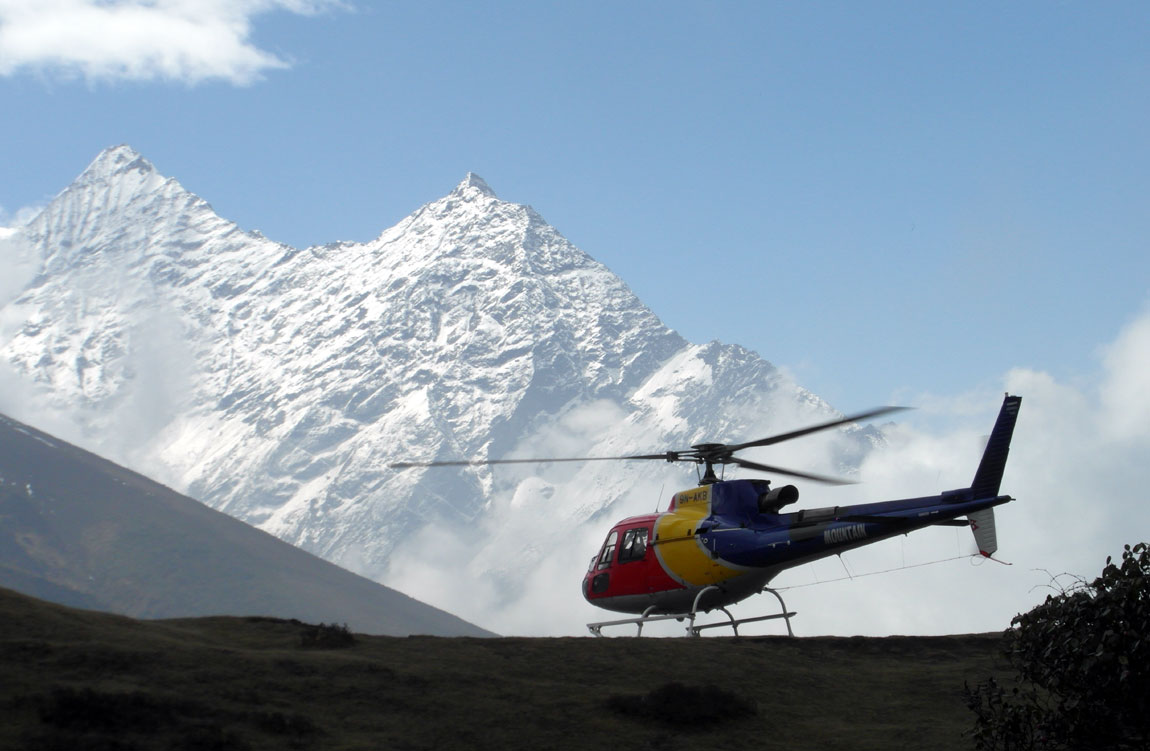
For one trekker, the difference between paying for a shared seat and chartering an entire helicopter can be substantial. For a family or group of friends, however, we would check both options. Once several people are paying for individual seats, it makes sense to compare the total with the current charter quotation rather than assuming that shared will always be the better choice.
There is one detail we clarify before confirming the trip: having your own guide and a private trekking itinerary does not necessarily mean having the helicopter to yourself. The trekking arrangement and helicopter arrangement should be confirmed separately.
If I Book a Shared Seat, Will the Helicopter Leave at a Fixed Time?
A shared helicopter return from Gorak Shep should not be planned like a scheduled airline departure with a fixed boarding time.
You may return to Gorak Shep after an early morning climb of Kala Patthar expecting to fly later that morning. Back at the lodge, your guide checks the latest flight information while you have breakfast, pack the equipment you used for the climb and prepare your baggage for the return. The helicopter movement then has to fit the flying conditions and the passengers being coordinated that day.
On a clear morning, everything may move quickly. On another morning, cloud may remain around the valley, wind may increase, or the helicopter may be completing other sectors before reaching Gorak Shep. With a shared flight, other passengers may also need to be coordinated into the day's operation.
This is why we are careful about promising an exact departure such as “8:00 am from Gorak Shep.” We can arrange the flight and have an expected time, but the actual departure depends on what is happening in the mountains that morning.
While you are trekking, your guide and our Kathmandu team remain involved in coordinating the return and communicating any changes to the expected arrangement.
The practical expectation with a shared seat is therefore simple: have the return arranged, know the planned pickup point and be ready to fly, but keep the departure day flexible enough for mountain aviation.
Does Sharing Mean Everyone Flies Together?
Not necessarily.
Gorak Shep is above 5,000 metres, where a helicopter is operating in much thinner air than at Kathmandu or Lukla. The number of passengers that can be carried cannot be separated from body weight, baggage, weather, aircraft performance and the flight sector being operated.
This is why accurate passenger and baggage information matters when the flight is being arranged.
Depending on the operating conditions, passengers may need to be divided or the flight may be operated in stages rather than everyone simply boarding together at Gorak Shep. The helicopter operator and pilot determine what can be carried safely on the day.
We do not override that decision to keep an itinerary on schedule.
It is also why we would be cautious of choosing a helicopter arrangement based only on the number of passenger seats inside the aircraft. The number of seats and the payload that can safely be carried above 5,000 metres are not necessarily the same thing.
What Changes If You Charter the Whole Helicopter?
With a private charter, the helicopter is arranged for your party rather than your return being coordinated around other trekkers buying seats on the same flight.
For some groups, that is worth paying for. It removes the need to wait for other passengers to make a shared arrangement work and gives your party more control over the flight planning.
It does not, however, give you control over the weather.
A private charter from the upper Khumbu still depends on visibility, wind, aircraft performance and the pilot's assessment of conditions. If cloud settles around Gorak Shep and conditions are unsuitable for flying, paying for the whole helicopter does not make the flight possible.
That distinction is important when deciding whether the additional charter cost is worthwhile.
Which Option Would We Recommend?
For one or two trekkers, we would normally check shared-seat availability first.
For a family or group of friends, we would compare the total cost of shared seats with the current private charter quotation before recommending either option.
For travelers who specifically want the aircraft reserved for their own party and are comfortable with the additional cost, we can arrange the trip around a private charter from the beginning.
There is little reason to pay for an entire helicopter simply because the trekking portion of your Everest Base Camp journey is private.
Before paying the booking deposit, ask for one point to be stated clearly in your trip details: Are you paying for a seat on a shared helicopter, or is the entire aircraft being chartered for your party?
Knowing that before you arrive in Nepal is far better than discovering the difference in Gorak Shep.
Where Does the Helicopter Pick You Up After Everest Base Camp?
For our standard Everest Base Camp Trek with helicopter return, Gorak Shep is normally the planned pickup point. Reaching Everest Base Camp does not usually mean finishing the trek there and stepping straight into a helicopter.
The sequence on the trail is different. From Lobuche, you trek to Gorak Shep and leave most of your luggage at the lodge before continuing toward Everest Base Camp. The walk crosses rough moraine beside the Khumbu Glacier, and after reaching Base Camp you return along the same trail to Gorak Shep. If Kala Patthar is part of the itinerary, that climb is normally made separately before the helicopter return.
This is why we describe the trip as a helicopter return after reaching Everest Base Camp, rather than promising a helicopter pickup directly from Everest Base Camp.
On the planned flight morning, you may be out of the lodge before sunrise for Kala Patthar. After coming back down to Gorak Shep, there is normally time to have breakfast, reorganize your baggage and get ready while your guide checks the latest flight arrangement. By this stage you have already completed the hardest part of the walking journey; what remains depends much more on the flying conditions in the upper Khumbu.
Gorak Shep is above 5,000 metres, so we do not treat the planned pickup in the same way as a confirmed airport departure. A clear morning may allow the flight to operate as expected. Cloud, wind, visibility, aircraft performance or payload can change the arrangement.
If the helicopter cannot collect you from Gorak Shep, we do not regard the itinerary printed before the trek as more important than the pilot's decision. You may have to wait for conditions to improve or, depending on the situation, continue down the trail toward a lower point from which another arrangement can be made.
That possibility is worth understanding before booking because “Gorak Shep pickup planned” is not the same as “Gorak Shep pickup guaranteed regardless of conditions.”
We also would not promise months beforehand exactly which lower location would be used if the original plan changes. That decision should be made from the conditions and instructions available at the time. On the mountain, a realistic alternative is more useful than a contingency written for marketing purposes.
Our Kathmandu team therefore confirms the intended helicopter arrangement before departure and continues coordinating with the guide as the group moves higher. By the time you reach Lobuche and Gorak Shep, we are dealing with the conditions around your actual flight day rather than relying only on what was planned when you booked the trek.
Before paying for any Everest Base Camp helicopter-return package, check the wording carefully. Ask the operator where the planned pickup takes place rather than assuming that “helicopter return from Everest Base Camp” means the aircraft will collect you from Everest Base Camp itself.
For our standard arrangement, the clearest description is: you reach Everest Base Camp on foot, return to Gorak Shep, and the helicopter return is normally planned from Gorak Shep when operating conditions allow.
How Far in Advance Should You Book an Everest Base Camp Trek with Helicopter Return?
If you are planning an Everest Base Camp Trek with helicopter return during April, May, October or November, we recommend contacting us at least several weeks before your intended start date. Travelers with fixed dates, larger groups or specific accommodation requirements should start earlier. If your dates are flexible, a later booking can sometimes be arranged.
We do not use a rule such as “everyone must book six months ahead” because that is not how these trips work in practice.
When an inquiry reaches our Kathmandu office, the number of trekkers and flexibility of the travel dates can matter as much as how early the inquiry arrives. Finding an arrangement for one person who can move the departure by a day or two is different from organizing a group whose international flights allow only one possible trekking date.
Before the trek begins, we need the guide and porter arrangement, permits, accommodation plan and the flight into the Everest region to fit the same departure. At the other end of the trek, the planned helicopter return has to be coordinated for the period when you are expected to reach the upper Khumbu.
During the busiest weeks of spring and autumn, we pay particular attention to the higher villages. Namche Bazaar has many accommodation options, but by the time the trail reaches Lobuche and Gorak Shep, choices are naturally more limited. A couple who is happy with the accommodation available has more flexibility than a larger group expecting several rooms together at a particular lodge.
The journey into the Khumbu also matters. Many travelers focus on securing the helicopter out of Gorak Shep and forget that they first have to get to the trailhead. If the flight at the beginning of the trek is disrupted, every date farther up the itinerary moves with it.
That is why, when someone contacts us close to departure, we do not answer based only on whether a helicopter seat appears to be available. We check whether the whole journey can still be put together without compromising the trekking itinerary.
A late booking is therefore not automatically a problem. If you contact us two or three weeks before your preferred departure and the necessary arrangements are still available, there may be no good reason to reject the trip simply because another website says Everest treks must be reserved months in advance. We would rather check the actual situation for your dates.
What we would not do is recover time by making the ascent unnecessarily fast. The helicopter saves time after you have reached the upper part of the Everest trail. It does not give you a shortcut through the acclimatization needed on the way up. If a late booking only works by removing an important acclimatization day, we would change the departure plan rather than use the helicopter return to justify the shorter ascent.
Booking far in advance has limits too. Reserving the trek months earlier gives you more choice of dates, trekking staff and accommodation arrangements, but it cannot tell us what the cloud or wind around Gorak Shep will be doing on your flight morning.
For travelers with fixed international flights, we are therefore more concerned about the time left in Nepal after the planned helicopter return than whether the booking was made exactly three or six months beforehand.
If your flight home leaves shortly after you expect to return from Gorak Shep, you have built the itinerary around the assumption that mountain aviation will work exactly as planned. We would not recommend doing that.
The practical approach is straightforward: book earlier when your dates are fixed, your group is larger or you are travelling in the busiest weeks of spring and autumn. If your dates are flexible, ask us what can actually be arranged before assuming you are either too early or too late.
Should You Book the Shortest Everest Base Camp Helicopter Return Itinerary?
We would not choose an Everest Base Camp helicopter-return itinerary simply because it has the fewest days. When two trips have different durations, the useful comparison is which walking days have been removed, combined or shortened to create the difference.
This is one of the first things we look at when a traveler sends us a short itinerary and asks whether it is realistic.
Package titles can make the comparison look simple: a 12-day trip appears slower than a 10-day trip, and a 9-day trip appears even more efficient. Once we place the itineraries beside each other, however, the difference may come from very different parts of the journey.
Compared with the standard Everest Base Camp Trek, a helicopter return naturally removes walking days from the end. Instead of leaving the upper Khumbu and retracing the trail through Pheriche, Namche Bazaar and onward toward Lukla, you can finish the walking portion higher in the valley and use the helicopter for the return.
We become more cautious when the shorter itinerary has also compressed the journey before Everest Base Camp.
For example, we look at where you sleep after leaving Lukla, how the itinerary handles Namche Bazaar, when you reach Dingboche, how quickly the overnight elevations increase after that point, and what is expected between Lobuche, Gorak Shep, Everest Base Camp and Kala Patthar. Those details tell us considerably more than the number printed beside the package title.
The upper days deserve particular attention because short distances can be misleading there. Lobuche to Gorak Shep does not look like an intimidating distance when measured on a map, yet you are walking at an elevation where pace is slower and recovery is different from the lower trail. Adding Everest Base Camp to the same day changes the workload again, even though the itinerary may still occupy only one line on a website.
Kala Patthar creates another useful comparison. We look at whether the climb has its own sensible place in the itinerary or has been squeezed into an already demanding upper day simply to remove another night. An itinerary can be technically possible on paper while still being unnecessarily rushed for the person who actually has to walk it.
This is why fitness alone does not persuade us that a compressed schedule is automatically appropriate. Someone who regularly runs marathons may move very efficiently on the trail, but physical strength does not allow us to predict exactly how that person will respond after several nights at increasing altitude.
At the same time, we would not assume that a longer itinerary is automatically better. An extra day should have a purpose. It may provide useful acclimatization, make an upper trekking day more manageable or give the itinerary sensible flexibility. Simply adding a night to make a package appear safer does not tell us much.
When someone has limited time in Nepal, we therefore compare the available days with the actual route rather than trying to force Everest Base Camp into whatever gap remains between two international flights. Sometimes a shorter helicopter-return itinerary fits well because most of the time has been saved on the descent. In another itinerary with the same headline duration, too much may have been taken from the ascent.
Travelers whose main limitation is the total number of days can also compare our Everest Base Camp Short Trek, which uses a shorter itinerary and should be evaluated carefully for its walking schedule and acclimatization plan.
The most useful question to ask when comparing packages is therefore not “Which company offers the shortest Everest Base Camp trek with helicopter return?” Ask “Where did those saved days come from?”
Look at the overnight stops from Lukla upward, the time around Namche and Dingboche, and how the final sequence through Lobuche, Gorak Shep, Everest Base Camp and Kala Patthar has been arranged. If the itinerary only becomes impressively short by making several of those days work harder, the helicopter at the end should not distract you from what the walking schedule requires before you ever reach it.
Should You Book the Trek and Helicopter Return Together or Separately?
You can book an Everest Base Camp trek and the helicopter return as one arrangement, or book the helicopter separately from the company operating your trek. Both can work. The important difference is who takes responsibility for connecting the walking itinerary with the flight at the end.
If you are planning the complete trip from the beginning and already know that you want a helicopter return, we generally prefer to arrange both together. This gives us one operating plan rather than a trekking booking that ends in the mountains and a separate helicopter booking that begins there.
The date written for your helicopter return is based on the trekking itinerary reaching the upper Khumbu according to plan. If the journey starts a day later or the walking schedule changes, somebody needs to make sure the helicopter side is working from the updated information. When we are responsible for both arrangements, that handover stays within the same operating chain: the guide knows the trekking progress, our Kathmandu team knows the booked return arrangement, and changes can be communicated without asking the traveler to connect two companies from the trail.
There is also a less obvious part of the booking that concerns the trekking crew. If a porter has accompanied you toward Everest Base Camp, your helicopter departure does not end the porter's journey. The crew still needs an onward plan after you stop walking. When we build the trek and helicopter return together, that movement can be considered when the itinerary is arranged rather than treated as an afterthought at the end.
Booking the helicopter separately can still be a sensible choice, particularly if your trek is already confirmed. There is little reason to replace a trekking arrangement you are happy with simply because you later decide that you would prefer to fly out.
In that situation, tell your trekking company or guide about the helicopter booking rather than treating it as an independent reservation that only concerns you and the flight provider. The trekking side should know where its responsibility finishes, while the helicopter side should have the passenger and booking information it requires. Most importantly, you should know which company you contact if the date or location expected by one side no longer matches the other.
This is where two bookings can create a gap even when neither company has done anything wrong. The trekking company may be responsible for bringing you through the itinerary it sold, while the helicopter company may be responsible for operating the flight it confirmed. Unless coordination between them has been discussed, each may reasonably assume that the traveler is managing the connection between those services.
For a traveler arranging the helicopter independently, we would therefore ask for more than a booking receipt. Confirm who will communicate a change in the trekking schedule, who your guide should contact regarding the flight, and what part of the arrangement each company is responsible for.
The same principle applies if you decide to add a helicopter return after the trek has already started. A seat may be available, but availability is only one part of making the change work. Your guide needs to know that your planned descent has changed, the crew arrangement may need adjusting, and the new flight needs to fit the journey you are already undertaking.
For someone starting with no existing bookings, putting the trek and helicopter return under one arrangement is usually the simpler option because there is one chain of responsibility from the beginning of the trek to the planned flight out. For someone whose trek is already organized, booking only the helicopter can work well as long as the handover between the two services is clear.
Before paying separately, ask one question that rarely appears in a package comparison: “If my trekking schedule changes, who is responsible for coordinating that change with the helicopter booking?”
A clear answer to that question is more useful than having both services on the same invoice. The real advantage of booking them together is not the paperwork; it is avoiding an operational gap between the people bringing you up the trail and the people expected to fly you out.
How Do You Compare Everest Base Camp Helicopter Return Quotes?
When two Everest Base Camp helicopter-return quotations arrive with different prices, first check whether they are based on the same itinerary. If one trip has fewer trekking days or a substantially different ascent schedule, the price difference is partly a difference in the product rather than simply a difference between operators.
Once the itineraries are reasonably comparable, look at the services that materially change how each trek operates rather than counting the number of bullets under “Cost Includes.” This is where differences in guide and porter arrangements, accommodation, transport and the helicopter service itself begin to explain why two apparently similar quotations may have different totals.
Guide and porter arrangements deserve closer attention because apparently small wording differences can represent different services on the trail. Check whether the trek is private or group joining, whether a guide remains with you throughout the walking itinerary, whether porter support is included or optional, and how the crew arrangement works when your own walking journey finishes with a helicopter return from the upper Khumbu. If porter service is included in one quotation and added later in another, the headline prices are not yet ready for a fair comparison.
The helicopter arrangement needs to be compared separately from the trekking arrangement because a private Everest Base Camp trek does not automatically include a private helicopter. A couple may trek privately with their own guide and still purchase seats on a shared helicopter return, while another quotation may include exclusive use of an aircraft. Those are materially different products, and a substantial price difference between them cannot be understood until you know whether each company has quoted a shared seat or a full charter.
Accommodation descriptions can create a similar problem when comparing offers. Terms such as “standard tea house,” “best available room” or “luxury Everest Base Camp trek” may sound precise in a quotation but need to be considered village by village, because the range of accommodation available in Namche Bazaar is not the same as what can normally be offered higher in Lobuche or Gorak Shep. If an accommodation upgrade is part of the reason one package costs more, ask where that upgrade actually changes the rooms or services you receive rather than assuming the same standard follows you throughout the trek.
Transport at the beginning of the journey can also account for differences that are easy to overlook when attention is focused on the helicopter return. Check how the flight toward Lukla is being arranged and whether any ground transfer required by the operating plan during your travel period is included in the quoted cost. If one company has incorporated that movement into the package while another expects it to be paid separately, the two totals need to be adjusted before deciding which quotation is genuinely cheaper.
We would apply the same method to exclusions without assuming that every expense must be included for a quotation to be good value. Personal lodge expenses, additional services and costs created by circumstances outside the original itinerary may be handled differently by different operators, but those differences should be understandable before payment. A lower package price is perfectly reasonable when the traveler knowingly chooses to pay certain items separately; the problem is when the comparison is being made without realizing that one quotation has transferred costs outside the headline figure.
When travelers show us a lower quotation from another trekking company, we would not assume that the lower price means something is wrong with it. Companies have different operating costs, supplier relationships, staffing structures and margins, so two genuinely comparable Everest Base Camp trips can still have different prices. The useful comparison is to identify whether the difference remains after the itineraries, trekking support and helicopter arrangements have been brought onto the same basis.
The opposite assumption can also be misleading because paying more does not automatically produce a better-operated trek. A higher quotation should be understandable through the itinerary, crew arrangement, accommodation, transport, helicopter service or another identifiable part of the trip rather than relying on general claims about quality, safety or premium service that cannot be connected to what will actually happen in Nepal.
When we compare two offers, we therefore reduce them to the same operating structure: where the traveler sleeps each night, how the ascent has been paced, who is supporting the trek, what happens to the crew when the traveler stops walking, what helicopter service has actually been quoted and what the traveler will ultimately need to pay for the arrangement they intend to use. Once those points match, the remaining difference in price becomes much more meaningful.
The final comparison should include the company behind the quotation as well as the itinerary itself. Before paying a deposit, see whether the operator can explain why particular overnight stops have been chosen, how its guide and porter arrangement works, what helicopter service the quotation contains and who takes responsibility when the walking itinerary and flight need to be coordinated. Detailed and consistent answers to those questions tell you considerably more about how a company works than a long inclusion list filled with services that every normal Everest Base Camp trek already requires.
For an Everest Base Camp trek with helicopter return, the most useful quotation is therefore not automatically the cheapest or the most expensive one. It is the quotation that allows you to understand the complete journey you are buying, compare it fairly with another offer and identify exactly what changes when one company asks you to pay more or less than another.
How Do You Choose a Reliable Company for an Everest Base Camp Trek with Helicopter Return?
Before paying a deposit for an Everest Base Camp trek with helicopter return, we would look beyond the itinerary and ask who is actually responsible for operating the trip in Nepal. A professional website, a long list of inclusions and quick replies can make a good first impression, but they do not by themselves tell you who will arrange the permits, assign the guide, deal with the mountain flights or respond when something changes after you arrive.
Start by identifying the business behind the website. A Nepal-based trekking company should make it reasonably easy to find its company name, contact information and physical presence in Nepal, and you should be able to understand whether you are booking directly with the operator or through another business selling the trip. If the website uses one brand name while the invoice, payment request or booking documents use another legal name, ask for the relationship to be explained before transferring money rather than assuming the difference is unimportant.
For a Kathmandu operator, a real local office has practical value beyond appearing on an About Us page. Before an Everest departure, clients may need to meet the team, check equipment, discuss a flight change, leave luggage or resolve something that could not be completed by email. Being able to identify where the company operates and who you will meet in Kathmandu gives you a clearer picture of the organization that will be responsible once the online booking becomes an actual trek.
We would also pay close attention to the quality of the answers you receive before booking. Ask something specific about the route, such as how the company handles the final days above Dingboche, what normally happens during the Kathmandu briefing or how the guide communicates with the office when an itinerary needs adjusting. The value is not in asking difficult questions for the sake of testing the salesperson; it is in seeing whether the answer contains practical detail or simply returns to phrases such as “experienced team,” “best service,” “100% safety” and “once-in-a-lifetime adventure.”
A company does not need to answer every question with absolute certainty to demonstrate experience. In fact, we would be cautious when an operator gives guaranteed answers about matters that depend on mountain conditions. Someone who works with Everest departures regularly should be able to distinguish between an arrangement the company can confirm before departure and a decision that can only be made after the guide or operating team sees the conditions at the time.
The guide deserves separate attention because the guide will represent the company for most of the days you are actually trekking. Instead of accepting “experienced English-speaking guide” as the end of the discussion, ask whether guides are licensed, how the company selects them for Everest departures and whether the people shown on the company's team pages are genuinely involved in its trips. If an exact guide cannot be assigned months in advance, the company should still be able to explain the type of guide it uses and when the assignment is normally confirmed.
Reviews are most useful when they help verify those claims. We would read recent reviews for names, places and situations rather than simply counting five-star ratings. A traveler who mentions a guide by name, describes the briefing in Kathmandu, refers to particular stages of the Everest trail or explains how the office dealt with a change provides more evidence about the operation than a one-line review saying everything was perfect.
Older reviews can show that a company has been operating for years, while recent reviews are more useful for understanding how it is operating now. Reading both can help distinguish an established business with continuing activity from a website that relies mainly on an old reputation. The same approach can be applied to recent trip photographs, guide profiles and current information published by the company, provided those materials clearly relate to its own operation rather than functioning as generic Himalayan content.
Consistency across the booking process is another useful check. The itinerary on the website does not need to be identical to a customized quotation, but important differences should have an explanation. The company name, trip dates, agreed services, payment instructions and booking terms should make sense together, and any change introduced during the conversation should be clear enough that you know which version you are actually purchasing.
We would be particularly cautious with claims that cannot realistically be measured before the trek. Statements such as “best company in Nepal,” “100% safe,” “guaranteed perfect weather” or “always on-time helicopter” provide much less useful information than an explanation of who your guide will be, how the company prepares the departure and what its team does when the planned itinerary needs to change.
The way an operator handles a request it disagrees with can also reveal more than promotional material. If you ask to remove a day, change an overnight stop or compress the trip around an international flight, an experienced company should be able to explain the consequence of that change rather than agreeing automatically because it makes the sale easier. You may still decide to request a different arrangement, but the advice should help you understand what you are changing.
For travelers booking directly with Dream Heaven Adventure, our own standard should be the same one we would recommend using to evaluate another Nepal operator: you should be able to identify the company behind the booking, understand where it operates, receive detailed answers from people familiar with the trip, know how the guide is arranged and see recent evidence that the company is actively operating treks in the region. Those are more useful signs of reliability than the number of times a website describes itself as trusted, leading, safe or experienced.
Everest Base Camp Trek with Helicopter Return Booking FAQs
1. Do I need to book my international flights before confirming an Everest Base Camp trek with helicopter return?
No. Many travelers confirm their Everest Base Camp trek before purchasing international flights. However, before making the final booking, your arrival and departure dates should be checked against the trekking itinerary to ensure you have enough time in Nepal for the trek and the planned helicopter return. We generally recommend avoiding international departures immediately after the expected return from the Everest region, as mountain travel schedules can change due to weather and operating conditions.
2. Can friends book separately and still trek together?
Yes. Friends or family members can often make separate bookings and still join the same trekking departure, provided the operator knows in advance that the bookings belong together. If travelers confirm at different times, it is worth checking that the itinerary, guide arrangement and other services remain the same for everyone in the group before the trip begins.
3. Can I change my Everest Base Camp helicopter-return trek after paying the deposit?
Changes are often possible, especially when requested well before departure, but the answer depends on what part of the trip you want to modify. Adjusting Kathmandu hotel nights may be straightforward, while changing trekking dates, shortening the itinerary or switching from a shared helicopter arrangement to a private charter can require additional planning. If your travel plans change after booking, contact the operator as early as possible so available options can be reviewed.
4. Can I extend my stay in Nepal after the helicopter return?
Yes. Many travelers choose to spend additional time in Kathmandu, visit another part of Nepal or simply keep a few extra days available before their international departure. A helicopter return shortens the descent from the Everest region, but the time saved does not need to be used for an immediate flight home. Allowing some flexibility after the trek often creates a more comfortable overall travel schedule.
5. When is my Everest Base Camp trek with helicopter return officially confirmed?
A trek is normally considered confirmed after the required traveler information has been provided, the agreed deposit has been received and the operator has issued booking confirmation. Before making payment, make sure you understand exactly what services are being confirmed, what amount remains outstanding and whether any specific arrangements require later confirmation closer to departure.