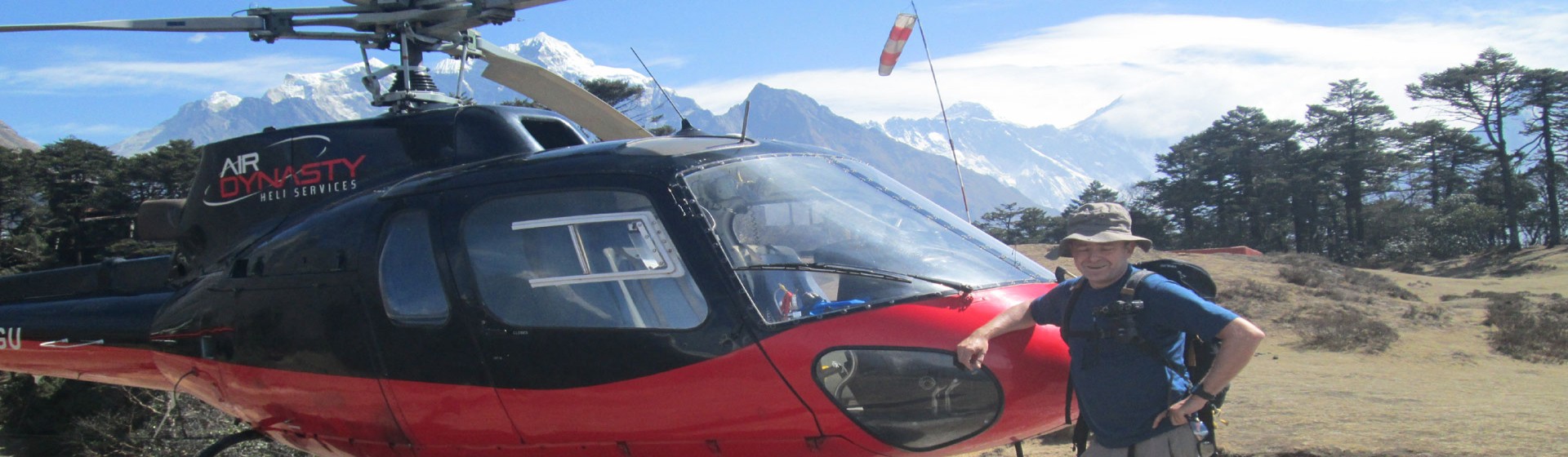
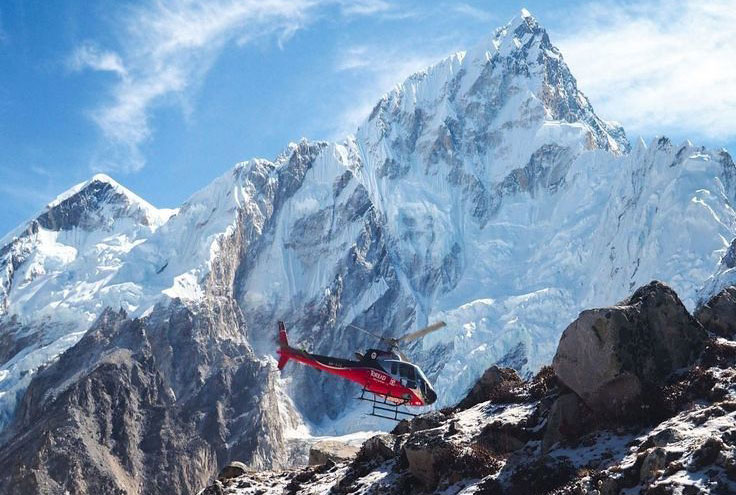
What Is an Everest Base Camp Helicopter Tour?
An Everest Base Camp Helicopter Tour is a same-day flight from Kathmandu into the Everest region for travelers who want to experience the Khumbu from the air without spending days trekking to reach the upper valley. You fly from the lower hills toward the high Himalayas, see the landscape change beneath the aircraft and return to Kathmandu according to the day's flight program.
It sounds simple when described that way, but we would not explain it to a client as a direct helicopter ride from Kathmandu to Everest Base Camp and back. That creates the wrong expectation about how these flights actually operate.
The sightseeing begins long before you reach the upper Khumbu. After leaving Kathmandu, the aircraft crosses the middle hills before the terrain becomes much steeper toward the Everest region. Lukla and the Dudh Koshi valley provide the first familiar reference points for anyone who knows the trekking route. Farther north, you begin to see how Namche sits above the river valley and how the trekking country around Tengboche, Pangboche and the higher settlements connects with the mountains surrounding it.
As the flight continues higher, the landscape changes quickly. Forest and settled valleys give way to more exposed terrain, glaciers and moraine, and the scale of peaks such as Ama Dablam, Lhotse, Nuptse and Everest becomes much easier to understand from the air. Instead of seeing one section of trail at a time, you can look across valleys that would take a trekker hours or even days to cross.
That wider view is really what you are buying.
The words “Everest Base Camp Helicopter Tour” can be slightly misleading if you interpret them too literally. They do not mean that every passenger is guaranteed to land at Everest Base Camp itself. Base Camp is on the Khumbu Glacier, and the actual upper-Khumbu flight and landing arrangement depends on the particular program being sold and what can be operated.
This is also where shared flights can work differently from what first-time passengers expect. At high altitude, the helicopter cannot necessarily carry the same load it carried lower down. Passenger weight becomes important, and depending on the aircraft and conditions, a group may need to be divided into smaller loads for part of the higher flight. That does not mean something has gone wrong with the tour; it can simply be part of operating a helicopter at these elevations.
Weather matters throughout the journey as well. Kathmandu can be clear while cloud is sitting farther up the Khumbu, or conditions can be good in one part of the Everest region and unsuitable somewhere else. Wind, visibility, passenger load and conditions around a planned stop can all influence how the day's flight is carried out. This is why we are careful about treating a printed flight program as though every minute and every stop can be guaranteed in advance.
There is another reason to look beyond the tour name. A shared Everest helicopter tour and a private helicopter charter are not necessarily the same product with different passenger numbers. The operating arrangement, flexibility and cost can be quite different. Even among shared tours, travelers should check what upper-Everest section is planned rather than assuming every company selling an “Everest Base Camp Helicopter Tour” is offering an identical flight.
When somebody asks us what is actually included, we therefore start with practical questions: Where is the helicopter planned to fly? What stops are scheduled? Which parts are sightseeing from the air? Is the upper section operated with the same passenger load? And what can change if the weather or operating conditions are different from what was expected?
Those answers tell you far more than the package name.
An Everest Base Camp Helicopter Tour is therefore best understood as an aerial journey through the Everest region, not simply transportation to Everest Base Camp. Base Camp and the upper Khumbu are important parts of what you have come to see, but the experience starts much earlier, as the valleys, villages, trekking routes, glaciers and mountains of the Khumbu begin connecting below you.
That is what makes the helicopter tour different from simply flying somewhere and flying back.
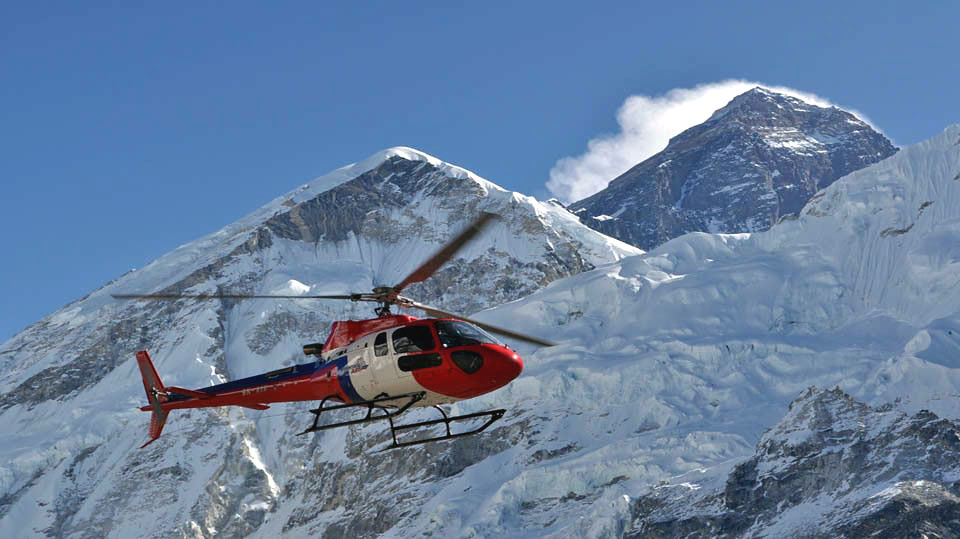
What to Expect During an Everest Base Camp Helicopter Tour
An Everest Base Camp Helicopter Tour normally starts early in the morning, but we tell guests not to build the rest of the day around an exact return time. You may be flying for only part of the day, yet there is a big difference between a short flight and a fixed schedule. Kathmandu can be clear while cloud is sitting farther up the Khumbu, and conditions around Lukla can be different again from those higher toward Everest. The helicopter leaves when the crew is satisfied with the conditions, not simply because the itinerary says it should leave at a particular minute.
Before departure, one of the details we need from every passenger is an accurate body weight. People sometimes wonder why we ask for this before what looks like a sightseeing flight, but it becomes important once the aircraft is operating higher in the mountains. Passenger load and seating have to be planned properly, and the higher section may not always operate with exactly the same passenger arrangement as the lower flight. We also recommend carrying only what you actually need for the morning rather than arriving with luggage as though you were starting the Everest Base Camp Trek.
The first part of the flight is very different from the photographs people normally associate with an Everest helicopter tour. You leave Kathmandu above densely settled hills, terraced slopes, roads and river valleys. There is no sudden moment when the city disappears and Everest fills the window. The mountains build gradually in front of you as the terrain becomes steeper toward the east.
Around Lukla, the change is much easier to notice. The valleys tighten, the slopes become much bigger, and from above you can begin picking out the country trekkers normally enter on foot. The Dudh Koshi runs deep below, suspension bridges can appear surprisingly small from the aircraft, and settlements sit on pieces of ground that look very different from the air than they do when you are walking between them.
Namche Bazaar is one of the easiest places to recognize. From the trail, you arrive after the long climb from the river and only gradually understand the size of the town. From the helicopter, its curved shape on the mountainside is much clearer, and you can see why Namche became such an important stopping point in this part of the Khumbu.
Farther north, the valley changes again. The greener country begins to thin out, Tengboche and Pangboche appear among much larger surroundings, and Ama Dablam becomes difficult to mistake once you have seen its shape. What takes several trekking days happens quickly from the aircraft, so it helps to know roughly what you are looking at rather than expecting the pilot to slow down beside every village or mountain.
Higher up, villages become smaller and eventually stop being the main feature of the view. Around the upper Khumbu, your attention moves toward moraine, exposed slopes, glacier and the walls of the surrounding mountains. The Khumbu Glacier makes considerably more sense from above. On foot, especially around Lobuche and Gorak Shep, you spend much of the time seeing only the section immediately around you. From the aircraft, you can follow a much larger part of the glacier and see how the moraine, Base Camp area and surrounding mountains sit within the valley.
Everest itself can also surprise first-time visitors. People often expect the world's highest mountain to be the obvious giant in every direction, but the Khumbu does not present the peaks that neatly. Nuptse can look enormous from this side, Lhotse rises close by, and Everest appears differently as the aircraft's angle changes. Knowing which mountain you are looking at makes a considerable difference, particularly for somebody seeing the Everest massif for the first time.
If your particular flight includes a high-altitude landing, do not expect it to become a long sightseeing stop. You have come from Kathmandu in a very short period rather than spending days acclimatizing as a trekker would. At these elevations, getting out of the helicopter does not mean you should wander around trying to make the stop last as long as possible. Stay with the instructions given by the crew, keep the stop simple and remember that the purpose is to experience the setting, not to behave as though you have acclimatized there.
The flight back is worth watching as carefully as the flight in. On the outward journey, most passengers naturally keep looking north toward the highest mountains. Heading south again, the geography starts to make more sense in the opposite direction. You can see how the upper valley drains toward the lower Khumbu, how settlements are separated by ridges and river crossings, and how quickly the severe high-altitude terrain gives way to greener country.
There can also be waiting during the morning. A planned stop may be shorter than expected, departure may be held while conditions are checked, or the operating arrangement may need to change. We would rather explain that before the flight than give somebody the impression that an Everest helicopter tour operates like a city sightseeing bus with guaranteed arrival and departure times.
So when you book, expect an organized flight but a flexible morning. Have your weight information correct, carry lightly, listen to the crew around the aircraft and pay attention from the moment you leave Kathmandu rather than waiting for Everest to appear.
Some of the most interesting parts of the flight are not one famous mountain or one landing point. They are the few minutes when you can look down and understand how Lukla, Namche, the Dudh Koshi, the trekking trail, the Khumbu Glacier and the high mountains all belong to the same landscape.
Where Does an Everest Base Camp Helicopter Tour Land?
This is one of the first things we would check before booking because not every Everest Base Camp Helicopter Tour being sold in Nepal has the same landing plan. The name can easily give somebody the impression that the helicopter flies from Kathmandu and puts passengers down at Everest Base Camp. That is not a good assumption to make.
Everest Base Camp itself is at about 5,364 meters on the Khumbu Glacier. It is not a normal sightseeing helipad where helicopters routinely arrive, unload tourists and wait while everybody walks around Base Camp. On many helicopter sightseeing programs, passengers see Everest Base Camp, the Khumbu Glacier and the surrounding high mountains from the air instead.
This actually gives you a very different view of Base Camp from the one trekkers get on foot. From above, you can follow the glacier through the valley and see where Base Camp sits beside it, with the Khumbu Icefall rising farther ahead. During the main spring expedition season, the concentration of expedition tents makes Base Camp much easier to pick out. At other times of year, somebody expecting to see a permanent settlement below may be surprised by how little there is to identify.
Kala Patthar is where the current market becomes more confusing.
Some Everest helicopter tours currently advertise a short landing at Kala Patthar, around 5,545 meters, while other shared programs advertise an overflight of Kala Patthar and Everest Base Camp instead. Both types of tour are being sold under very similar “Everest Base Camp Helicopter Tour” names.
For that reason, if standing at Kala Patthar is important to you, we would ask one very specific question before paying:
“Is Kala Patthar a planned landing on my flight, or do we see it from the helicopter?”
That is much more useful than looking at the photographs on the package page.
Pheriche can also appear in the operating plan, but for a completely different reason. At this elevation, the helicopter is already operating in much thinner air than it was in Kathmandu or Lukla. Depending on the aircraft, passenger weights and the arrangement being operated, a full group may be divided into smaller loads before the higher section of the flight. Some current shared Everest helicopter programs specifically use Pheriche for this shuttle arrangement.
From a passenger's point of view, this can initially look strange. You left Kathmandu together, so naturally you expect everybody to stay in the same helicopter all morning. Then some passengers may continue toward the upper Khumbu while others wait for their turn. That does not necessarily mean the company has changed your tour. It can be part of the planned high-altitude operation.
The stop around Syangboche and Hotel Everest View is different again. Many current programs include a landing in this area, above Namche Bazaar, with time for breakfast or refreshments and mountain views before returning toward Kathmandu. At roughly 3,880 meters, you are considerably lower than Kala Patthar, so this should not be confused with the high-altitude portion of the flight.
This is why we prefer to explain the morning as a sequence rather than simply saying, “You land at Everest.”
Depending on the particular tour you buy, there may be a Lukla stop connected with refueling, a Pheriche stop connected with the upper-Khumbu operation, an overflight or landing arrangement around the highest sightseeing section, and a stop around Hotel Everest View. Your exact program may not contain every one of these, and that is precisely why it needs to be checked before booking. Current operators advertise materially different versions of the flight.
Even a planned landing remains subject to the conditions on the day. Cloud can move into one part of the valley while another remains clear, wind can become stronger higher up, and the pilot may decide that a landing should not be attempted. Passenger load and other operating requirements can also affect how the upper section is handled.
We would therefore be cautious with any itinerary that makes one high-altitude landing sound unconditional.
Before somebody books through us, we would rather they understand three things clearly: where we expect the helicopter to land, which places are expected to be seen from the air, and which parts of that plan may have to change if the pilot cannot operate them as intended.
That prevents one of the easiest misunderstandings to have with an Everest helicopter tour.
You are not paying simply for a helicopter to land at Everest Base Camp. You are paying for a particular flight program through the Everest region, and the landing points are only one part of that program.
Know the exact flight you are buying, not just the name printed above it.
How Much Does an Everest Base Camp Helicopter Tour Cost?
For 2026, a shared Everest Base Camp Helicopter Tour generally costs around USD 1,200 to USD 1,500 per person, while a private helicopter is normally quoted for the whole aircraft and can cost roughly USD 5,000 to USD 6,500 or more, depending on exactly where the helicopter flies and lands. Current published prices show why we treat these as working ranges rather than one fixed Everest helicopter fare.
| Flight arrangement | Typical 2026 cost | Usually makes sense for |
|---|
| Shared/group-joining flight | USD 1,200–1,500+ per person | Solo travelers and couples |
| Private helicopter charter | USD 5,000–6,500+ per aircraft | Families and private groups |
When somebody asks us the price, however, the first thing we want to know is which Everest helicopter flight they are comparing. A USD 1,200 seat and a USD 1,500 seat are not necessarily the same tour with a USD 300 difference.
This is particularly important now because “Everest Base Camp Helicopter Tour” is being used for several different products. One current shared program, for example, advertises an Everest Base Camp and Kala Patthar overflight with stops at Lukla, Pheriche and Syangboche for USD 1,399 per person, while additional airport, park and local fees are listed separately. Another current operator advertises its group-joining flight around USD 1,360–1,400 per person with a different inclusion structure.
That is why we would never choose between the two by looking at $1,399 versus $1,400.
We would open both itineraries and see what the helicopter actually does.
For a solo traveler or couple, a shared flight is normally where we would start. You buy a seat rather than paying for the entire helicopter, which keeps the individual cost much lower. Other passengers join the same departure, and depending on the high-altitude operating arrangement, everybody who leaves Kathmandu together may not necessarily remain in the same passenger load for every part of the upper-Khumbu flight.
If you are traveling alone, there is one practical question worth asking before paying: Is my shared departure already confirmed? A company may advertise a group-joining price, but you should understand whether that price and departure depend on enough passengers being available for your date.
A private charter works differently. Instead of buying one or two seats, you are paying for the aircraft arrangement. That makes very little financial sense for most solo travelers, but the calculation starts to change for a family or small private group.
Suppose four people are considering shared seats at around USD 1,300-1,400 each. Their combined cost is already above USD 5,000. At that point, we would ask for a private charter quotation as well rather than automatically booking four shared seats. It may still cost more, and the operating program may differ, but now there is a genuine comparison to make.
We would not choose private simply because it sounds more luxurious. If your only objective is to see the Everest region from the air, a well-arranged shared flight may give you what you came for while costing considerably less. Private charter becomes more interesting when traveling only with your own party, exclusivity or a particular flight arrangement has enough value to justify the difference.
There is also an important limit to what the extra money buys. Chartering privately does not give you control over Himalayan weather, and it does not allow the aircraft to ignore high-altitude performance limitations. The pilot still makes the operational decisions, and passenger weight, visibility, wind and conditions around the planned landing areas still matter.
The other mistake we see when people compare prices is looking only at the large number printed at the top of the package page.
One quotation may include hotel transfers, airport charges and the required local or national-park fees. Another may list some of those separately. Breakfast or refreshments at Hotel Everest View may be included in one program and an additional expense in another. Current published packages demonstrate exactly this difference: one $1,399 offer lists approximately NPR 7,000 in airport, park and local charges plus optional breakfast separately, while another similarly priced offer advertises national-park fees, airport taxes and passenger insurance among its inclusions.
So before deciding that one company is cheaper, we would want the final amount payable, not just the advertised seat price.
The same applies to landing arrangements. If one tour includes an overflight of Everest Base Camp and Kala Patthar while another quotation is for a different high-altitude landing arrangement, comparing their prices as though they are identical products does not tell you much.
Before paying a deposit, get the important details in writing: whether the quotation is per passenger or per helicopter, shared or private, the planned route and landing points, which locations are overflights, what fees are included, whether hotel transfers and breakfast are included, and what cancellation or postponement terms apply if the flight cannot operate because of weather.
For us, that is the useful way to answer “How much does an Everest Base Camp Helicopter Tour cost?”
Budget roughly USD 1,200-1,500 per person for a shared tour and around USD 5,000-6,500 or more for a private charter, but do not compare the prices until you have compared the flights behind them. Current 2026 listings support those broad ranges, while also showing substantial differences in what the advertised price actually includes.
Is the Everest Base Camp Helicopter Tour Safe?
An Everest Base Camp Helicopter Tour involves flying into some of the highest and most demanding mountain terrain in Nepal, so we would never describe it to a client as risk-free. The more useful question is whether the flight is being operated by an authorized helicopter company, with an appropriately qualified crew, within the aircraft's operating limits and only when the conditions allow the planned flight to go ahead.
Nepal's helicopter operators operate under the Civil Aviation Authority of Nepal (CAAN), and high-altitude flying is not treated the same as ordinary lower-elevation flying. CAAN's helicopter flight requirements include specific high-altitude training and assessment requirements for pilots operating at higher elevations. CAAN also maintains oversight of Nepal's rotary-wing operators.
For a passenger, however, one of the easiest signs of a sensible operation is something much simpler: the company and pilot must be willing to change the plan.
We occasionally have guests disappointed when a mountain flight is delayed even though the weather in Kathmandu looks beautiful. Kathmandu is only one end of the journey. Conditions around Lukla can be different, and what is happening farther up the Khumbu can be different again. Cloud against a ridge, visibility inside a valley, wind at altitude or conditions around a planned landing point can all affect what the helicopter can do. CAAN itself describes Nepal's helicopter environment as unusual because of its terrain, elevation and challenging weather.
So if a pilot decides to wait, change part of the flight or return rather than continue with the advertised plan, we would not regard that as poor service. We would be much more concerned by pressure to complete a sightseeing program when the conditions do not support it.
Passenger weight is another part of the flight that travelers sometimes underestimate.
When we ask for your body weight before arranging an Everest helicopter tour, give the actual figure. Do not take five kilograms off because you are embarrassed by the number or think a lower weight will give you a better seat. At high elevation, aircraft performance and load planning matter. CAAN has specifically required operators to follow approved weight procedures and ensure baggage and cargo are weighed and distributed according to their operating manuals.
This is also why a helicopter with several passenger seats does not necessarily carry the same passenger load through every part of a high-altitude flight. If the operating company needs to reorganize passengers for the upper section, that is an aviation decision rather than something to argue about because everybody paid for the same tour.
There is a second issue on an Everest helicopter tour that has nothing to do with the aircraft itself: your body has reached high altitude much faster than it would during a trek.
Someone walking to Everest Base Camp normally spends days gaining elevation. A helicopter passenger can travel from Kathmandu at roughly 1,400 meters into the high Khumbu within a very short period. Your body has not suddenly become acclimatized simply because you arrived sitting in an aircraft.
Altitude illness is possible after rapid ascent. Recognized symptoms of acute mountain sickness include headache, tiredness, loss of appetite, nausea and vomiting; more serious altitude illness can involve confusion, loss of coordination, severe weakness or breathing problems.
This is one reason we would not choose an Everest helicopter tour by asking which company promises the longest possible stop at the highest possible altitude.
Longer is not automatically better.
If your flight includes a high-altitude landing, get out calmly, stay close to where the crew tells you to remain and do not turn a short sightseeing stop into a physical challenge. People sometimes feel fine while standing beside the helicopter and then become surprisingly breathless after trying to walk quickly for photographs. If you develop concerning symptoms, tell the crew rather than trying to hide them because you do not want your sightseeing time shortened.
The CDC recommends gradual ascent where possible and notes that travelers with certain pre-existing medical conditions should seek appropriate medical advice before going to high elevation. If you have a condition that could make rapid ascent a concern, that conversation belongs with a qualified medical professional before you book, not with a tour salesperson on the morning of the flight.
We would also not make a universal promise about oxygen equipment in this article. Different aircraft and operators may have different equipment and procedures. If this matters to you, ask the company operating your specific flight what emergency or supplemental oxygen equipment is carried and how it is intended to be used. Do not assume that seeing “Everest Base Camp Helicopter Tour” on a booking page tells you what medical equipment will be aboard.
Passengers have a few simple responsibilities of their own as well. Follow the baggage limit, keep hats, scarves, camera straps and other loose items secured around the aircraft, and do not approach or leave the helicopter until the crew tells you to. Rotor wash is not the moment to walk away from the group because you have spotted a better photograph.
Before paying, we would also ask which helicopter company is actually operating the flight. A trekking company or tour operator may organize your booking, but the aviation company provides the aircraft and pilot. CAAN currently lists authorized rotary-wing operators in Nepal, so this is something that can be checked rather than simply taking a seller's word for it.
We would want to know the operating company, the planned flight and landing arrangement, how passenger weight will be handled, what happens when weather prevents the planned flight, and the cancellation or rescheduling conditions. If you specifically want to know whether oxygen is carried, ask that as well.
For us, the reassuring answer to “Is the Everest Base Camp Helicopter Tour safe?” is therefore not somebody promising that the helicopter will definitely leave at 6:30, definitely make every advertised landing and definitely return on schedule.
It is almost the opposite. We want the pilot to have the final say, even when that means the flight we planned is not the flight we get that morning. That is part of flying in the Everest region, not a failure of the tour.
Everest Base Camp Helicopter Tour vs Trek: Which Is Better?
If you have enough time, suitable fitness and actually want to trek, we would choose the Everest Base Camp Trek. If you mainly want to see the Everest region but cannot give nearly two weeks to the journey, the helicopter tour makes far more sense. Neither is simply a faster or slower version of the other.
The difference is what happens between Kathmandu and the high Khumbu.
With the helicopter, a landscape that takes trekkers days to understand passes beneath you within a morning. You see valleys opening into one another, Namche sitting above the Dudh Koshi, the greener lower Khumbu giving way to rock and glacier, and the enormous scale of the mountains surrounding Everest.
On the trek, you live through those changes.
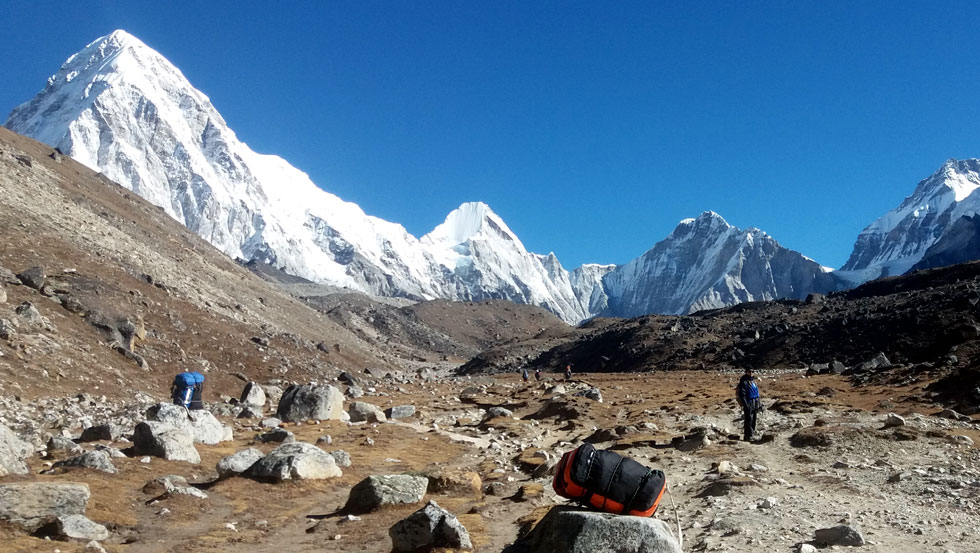
You arrive in Namche after climbing there rather than identifying it through a window. You spend nights at increasing elevations, walk out of the forest toward the colder country above Dingboche, and eventually reach the moraine and glacier around Gorak Shep after more than a week of moving north through the valley. By the time you reach Everest Base Camp, the places behind you are not names on a map. You remember how long they took to walk between.
That is why we would not tell somebody that the helicopter tour is a substitute for the trek. It is a different Everest experience.
| Experience | Helicopter Tour | Everest Base Camp Trek |
|---|
| Time required | Usually part of a day | Commonly around 12–14 days |
| Main experience | Seeing the Khumbu from the air | Traveling through the Khumbu on foot |
| Physical effort | Very little walking | Consecutive high-altitude trekking days |
| Altitude approach | Rapid ascent and brief exposure | Gradual ascent with acclimatization |
| Villages | Mainly seen from above | Walked through and stayed in |
| Everest Base Camp | Usually viewed according to the flight program | Reached on foot |
| Perspective | Valleys, glaciers and mountains seen on a broad scale | Landscape experienced gradually from ground level |
| Best for | Limited-time visitors and non-trekkers | Travelers who want the trail itself |
The part a helicopter cannot reproduce is not simply standing somewhere near Everest. It is everything that happens while getting there.
From Lukla, the trail initially drops toward the Dudh Koshi. There are river crossings, suspension bridges and villages before the long climb toward Namche. That climb matters. When you finally walk into Namche Bazaar, you have already earned your first understanding of how different distances feel in the mountains.
You walk higher to acclimatize, come back down to sleep and continue only when the itinerary says it is sensible to move farther up the valley. Beyond Namche, Ama Dablam becomes a constant presence around sections of the trail toward Tengboche and Pangboche. Forest eventually begins disappearing as you move toward Dingboche. By Lobuche, the environment that surrounded you during the first trekking days has almost completely gone.
There are smaller things too. A warm dining room feels different after walking outside for six hours. You meet yak and mule trains carrying supplies in both directions. You pass mani walls, monasteries, porters and people whose homes are along the same route you are treating as an adventure. The next mountain lodge is not simply another point on an itinerary; for that particular afternoon, it is where you are trying to get.
None of this makes a good helicopter flight less impressive. It explains why the two experiences should not be sold as equivalents.
What the helicopter gives you instead is something we cannot get in the same way while walking: scale.
On the trail, a ridge can hide the next valley for hours. A village that looks close on a map may still involve a descent to the river and another climb. Most of the time you understand only the piece of the Khumbu immediately around you.
Namche's position above the Dudh Koshi becomes obvious. You can follow valleys rather than simply walk inside them. Higher up, the relationship between Gorak Shep, the Khumbu Glacier, Everest Base Camp and the surrounding mountains is much easier to understand from above.
For somebody who has already trekked in the Everest region, this can be particularly rewarding. Places that once represented an entire day's walking suddenly sit within the same view.
Everest Base Camp is not the place where trekkers get the classic unobstructed view of Everest that many first-time visitors imagine. Nuptse occupies a huge part of the skyline from the glacier, while viewpoints such as Kala Patthar provide a much stronger perspective of Everest.
From a helicopter, the viewing angle keeps changing as the aircraft moves through the region. You gain a broader aerial perspective of the massif, but everything happens quickly. On foot, you may see the mountains in morning light, cloud, snowfall or clear afternoon conditions over several different days.
So if your priority is seeing the geography of Everest from above, the helicopter has something the trek cannot match. If your priority is spending time inside that geography, the trek wins easily.
Physical difficulty is another obvious difference. The helicopter requires very little walking compared with days of climbing and descending at altitude. But we would never call it an “easy Everest Base Camp Trek.” Once you remove the trekking, it is no longer a trek.
For somebody who cannot realistically undertake the full route, that is precisely why the helicopter can be valuable. Everest does not have to become completely inaccessible simply because twelve or fourteen trekking days are impractical.
For a fit traveler with enough time whose ambition is specifically to trek to Everest Base Camp, however, we would not replace the journey with a flight merely to avoid the effort. The effort is part of what that traveler came for.
There is also a third option, and for some people it is the most interesting compromise: walk to Everest Base Camp and leave the upper Khumbu by helicopter.
You still trek through Namche, Tengboche and the higher villages, follow a gradual acclimatization schedule and reach Everest Base Camp on foot. Only after the main objective has been completed does the helicopter change the journey.
The flight feels different in this situation too. Looking down on the Khumbu, you recognize places rather than simply being told their names. A valley below may have taken you most of a day to cross. A village that appears tiny from the aircraft may be somewhere you slept two nights earlier.
The aerial view now has context because your legs already know the ground underneath it.
That option also removes much of the walk back toward Lukla, although the helicopter remains dependent on suitable operating conditions. Travelers interested in this combination can compare our Everest Base Camp Trek with Helicopter Return with the conventional trekking itinerary.
So which would we choose?
With enough time and a genuine desire to trek, we would walk. The trail gives Everest Base Camp meaning that cannot be recreated from the air.
With only a short time in Nepal, or when a multi-day high-altitude trek is not realistic, we would take the helicopter and enjoy it for what it actually does exceptionally well rather than pretending it is a compressed trek.
And if we wanted to earn Base Camp on foot but did not particularly value retracing the trail afterward, we would seriously consider trekking in and flying out.
Best Time for an Everest Base Camp Helicopter Tour
The best time for an Everest Base Camp Helicopter Tour is generally October to November and March to May, when clear mornings are more common in the Khumbu. For this trip, we care more about visibility and a suitable flying window than comfortable trekking temperatures because most of the journey is spent inside the helicopter rather than walking outside for hours.
If mountain visibility were our main priority, October and November would be our first choice. After the summer monsoon, the air can be exceptionally clean, and on a good morning the ridges, glaciers and high peaks appear sharply defined from the aircraft. October is busier in the Everest region, while November becomes colder, but neither matters as much to a helicopter passenger as it does to someone spending two weeks on the trail.
March to May gives the flight a different character. March can still carry a winter feel in the upper Khumbu, while April brings much more trekking and climbing activity. During the main Everest expedition season, Base Camp changes dramatically. What looks like a quiet stretch of glacier and moraine outside the climbing season becomes filled with expedition tents. From the air, that contrast is particularly interesting, which is why April is one of our favorite months for passengers interested in Everest mountaineering as well as the scenery.
Winter should not be dismissed. December and January can produce some exceptionally clear mornings, and snow across the upper Khumbu can make glaciers, ridges and mountain faces stand out beautifully from above. The disadvantage is the cold. We tell winter passengers to dress for where the helicopter is taking them, not for the temperature outside their Kathmandu hotel. A jacket and gloves that feel unnecessary before departure can become very useful once the door opens at altitude.
We would be much less likely to choose June through September if the dates were flexible. The problem is not simply monsoon rain; it is cloud and visibility. Kathmandu can look reasonably clear while cloud sits around Lukla or farther up the Khumbu, hiding exactly the landscape you have paid to see. Flights can operate when a suitable weather window appears, but we would leave additional time in Kathmandu rather than depending on one particular morning.
The morning is normally the most practical time to fly. Conditions often become more unsettled as the day develops, and an early plan also leaves more time if departure has to wait. We would never treat an advertised morning departure as a guaranteed takeoff minute, however. In the Everest region, the conditions along the route matter more than the time printed on the itinerary.
If we had completely flexible dates, our choices would be straightforward: October or November for strong post-monsoon visibility, April for the added interest of Everest expedition season, and December or January for clear winter landscapes if the cold is not a concern.
There is no perfect month that guarantees Everest will remain visible all morning. The right season improves the odds; the weather on the day still decides the flight.
Everest Base Camp Helicopter Tour FAQs
1. How long does an Everest Base Camp Helicopter Tour take?
An Everest Base Camp Helicopter Tour from Kathmandu usually takes around 4 to 5 hours, including the flight and planned stops, although we would keep at least half a day free rather than working around an exact return time.
Weather, visibility and the operating arrangement can change the morning. If you have another important activity afterward, leave enough room for the helicopter to return later than originally expected.
2. Can a solo traveler join an Everest Base Camp Helicopter Tour?
Yes. A solo traveler does not need to charter an entire helicopter. You can book a seat on a shared or group-joining Everest helicopter tour with other passengers traveling on the same program.
If your dates are fixed, ask whether the shared departure is already confirmed. An advertised seat price does not necessarily mean every date will operate with only one passenger booked.
3. Do I need trekking experience for an Everest helicopter tour?
No. You do not need previous trekking or mountaineering experience for a normal Everest helicopter sightseeing flight.
There is very little walking compared with the Everest Base Camp Trek, but the helicopter can take you from Kathmandu into the high Khumbu very quickly. Follow the crew's instructions carefully and remember that arriving at altitude by helicopter does not mean your body has acclimatized there.
4. Can children take an Everest Base Camp Helicopter Tour?
Potentially, but we would check the specific helicopter company's current requirements before booking rather than apply one age rule to every flight.
Parents should provide the child's age when enquiring and understand that the rapid increase in elevation is very different from gradually reaching the same region on foot. Where there are health concerns about high-altitude exposure, appropriate medical advice should be obtained before the flight.
5. Is there a maximum age for an Everest Base Camp Helicopter Tour?
We would not use age alone to decide whether somebody can take the flight.
A passenger's health, mobility and ability to manage rapid exposure to high altitude are more relevant than the number on a passport. If an older traveler needs assistance getting into or out of the aircraft, tell the operator beforehand rather than waiting until departure morning.
Anyone with relevant medical concerns should get individual medical advice before traveling to very high elevation.
6. Which side of the helicopter gives the best Everest views?
There is no one side we would call the best for the entire flight. The aircraft changes direction and the viewing angle changes continuously as you move through the Khumbu.
We would also not choose a tour because somebody promises a particular seat. Passenger seating can be influenced by weight and aircraft balance, so the crew may decide where everybody sits.
Keep watching throughout the flight rather than waiting for Everest to appear beside one particular window.
7. Do I need a permit for an Everest Base Camp Helicopter Tour?
Required charges depend on the actual flight and landing program, so we would check the quotation rather than assume the same permit arrangement used for the Everest Base Camp Trek applies unchanged to a sightseeing flight.
Ask the operator to identify any national park, local, airport or other compulsory charges and whether they are already included in the advertised price. This is particularly important when comparing two flights with similar headline prices.
8. How far in advance should I book an Everest helicopter tour?
If you are traveling during spring or autumn and have only one suitable date, booking several weeks ahead is sensible. We would be particularly careful about leaving a private charter or an important fixed-date flight until the last minute.
Shared seats can sometimes be arranged much closer to departure as companies combine passengers, but availability is not something we would build a tightly scheduled Nepal trip around.
9. Can I book an Everest helicopter tour after arriving in Kathmandu?
Yes. If you have flexible dates, booking after arriving in Kathmandu can work well, particularly when a seat becomes available on an existing shared departure.
The trade-off is certainty. If the helicopter flight is one of the main reasons you are visiting Nepal and you have only one possible day, we would arrange it beforehand.
Whichever way you book, ask which helicopter company will actually operate the aircraft, not simply which trekking or travel company is selling the seat.
10. Can I take an Everest helicopter tour if I have only one free day in Kathmandu?
Yes, but we would be careful about which day you choose.
The flight itself normally fits within part of a day, but that does not make the operating schedule guaranteed. If Everest is important to your trip, place the helicopter tour earlier in your Kathmandu stay so another morning remains available if the original flight cannot operate.
We would not deliberately schedule it immediately before an international departure.
Is the Everest Base Camp Helicopter Tour Worth It? Our Verdict
Yes, if seeing the Everest region from the air is genuinely the experience you want.
What justifies the cost for us is not simply getting close to Everest quickly. It is what becomes visible from above. Namche suddenly makes sense in relation to the Dudh Koshi below it. Valleys that take trekkers hours to cross sit within the same view. Higher up, the Khumbu Glacier, moraine, Base Camp area and surrounding mountains connect into one landscape rather than appearing as separate places encountered over several days.
That perspective is difficult to reproduce from the trail.
But the opposite is equally important. A helicopter cannot reproduce what happens during the walk to Everest Base Camp. You do not climb into Namche, spend nights acclimatizing, walk beyond the tree line or feel the landscape becoming progressively colder and more exposed as you approach Gorak Shep. You see an extraordinary amount of the Khumbu, but you do not experience distance in the way a trekker does.
So if somebody came to us saying, “My dream is to trek to Everest Base Camp,” we would recommend the trek rather than persuade them that several hours in a helicopter provide the same experience.
If they said, “I have very little time in Nepal, but I want to see the scale of the Everest region from the air,” the helicopter tour becomes much easier to justify.
Before paying, we would still look past the words “Everest Base Camp Helicopter Tour.” We would check the actual route, planned landing points, which places are seen only from the air, whether the flight is shared or private, the final cost after compulsory charges, and what happens if mountain conditions change the planned operation.
That is what determines whether a particular tour is good value. Not the photograph at the top of the booking page and not a promise that every advertised stop will happen exactly as written.
For the right traveler, the flight offers something the trek genuinely cannot: the chance to see the valleys, glaciers and mountains of the Khumbu connected beneath you within a single journey.
For the wrong traveler, it can be an expensive substitute for a trek they actually wanted to walk.
We would choose the Everest helicopter tour for the aerial perspective, not because it is an easier way to claim the Everest Base Camp experience.