Is It Possible to Trek the Manaslu Circuit in May?
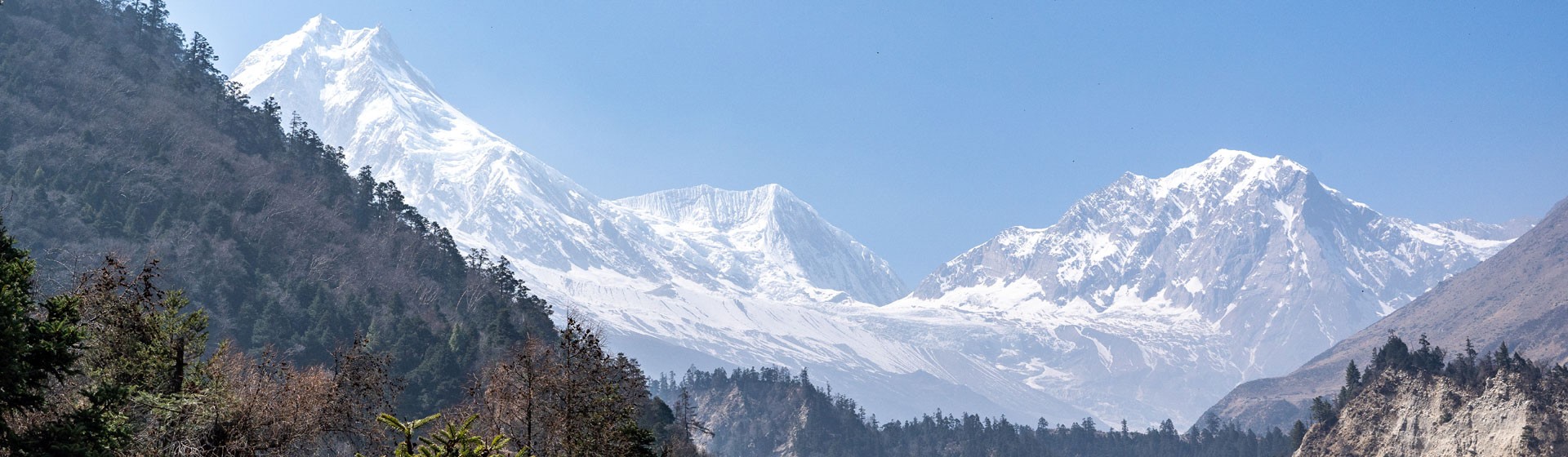
Yes. May is widely regarded as one of the best months for the Manaslu Circuit Trek, offering comfortable trekking temperatures, generally stable spring weather, and favourable trail conditions across much of the route. Every year, many trekkers choose May to complete the circuit before Nepal's summer monsoon begins. By this time, the main trail is usually well established after winter, tea houses along the route are fully operating, and the longer daylight hours allow for comfortable trekking days.
Even so, the Manaslu Circuit remains a high-altitude Himalayan trek where conditions can change quickly. The route climbs from warm river valleys to the 5,160-metre Larkya La Pass, so temperatures, weather, and trail conditions naturally vary with elevation. While lower sections are often warm and pleasant during the day, higher areas may still experience fresh snowfall, strong winds, or rapidly changing mountain weather. These variations are a normal part of trekking in the Himalayas and highlight the importance of proper acclimatisation, a flexible itinerary, and the support of an experienced licensed guide.
For most trekkers, May provides an excellent balance of comfortable walking conditions, active tea houses, and rewarding mountain scenery. If you're looking for a spring departure with generally reliable weather, good trail conditions, and excellent opportunities to enjoy the landscapes of the Manaslu region, May remains one of the strongest times of the year to experience this remarkable Himalayan trek.
Why Trek the Manaslu Circuit in May?
For many trekkers, May offers one of the most balanced trekking experiences on the Manaslu Circuit. As the spring season reaches its final weeks, the route is generally well established, the surrounding landscapes remain vibrant, and the mountains often reveal their best views during the clearer morning hours. The combination of comfortable trekking conditions and the natural beauty of late spring is one of the main reasons why May continues to be a popular time to visit the region.
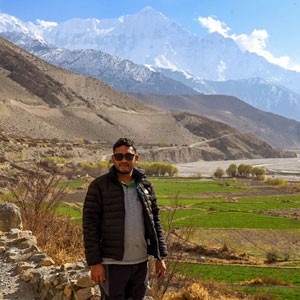
Another advantage of trekking in May is the variety of landscapes you experience throughout the journey. The trail begins in warm river valleys and traditional mountain villages before gradually climbing into alpine terrain, glacial valleys, and the dramatic surroundings of Larkya La Pass. This steady transition is one of the highlights of the Manaslu Circuit, giving trekkers a constantly changing landscape rather than the same scenery day after day.
May also offers a rewarding tea house trekking experience. Villages along the route are fully active, creating a welcoming atmosphere while still preserving the quieter character that makes the Manaslu Circuit different from Nepal's more heavily travelled trekking routes. Even during the busy spring season, there are many sections where the trail feels peaceful, allowing you to appreciate the mountains, local culture, and the rhythm of walking through one of Nepal's most remote Himalayan regions.
While mountain conditions always depend on the weather and can never be guaranteed, May consistently remains one of the most suitable months for trekkers looking for a combination of favourable trail conditions, rewarding scenery, and an authentic Himalayan trekking experience. For these reasons, it continues to be one of the preferred months for completing the Manaslu Circuit Trek.
If your travel dates are flexible, our guide to the best time for the Manaslu Circuit Trek compares the main trekking seasons and helps you decide which period best matches your preferred weather, trail conditions, and trekking experience.
Weather on the Manaslu Circuit Trek in May
The Manaslu Circuit Trek in May is generally characterised by stable late spring weather, making it one of the most popular times of the year to explore the region. While conditions are often comfortable for trekking, the weather changes noticeably as you gain altitude, so it is normal to experience different temperatures and mountain conditions throughout the journey.
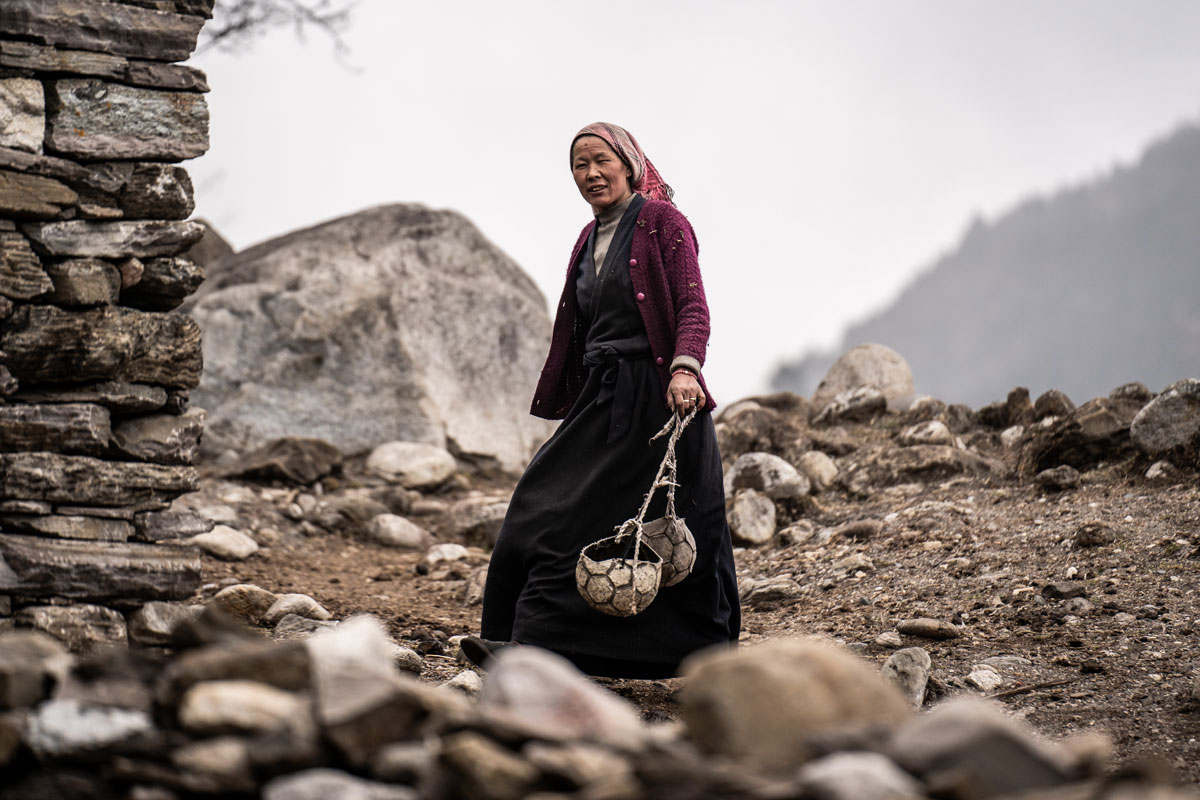
In the lower sections of the trail, days are usually mild to warm, with comfortable walking conditions through river valleys, forests, and traditional villages. As you continue towards Sama Gaun, Samdo, and Dharmasala, temperatures become progressively cooler, especially during the early morning and after sunset. Around Larkya La Pass, weather can change quickly, with stronger winds, colder temperatures, and occasional snowfall still possible, even during May.
A typical trekking day often begins with clear skies, making the morning the best time to enjoy mountain views and complete higher sections of the route. During the afternoon, clouds frequently develop over the surrounding peaks as temperatures rise, which is a common weather pattern in the Himalayas during late spring. For this reason, experienced guides normally start walking early each day to make the most of the clearer morning conditions.
Although May is widely regarded as one of the most favourable months for the Manaslu Circuit Trek, mountain weather is never completely predictable. Short periods of rain at lower elevations or fresh snowfall around Larkya La Pass can still occur, and conditions may change with little notice. Preparing for a range of weather conditions and remaining flexible throughout the trek helps ensure a safer and more enjoyable experience.
Manaslu Circuit Trek Temperature in May
Temperatures on the Manaslu Circuit Trek in May change considerably with elevation. The lower valleys can feel warm during sunny afternoons, while mornings and nights become progressively colder as you climb towards Sama Gaun, Samdo, Dharmasala, and Larkya La Pass. On the same trek, you may be comfortable walking in a light trekking layer lower down but need a down jacket, warm hat, and gloves at the higher overnight stops.
The figures below are approximate planning ranges for May rather than fixed temperatures or a weather forecast. Actual conditions vary with elevation, cloud cover, wind, snowfall, and changing Himalayan weather.
| Location | Elevation | Approx. Daytime Range | Approx. Nighttime Range |
|---|
| Machha Khola | ~870 m | 20°C to 28°C | 12°C to 17°C |
| Namrung | ~2,630 m | 12°C to 20°C | 4°C to 9°C |
| Sama Gaun | ~3,530 m | 8°C to 15°C | -1°C to 5°C |
| Samdo | ~3,875 m | 5°C to 12°C | -3°C to 3°C |
| Dharmasala | ~4,460 m | 2°C to 9°C | -6°C to 0°C |
| Larkya La Pass | ~5,160 m | -2°C to 6°C* | - |
Larkya La is crossed rather than used as an overnight stop. Trekkers normally reach the pass during the morning, and wind chill can make it feel considerably colder than the actual air temperature.
The temperature difference is particularly noticeable on the Larkya La crossing day. Trekkers usually leave Dharmasala before sunrise, when the air is cold and much of the surrounding terrain is still in shadow. A warm insulated jacket, gloves, hat, and several removable layers are useful during these early hours. Once the sun reaches the trail and you begin descending towards Bimthang, conditions can feel noticeably warmer.
At lower elevations, the opposite can happen. Exposed sections of the trail can become quite warm during a sunny May afternoon, making breathable clothing and sun protection more useful than heavy insulation while walking. Dressing in layers is therefore the most practical approach, allowing you to adjust as you move between warm valleys, shaded trails, cold mornings, and the high-altitude environment around Larkya La.
Trail Conditions on the Manaslu Circuit Trek in May
By May, most of the Manaslu Circuit trail is normally well established after the winter months, but the surface changes considerably as you move through different elevations. Lower sections follow a mixture of rough tracks, stone paths, forest trails, suspension bridges, and narrower sections cut into the side of the Budhi Gandaki Valley. These areas are generally straightforward to walk in May, although exposed stretches can become dry and dusty after several days without rain.
As the trail climbs beyond the lower valleys, the surroundings become cooler and the terrain gradually changes. Around Namrung, Lho, and towards Sama Gaun, trekkers encounter a mixture of forest paths, rocky sections, stone steps, and more open mountain terrain. A short spring shower can leave shaded sections temporarily muddy or slippery, but these conditions are usually localised rather than affecting the entire day's walk.
The character of the trail changes again above Sama Gaun as you continue towards Samdo and Dharmasala. Vegetation becomes sparse, the landscape opens up, and the path crosses increasingly rocky and exposed terrain. Snow left from winter is usually much less extensive by May, but patches of old snow or ice can remain in shaded areas and at higher elevations. Fresh snowfall is also possible, so the condition of the upper trail should never be assumed solely from the month on the calendar.
The approach to Larkya La deserves particular attention. Trekkers normally leave Dharmasala before sunrise, when frozen ground, snow patches, or icy sections can be firmer and more noticeable underfoot. Conditions vary from year to year, and after recent snowfall the crossing can be considerably different from a dry May morning. Your guide should check the latest trail and weather information locally before the crossing and adjust the departure or equipment recommendations when necessary.
Overall, May usually provides good walking conditions across much of the Manaslu Circuit, but it is still a remote Himalayan trail rather than a maintained walking path. Good trekking boots, trekking poles, and a willingness to adjust to changing surfaces are more useful than expecting the trail to remain dry and predictable from beginning to end.
Crossing Larkya La Pass in May
At 5,160 metres, Larkya La Pass is the highest point of the Manaslu Circuit Trek, and May is generally a favourable month for making the crossing. By late spring, much of the winter snow has usually settled or melted, but conditions are never identical from one year to the next. Old snow, frozen sections, or fresh snowfall can still affect the upper trail, particularly after a recent change in mountain weather.
Trekkers normally leave Dharmasala before sunrise, when the upper trail can still be frozen from the night. In May, this can mean walking over firmer snow or occasional icy patches before the sun reaches the exposed slopes. The first part of the crossing is usually cold and dark, with trekkers following the trail by headlamp as the landscape gradually opens into the high-altitude terrain below the pass.
As daylight reaches the surrounding mountains, visibility improves, but wind can become more noticeable on exposed sections. Snow remaining from earlier weather may soften as temperatures rise, while shaded areas can stay firm for longer. These changing conditions are one reason the crossing should be approached according to what is actually happening on the mountain rather than assuming that May automatically means a dry, snow-free trail.
Trekking poles and careful footing are often sufficient when conditions are good, while additional traction may occasionally be useful if snow or ice remains on the upper route. The need for equipment can vary between departures, so it is better to make that decision from recent trail information rather than carrying or relying on specialised equipment simply because of the month.
Reaching Larkya La is only part of the day's challenge. The descent towards Bimthang is long, and sections immediately below the pass can remain snowy, wet, or loose underfoot even when the ascent has been relatively straightforward. Trekkers should therefore continue to watch their footing and manage their pace after leaving the pass rather than treating the summit as the end of the difficult terrain.
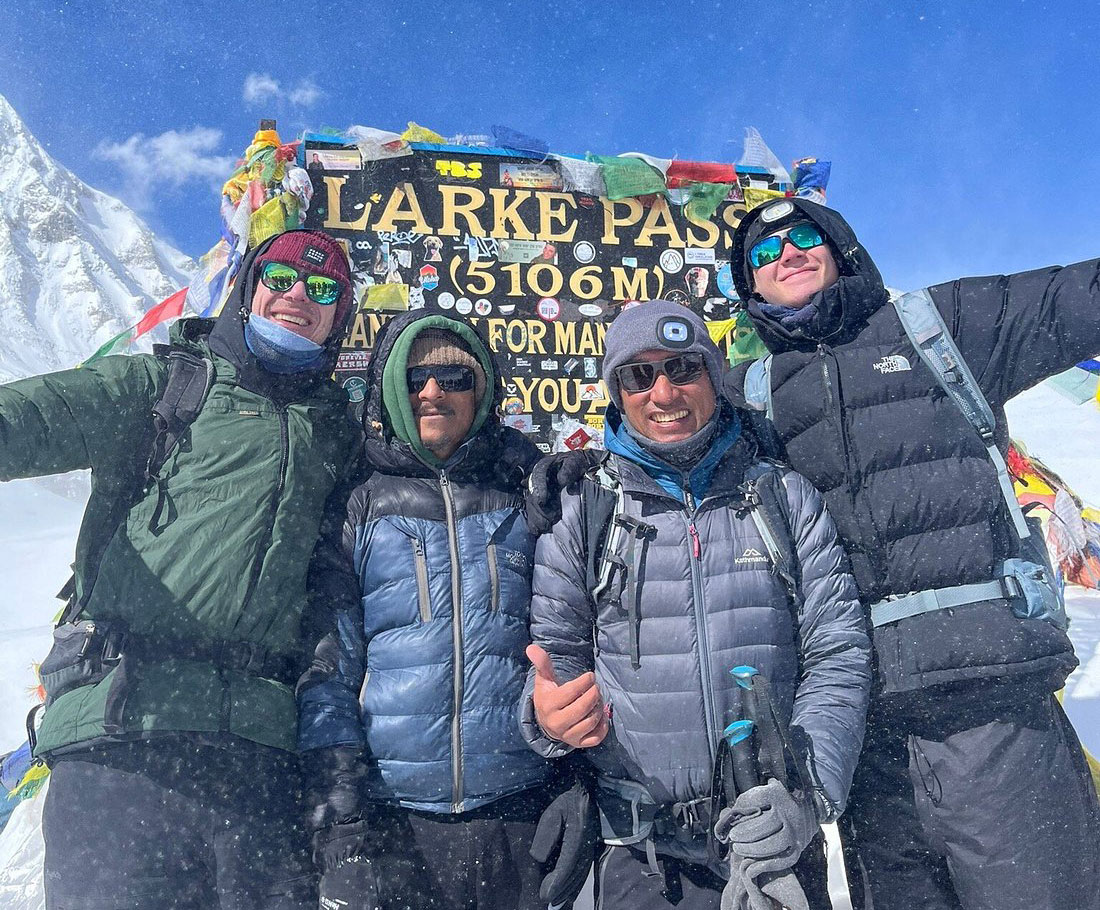
Before crossing, our guides check recent conditions using information available from local tea house owners, other guides, and people travelling through the upper route. May generally provides a good window for crossing Larkya La Pass, but the final decision should always reflect the conditions on the mountain that day rather than the season alone.
Crowds and Tea Houses on the Manaslu Circuit in May
May falls within the main spring trekking season, so you should expect to meet other trekkers on the Manaslu Circuit. However, busy does not necessarily mean crowded. Groups tend to spread out once they leave their tea houses in the morning, and there can still be long stretches of trail where you walk with only your guide, porter, or trekking companions around you.
The feeling changes when you reach the overnight villages. Trekkers following similar itineraries often arrive at the same places towards the end of the day, so tea houses can feel considerably busier in the late afternoon and evening than the trail itself. Sama Gaun is one of the places where groups naturally gather because many itineraries include additional time there for acclimatisation and side trips.
Room availability deserves more attention higher on the route. Larger villages generally provide more choice, while smaller overnight stops have fewer rooms to begin with. Dharmasala is usually the overnight stop where room availability deserves the most attention, particularly when several trekking groups following similar schedules arrive on the same day. This does not mean accommodation will always be difficult to find in May, but it is sensible for guides and operators to coordinate rooms ahead whenever possible rather than waiting until late in the day.
May is also a good time to experience the social side of tea house trekking. After walking for several hours, trekkers from different groups often end up sharing the same dining room, talking about the day's trail and discussing conditions farther ahead. Outside these evening gathering points, the Manaslu Circuit still retains much of the quieter, more remote atmosphere that attracts people to the region in the first place.
Women planning to travel to Nepal independently can also read our Manaslu Circuit Trek guide for solo female trekkers, which covers guide and group options, tea house privacy, personal hygiene, communication, and practical trail considerations.
For trekkers worried that travelling in May will make the Manaslu Circuit feel excessively crowded, that is generally not the case. You are unlikely to have the route entirely to yourself during the spring season, but the combination of an active trekking atmosphere and quieter stretches between villages remains one of the appealing features of trekking Manaslu at this time of year.
What to Pack for the Manaslu Circuit Trek in May
Packing for the Manaslu Circuit Trek in May requires clothing and equipment that can handle both warm spring afternoons and cold conditions at higher elevations. The temperature difference between the lower valleys and the area around Larkya La can be considerable, so a flexible layering system is more useful than relying on one heavy set of clothing.
For most May departures, the following items deserve particular attention:
- Lightweight trekking layers: Breathable shirts and trekking trousers are useful on warmer days in the lower valleys.
- Warm mid-layer: A fleece or similar insulating layer is useful as temperatures fall with elevation.
- Insulated jacket: A down or synthetic jacket is particularly valuable during cold mornings and evenings around Sama Gaun, Samdo, Dharmasala, and the Larkya La crossing.
- Waterproof outer layer: May is still part of the spring season, but occasional rain or snow is possible. Carry a waterproof jacket and protection for your backpack or important belongings.
- Warm hat and gloves: These can feel unnecessary lower on the route but become important during early starts at higher elevations.
- Good trekking boots: Well-broken-in boots with reliable grip are preferable because the trail can include dry ground, loose rock, mud, and occasional snow or ice during the same journey.
- Trekking poles: Particularly useful on uneven terrain and during the long descent from Larkya La towards Bimthang.
- Sun protection: Sunglasses, sunscreen, a sun hat, and lip protection are important because UV exposure becomes stronger at higher elevations and can be intensified by snow.
- Headlamp: Essential for early starts, particularly on the Larkya La crossing day.
- Water protection: Lightweight dry bags or waterproof pouches are useful for keeping spare clothing, electronics, passports, and other important items protected during unexpected showers.
Microspikes are not automatically necessary for every May departure. Their usefulness depends on recent snowfall and the condition of the upper trail around Larkya La. Rather than assuming they are required simply because you are trekking at high altitude, check the latest conditions close to your departure and follow the recommendation of your guide.
The most practical approach to packing for May is to prepare for contrasts: warm walking conditions lower down, colder mornings as you gain altitude, strong high-altitude sun, and the possibility of rain or fresh snow. Carrying adaptable layers allows you to respond to those changes without making your trekking bag unnecessarily heavy.
For equipment beyond these May-specific items, see our complete Manaslu Circuit Trek packing list.
Advantages and Disadvantages of Trekking the Manaslu Circuit in May
May offers a strong balance of late-spring trekking conditions, but it is not perfect for every traveller. Understanding both the advantages and the trade-offs can help you decide whether this month matches the type of Manaslu experience you are looking for.
| Advantages of Trekking in May | Disadvantages of Trekking in May |
|---|
| Generally favourable late-spring trekking conditions | Lower valleys can feel hot during sunny afternoons |
| Longer daylight hours provide more flexibility during trekking days | Afternoon cloud can sometimes reduce mountain visibility |
| Green valleys and vibrant late-spring landscapes | Popular spring dates can bring more trekkers to overnight villages |
| Tea houses along the route are normally fully operating | Occasional rain is possible at lower elevations |
| Good opportunities for clear mountain views, particularly in the morning | Snow, ice, or fresh snowfall can still occur around Larkya La |
| Warmer daytime conditions across much of the route | High-altitude weather remains unpredictable regardless of the season |
For many trekkers, the advantages outweigh the disadvantages. May works particularly well if you prefer warmer daytime conditions, longer daylight hours, active tea houses, and the greener landscapes of late spring. Starting early also gives you a better chance of enjoying clearer mountain views before afternoon cloud begins to build around the higher peaks.
The main trade-off is that May should never be treated as a guarantee of perfect weather. Lower sections can become warm, afternoons may turn cloudy, and conditions at higher elevations can still change after fresh snowfall or a passing weather system. Trekkers hoping for consistently cold temperatures, completely empty trails, or uninterrupted mountain views throughout every day may find another time of year better suited to their expectations.
Overall, May is a strong choice for the Manaslu Circuit Trek, particularly for travellers who value comfortable spring trekking conditions and are prepared to remain flexible when Himalayan weather changes.
Manaslu Circuit Trek in May vs April: Which Month Is Better?
Both April and May fall within Nepal's spring trekking season and are excellent months for the Manaslu Circuit, but the experience is not exactly the same. April is generally cooler and sits closer to the middle of the spring season, while May brings warmer temperatures, longer days, and a gradual transition towards Nepal's summer monsoon. The better month therefore depends more on your preferences than on one being universally superior.
| Factor | April | May |
|---|
| Daytime temperatures | Generally cooler | Generally warmer, especially lower down |
| Early mornings at high altitude | Colder | Usually slightly milder, but still cold |
| Mountain visibility | Often good, particularly in the morning | Often good in the morning, with a greater chance of afternoon cloud later in the month |
| Lower-valley landscape | Fresh spring vegetation | Greener and more developed late-spring vegetation |
| Trail conditions | Generally good; more winter snow may remain higher up | Generally good; less old snow is typically present, although fresh snowfall remains possible |
| Larkya La | Snow or ice may still be present | Winter snow is often reduced, but conditions vary each year |
| Daylight | Long spring days | Slightly longer daylight |
| Trail atmosphere | Popular spring trekking period | Popular spring trekking period |
| Best suited for | Trekkers who prefer cooler conditions | Trekkers who prefer warmer days and late-spring landscapes |
Is April or May Better for the Manaslu Circuit?
Choose April if you prefer cooler walking temperatures and want to trek during the middle of Nepal's spring season. Higher elevations can feel colder, and there may be a greater chance of encountering remaining winter snow on the upper route, but April generally provides favourable conditions for completing the circuit.
Choose May if you prefer warmer daytime temperatures, longer daylight hours, and greener landscapes in the lower valleys. The trade-off is that afternoon cloud can become more common as the month progresses, particularly later in May as Nepal moves closer to the summer monsoon.
For most trekkers, there is no wrong choice between the two. April may appeal more to trekkers who prefer cooler spring conditions, while May can suit those who prefer warmer walking temperatures, longer daylight, and greener late-spring landscapes. Whichever month you choose, conditions around Larkya La should be assessed close to the crossing because high-altitude weather can vary significantly from year to year.
Manaslu Circuit Trek in May vs October: Which Is Better?
May and October are both popular months for the Manaslu Circuit Trek, but they offer noticeably different experiences. May brings the warmer, greener character of late spring, while October generally falls within Nepal's post-monsoon autumn trekking season, bringing cooler and typically drier conditions. Neither month is automatically better; the right choice depends on the weather, scenery, and trail atmosphere you prefer.
| Factor | May | October |
|---|
| Season | Late spring | Autumn, after the summer monsoon |
| Daytime temperatures | Generally warmer, particularly at lower elevations | Comfortable to cool, becoming colder higher up |
| Nights at high altitude | Cold | Cold, particularly later in the month |
| Mountain views | Often clearest in the morning; afternoon cloud can develop | Often clear with generally dry post-monsoon conditions |
| Landscape | Green valleys and late-spring vegetation | Fresh post-monsoon landscapes gradually becoming drier |
| Rain | Occasional showers possible, increasing towards the end of May | Usually less frequent than during the monsoon months |
| Larkya La conditions | Old snow may be reduced, although fresh snowfall remains possible | Often relatively settled, but snow and sudden weather changes remain possible |
| Trail atmosphere | Active spring trekking season | One of the busier periods of the trekking year |
| Daylight | Longer late-spring days | Shorter than May |
| Best suited for | Trekkers who enjoy warmer days and greener landscapes | Trekkers who prefer cooler, generally drier autumn trekking conditions |
Should You Choose May or October?
Choose May if warmer walking temperatures, longer daylight hours, and green spring landscapes are important to you. The lower valleys can feel noticeably warmer than the high country, while mornings often provide good opportunities for mountain views before afternoon cloud begins to develop. Later in the month, the gradual approach of the summer monsoon can bring increasing moisture and cloud into the region.
Choose October if you prefer cooler trekking temperatures and the character of Nepal's post-monsoon autumn season. The landscape has been refreshed by the summer rains, and generally drier conditions make October one of the most popular periods for Himalayan trekking.
Crowd levels are another consideration. October is often perceived as the busier of the two trekking periods, although actual trail traffic varies according to departure dates and from one year to another. Whichever month you choose, you should expect to meet other trekkers at popular overnight villages during the main spring and autumn seasons.
Ultimately, May is likely to suit trekkers who prefer warmer days, longer daylight, and greener landscapes, while October may appeal more to those who prefer cooler and generally drier autumn conditions. Larkya La remains a high-altitude mountain crossing in either season, so current conditions should always be assessed close to the trekking date rather than relying solely on typical seasonal patterns.
Is the Manaslu Circuit Trek in May Suitable for Beginners?
Yes, May can be a good time for fit beginners to trek the Manaslu Circuit, provided they arrive properly prepared and follow a sensible acclimatisation plan. Generally established trails, warmer daytime conditions, longer daylight hours, and fully operating tea houses can remove some of the seasonal difficulties that trekkers may encounter during colder or wetter periods of the year.
However, favourable May conditions do not make the Manaslu Circuit an easy trek. The route still reaches 5,160 metres at Larkya La Pass and involves consecutive days of walking through remote mountain terrain. For a first-time Himalayan trekker, the challenge comes less from technical climbing and more from sustained trekking, increasing altitude, and adapting to conditions that change considerably between the lower valleys and the high mountains.
If you are assessing whether the overall route matches your experience and fitness, our Manaslu Circuit Trek difficulty guide explains the walking demands, altitude, Larkya La crossing, and preparation in more detail.
For beginners, one of the main advantages of choosing May is that seasonal conditions are less likely to add unnecessary difficulty to an already demanding trek. Warmer lower sections, longer daylight, and generally established trails can make everyday trekking more comfortable. Higher up, however, cold mornings, strong winds, fresh snowfall, or remaining snow and ice are still possible, particularly around Larkya La.
Choosing a favourable month should therefore complement rather than replace good preparation. If you are reasonably fit, comfortable walking for several days in succession, prepared for basic mountain conditions, and willing to take altitude seriously, May is one of the more suitable periods for completing your first Manaslu Circuit Trek.
Is May a Good Time for Manaslu Circuit Photography and Mountain Views?
Yes, May can be a rewarding month for photography on the Manaslu Circuit, particularly during the clearer morning hours. One of its strengths is the variety of scenery encountered within a single journey. Green river valleys and forested hillsides gradually give way to traditional mountain villages, open alpine terrain, glaciers, and snow-covered Himalayan peaks as the trail climbs towards Larkya La.
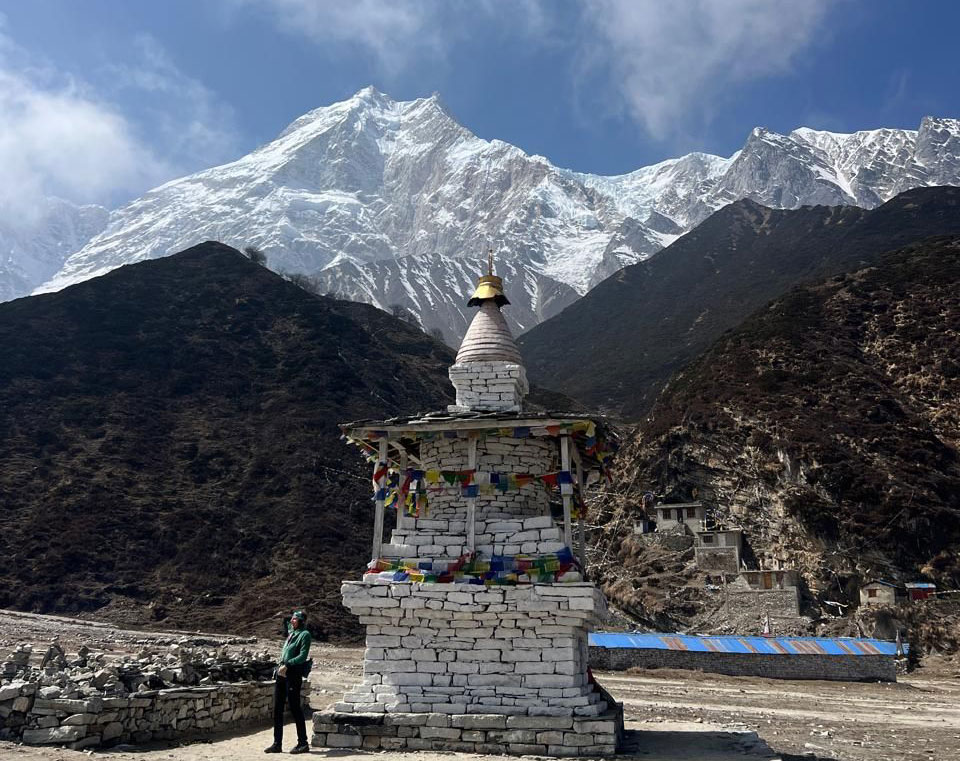
Some of the most rewarding mountain perspectives appear around Lho, Shyala, and Sama Gaun. When conditions are clear, these sections provide impressive views of Manaslu and the surrounding peaks, while village buildings, monasteries, fields, prayer walls, and changing vegetation give photographers plenty to work with beyond mountain panoramas alone.
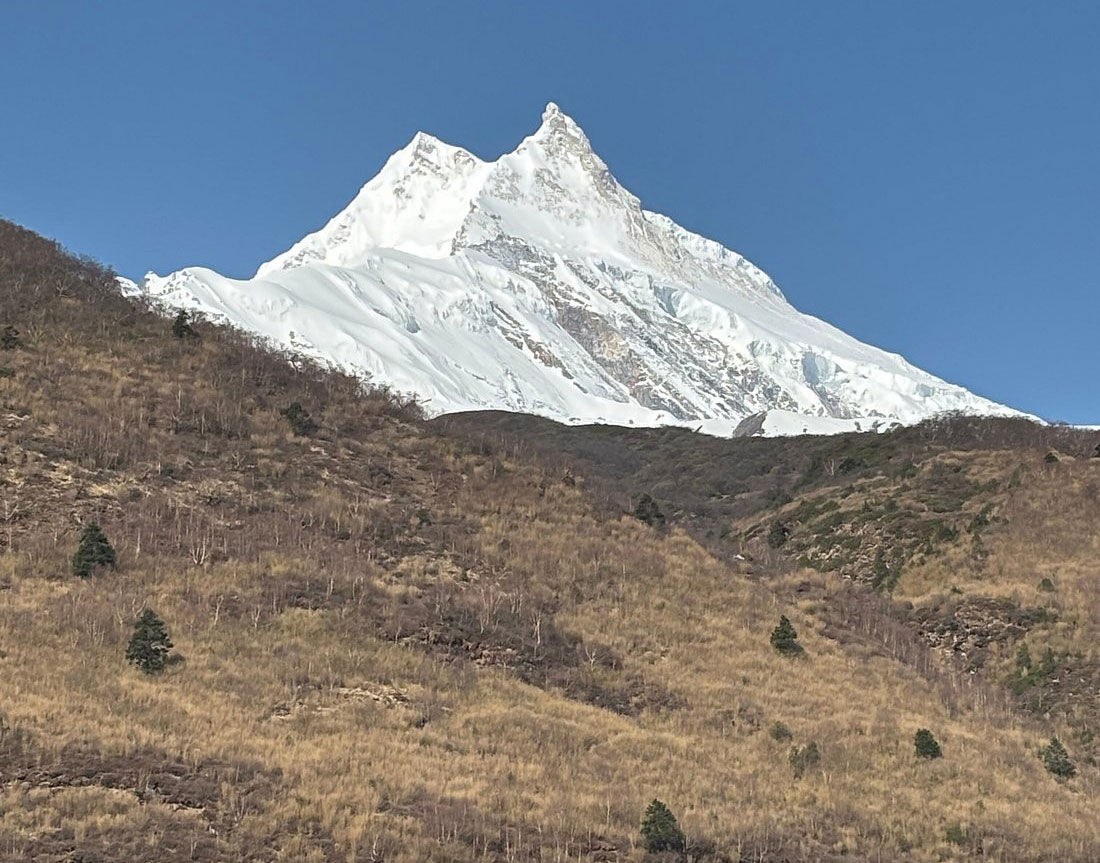
The visual character changes again above Sama Gaun. Around Samdo and Dharmasala, vegetation becomes sparse and the landscape feels increasingly open and rugged. By the time you approach Larkya La, rocky terrain, glacial features, snow patches, and high mountain surroundings create a very different setting from the warmer valleys encountered earlier on the route.
For mountain photography, it is worth keeping your camera accessible during the morning rather than buried inside your main trekking bag. Views are often clearer earlier in the day, while cloud can develop around the mountains during the afternoon, particularly as May progresses. Conditions vary from day to day, so clear panoramas should be treated as an opportunity rather than something guaranteed by the season.
What makes May particularly interesting from a photography perspective is this contrast. Within the same trek, you can photograph spring vegetation, village life, Buddhist cultural details, deep river valleys, snow-covered peaks, and the stark high-altitude landscape around Larkya La. The result is a much broader visual story than mountain views alone.
Frequently Asked Questions About the Manaslu Circuit Trek in May
Is May a good time for the Manaslu Circuit Trek?
Yes. May is one of the main spring trekking months for the Manaslu Circuit, with generally established trails, warmer daytime conditions, longer daylight hours, and tea houses operating along the route. High-altitude weather can still change quickly, so favourable seasonal conditions should never be treated as a guarantee of perfect weather.
Is early May or late May better for the Manaslu Circuit Trek?
For many trekkers, early to mid-May offers a particularly good balance of spring conditions. Later May can be warmer and greener, but afternoon cloud and occasional rainfall may become more frequent as Nepal gradually approaches the summer monsoon. The timing of this transition varies from year to year.
Does it rain on the Manaslu Circuit in May?
Yes, rain is possible in May, particularly at lower elevations and as the month progresses. Showers can develop later in the day even after a clear morning, so carrying a waterproof outer layer and protecting important belongings is sensible throughout the trek.
Is there snow on the Manaslu Circuit in May?
There can be. Much of the winter snow has normally reduced by May, but old snow may remain on higher sections of the route, particularly around Larkya La. Fresh snowfall is also possible at altitude, which is why recent trail conditions are more useful than assuming the upper route will be snow-free simply because it is May.
Is Larkya La Pass normally crossable in May?
May falls within the established spring trekking season, and Larkya La is normally crossed during this period. However, conditions on a 5,160-metre pass can change after fresh snowfall, strong winds, or an unusual weather system. Current trail and weather conditions should therefore be checked before the crossing rather than relying solely on the month.
Do I need microspikes for the Manaslu Circuit Trek in May?
Not necessarily. Many May departures may not require microspikes, but they can become useful when recent snowfall or freezing conditions leave icy sections on the upper route. Check recent Larkya La conditions close to your departure and follow your guide's recommendation rather than assuming traction equipment is always required.
What flowers and vegetation can you see on the Manaslu Circuit in May?
May brings noticeably greener landscapes to the lower and middle sections of the Manaslu Circuit. Spring vegetation and flowering plants can be seen along forested parts of the route, and rhododendrons may still be present in suitable locations and elevations. Flowering periods vary with altitude and yearly weather patterns, so particular blooms should not be guaranteed.
Should I book the Manaslu Circuit Trek in May in advance?
Advance planning is sensible, especially when your Nepal travel dates are fixed. May is an established spring trekking month, and arranging your guide, permits, transportation, and other logistics ahead of time allows more flexibility than leaving everything until immediately before departure. You can check our Manaslu Circuit Trek itinerary and departure details when planning your May journey.
Can road conditions affect the Manaslu Circuit Trek in May?
Yes. Although May generally comes before Nepal's main summer monsoon period, rain, road maintenance, landslides, or local conditions can occasionally affect overland access. Transport conditions should therefore be reconfirmed close to departure rather than assuming journey times will always remain the same.
When should I check the weather forecast for a Manaslu Circuit Trek in May?
Long-range forecasts can help identify general trends, but they should not be relied upon for exact mountain conditions several weeks in advance. Check the forecast again in the days immediately before your trek, and continue using local weather and trail information during the journey, particularly before travelling into the higher sections and crossing Larkya La.