Tsum Valley vs Manaslu Circuit Scenery
If mountain scenery is the main reason you are choosing between Tsum Valley and the Manaslu Circuit, we would choose the Manaslu Circuit. Tsum has beautiful mountain surroundings, but Manaslu gives you more days where the scale of the mountains directly shapes the walk, particularly from Lho onward and again around Samagaon, Samdo and Larkya La.
This is not obvious during the first few days. The lower Manaslu route spends considerable time beside the Budhi Gandaki, where steep valley walls, forest, waterfalls, suspension bridges and cultivated slopes can hide the higher peaks. Trekkers expecting constant close views of Manaslu from the beginning are sometimes surprised by this.
The change becomes much clearer after Namrung. At Lho, Manaslu starts to dominate the skyline rather than appearing only as a distant mountain. The trail around Shyala and Samagaon feels more open, with cultivated land and villages sitting beneath much larger mountain walls. On a clear morning, this part of the route is one of the places where stopping for the view can easily add time to the walking day.
Samagaon also gives trekkers the option of going closer to the mountain environment rather than only viewing it from the main trail. The acclimatization walks toward Birendra Lake and Manaslu Base Camp lead toward the glacial basin below Manaslu. The base-camp walk is considerably more demanding than the lake excursion, so we would not treat the two as interchangeable simply because both can be done from Samagaon.
Beyond Samagaon, the character changes again. The walk toward Samdo leaves much of the greener valley scenery behind. Vegetation becomes thinner, the ground more open and settlements fewer. Above Samdo, there are long stretches where villages, fields and trees no longer frame the walk in the same way they did lower down.
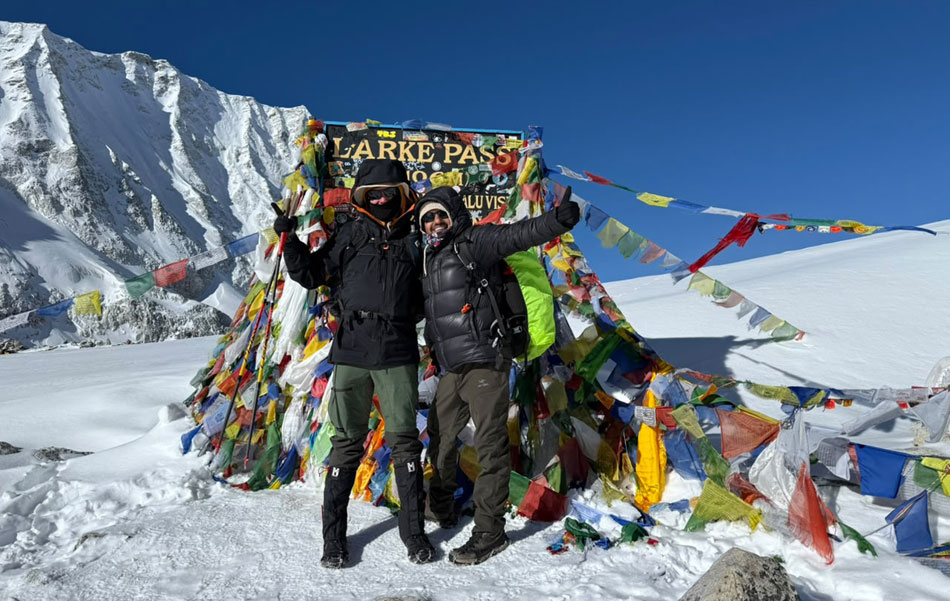
That transition matters because Larkya La is not just a viewpoint reached for a photograph. From Dharmasala, trekkers normally start before daylight and spend hours moving through cold, exposed terrain before reaching the pass and beginning the long descent toward Bimthang. Snow cover and visibility can completely change how this day looks from one departure to another. In clear conditions, however, the combination of the pass, surrounding peaks and the descent toward Bimthang is the strongest mountain-scenery section of either trek.
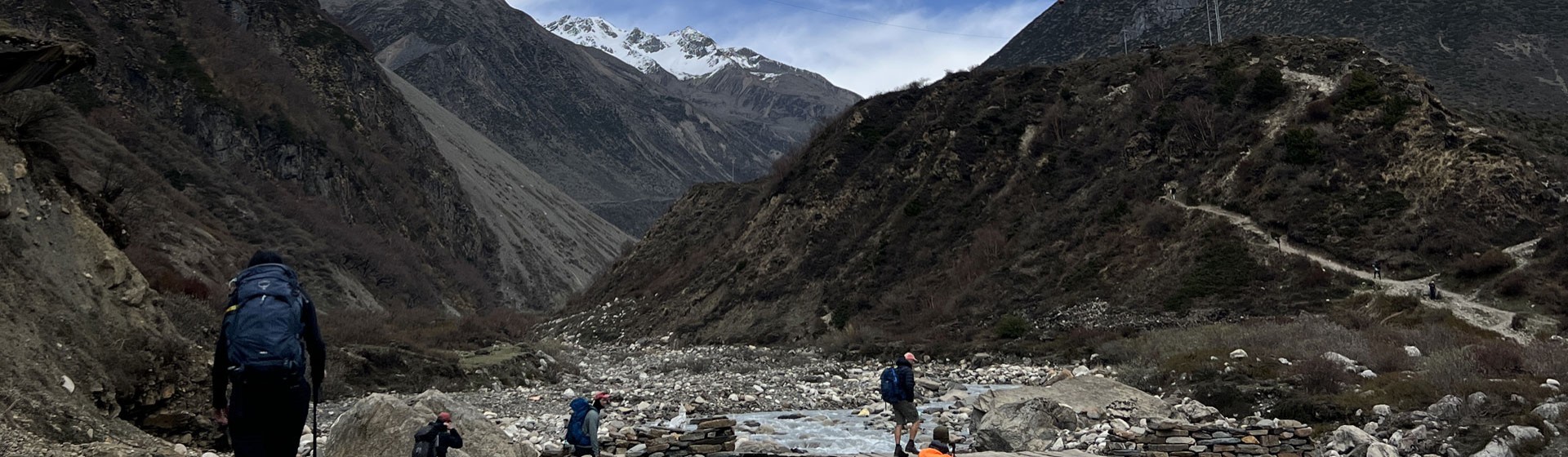
Tsum Valley looks different from the moment you leave the main Manaslu corridor near Lokpa. Instead of continuing toward the increasingly alpine upper Manaslu route, the trail turns into the Shiar Khola valley. Forest, cliffs and river scenery remain prominent around the lower settlements, and the mountains often appear behind villages and cultivated slopes rather than filling the entire horizon.
Around Chumling and Chhokang Paro, much of what makes the landscape memorable is this relationship between the settlements and their surroundings. Stone houses, fields, mani walls and monasteries are not separate attractions that you visit between mountain viewpoints; they are part of what you are looking at throughout the walking day.
The valley becomes more open as you continue through the upper settlements toward Chhule and Nile. Agricultural land becomes more limited, the terrain looks drier and the influence of the high country toward the Tibetan border becomes easier to see. Continuing toward Mu Gompa takes you farther from the busier trekking corridor, but it still does not produce the same high-alpine environment as the approach to Larkya La.
This distinction is important when looking at photographs online. A good photograph from Tsum can appear every bit as dramatic as one from Manaslu, but a trek is experienced over many consecutive days rather than through its best five images. Manaslu delivers the stronger progression from river valley to major Himalayan peaks and finally high-pass terrain. Tsum keeps villages, cultivated land and Buddhist sites much more closely connected to the landscape throughout the journey.
So, which trek has better scenery?
For trekkers who mean big mountains, glaciers, high-altitude terrain and dramatic changes in landscape, the Manaslu Circuit is the clear choice.
For travelers who prefer seeing mountains as part of an inhabited Himalayan valley, where villages, fields, monasteries and local life remain central to the view, Tsum Valley can be more rewarding.
That difference in scenery leads directly to an area where the balance shifts much more strongly toward Tsum: culture and village experience.
Tsum Valley vs Manaslu Circuit: Culture and Village Experience
For trekkers comparing Tsum Valley vs Manaslu Circuit for culture, Tsum Valley is the stronger choice. Both routes pass through communities with deep Tibetan Buddhist influence, but culture remains more central to the walking experience in Tsum, while the Manaslu Circuit gradually shifts toward altitude, mountain terrain and the Larkya La crossing.
The difference becomes clearer after leaving the main Manaslu route near Lokpa. On the way toward Chumling and the upper Tsum Valley, mani walls, chortens, prayer wheels, monasteries and cultivated villages repeatedly sit directly along the trail. They do not feel like separate attractions added to the trekking itinerary; much of the day is spent walking through the landscape in which they are still used.
Around Chhokang Paro, this becomes particularly noticeable. The broad cultivated area, traditional houses and Buddhist monuments make it worth looking beyond the lodge where you spend the night. Trekkers who arrive late and leave early the following morning can technically complete the same route as someone who spends more time here, but they do not necessarily experience Tsum in the same way.
Continuing farther north changes the scale again. Settlements become smaller and more scattered around Lar, Phurbe, Chhule and Nile, and there are fewer signs of the trekking infrastructure found along Nepal's busier routes. Walking between these villages also shows how closely agriculture, livestock, religious sites and everyday life are connected within the valley.
Rachen Gompa and Mu Gompa are two of the most important cultural stops, but they offer quite different experiences. Rachen Gompa lies within the inhabited valley and is associated with its Buddhist nunnery. Mu Gompa is farther north, at around 3,700 meters, where permanent settlement has already begun to thin out. The walk toward Mu Gompa therefore matters almost as much as reaching the monastery itself; you see the inhabited part of Tsum gradually giving way to the quieter upper valley.
This is one reason we would not recommend judging a Tsum itinerary only by how quickly it reaches Mu Gompa. Tsum rewards time differently from the Manaslu Circuit. An itinerary that allows time around the villages and monasteries can provide more value than one that simply reduces the number of trekking days.
If the cultural side of this comparison is what attracts you most, our Tsum Valley Trek follows the valley through Chumling, Chhokangparo and Nile toward Mu Gompa without continuing across Larkya La.
The Manaslu Circuit has its own strong cultural progression, particularly after Namrung. Around Lho, traditional houses, mani walls and Ribung Gompa sit beneath the increasingly prominent Manaslu massif. Shyala and Samagaon continue that mixture of village life, Buddhism and mountain scenery, while the side trip to Pungyen Gompa from Samagaon provides another cultural experience away from the main trail.
Samdo has a different character again. Its position close to the Tibetan frontier and at higher elevation gives the settlement a much more exposed feeling than the greener villages encountered earlier on the circuit. But from here, the priorities of the trek begin to change. Acclimatization, weather and the coming Larkya La crossing increasingly influence decisions about pace and itinerary.
By the time trekkers reach Dharmasala, the cultural comparison has largely ended. There is no sequence of permanent villages between Dharmasala, Larkya La and the descent toward Bimthang. That section is about moving through high mountain terrain rather than spending time within an inhabited valley.
Tsum never makes such a complete transition. Villages and Buddhist sites remain fundamental to the reason for going there, which is why simply describing both routes as having “Tibetan-influenced culture” misses an important difference.
On the Manaslu Circuit, culture is one part of a journey that eventually becomes dominated by the high mountains and Larkya La. In Tsum Valley, culture is much closer to the purpose of the journey itself.
So, is Tsum Valley or the Manaslu Circuit better for culture?
Choose Tsum Valley if culture is one of your main reasons for trekking. It provides more sustained time among traditional settlements, monasteries and the Buddhist landscape of the valley. Choose the Manaslu Circuit when you want those cultural experiences as part of a broader trek whose defining challenge is ultimately the high-altitude crossing of Larkya La.
Tsum Valley vs Manaslu Circuit Difficulty: Which Trek Is Harder?
The Manaslu Circuit is harder than the Tsum Valley Trek overall. The main difference is not simply that Manaslu reaches a higher point. On the circuit, several demanding trekking days come when you are already sleeping high, and the route eventually requires the long crossing of Larkya La. Tsum avoids that high-pass day, but the trail is still demanding enough that it should not be treated as an easy trek.
Tsum often feels harder than its altitude profile suggests. The route does not climb smoothly from one overnight stop to the next. There are repeated short climbs and descents as the trail crosses side valleys, follows the river and connects villages at different levels. You can finish a day only a few hundred meters higher than where you started while having climbed considerably more than that during the walk.
You notice this soon after turning toward Chumling. The route into Tsum is not a level walk along the valley floor. Stone steps, uneven ground and repeated changes in elevation interrupt the rhythm, and similar terrain continues on later days. None of these sections is particularly extreme on its own, but doing them day after day is where tired legs begin to show.
We often see the difference most clearly after several consecutive walking days. A trekker may feel very strong during the first two or three days and then start slowing on climbs that do not look significant on the itinerary. That is normal on a multi-day Himalayan trek: today's walking is being done on legs that have already worked for several days.
Carrying weight matters too. The same Tsum itinerary feels noticeably different with a light daypack than with most of your trekking equipment on your back. If you are assessing whether you are fit enough for Tsum, your ability to walk repeatedly on uneven terrain is more relevant than a single long hike completed at home.
The Manaslu Circuit adds another layer of difficulty as the route gets higher. Lower down, strong trekkers can often maintain a comfortable rhythm for hours. That usually changes as the circuit progresses toward Samagaon, Samdo and Dharmasala. Walking speed naturally drops, breaks may become more frequent, and even a straightforward uphill section can take longer than expected.
One mistake is trying to maintain the pace used lower in the valley. Arriving at Samdo or Dharmasala quickly provides no advantage. At these elevations, a steady pace that can be maintained without repeatedly stopping is generally more sensible than pushing hard because your legs still feel strong.
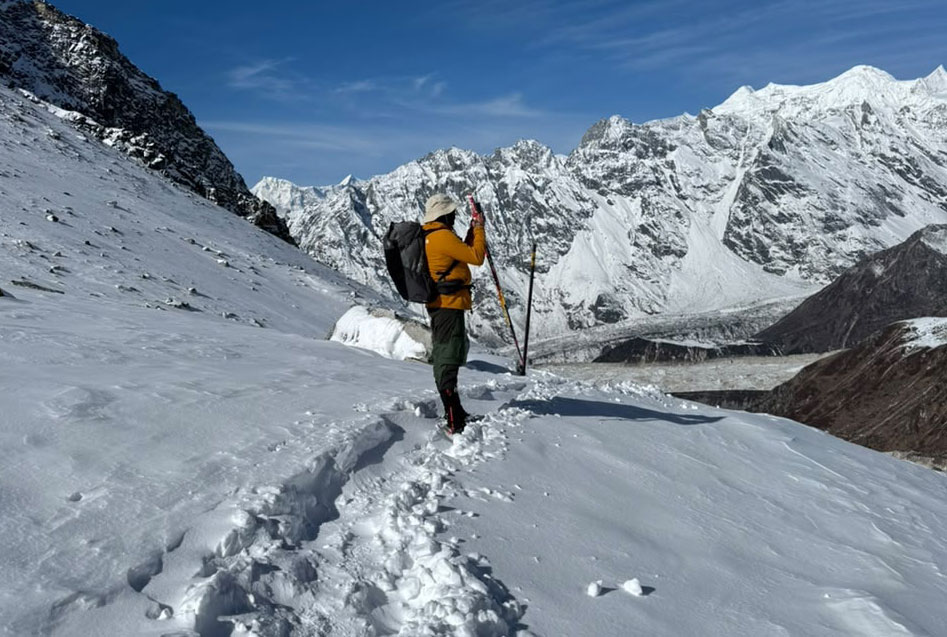
The biggest physical test comes on the Dharmasala-Larkya La-Bimthang day. Under normal trail conditions, this is a trekking route rather than a technical climbing route, so mountaineering skills are not normally required. What makes the day difficult is having several challenges together: a very early departure, cold morning temperatures, prolonged walking at high elevation, the climb to the pass and a long descent afterward.
Conditions can change that day considerably. Dry ground and clear weather produce a very different walking day from fresh snow, hard-packed snow or icy sections. When footing becomes slower, a group spends longer at elevation and the entire day stretches out. This is why comparing Larkya La only by distance or estimated walking hours can be misleading.
Another point that first-time pass trekkers sometimes underestimate is what happens after reaching Larkya La. The pass feels like the obvious finish line when climbing toward it, but reaching the top does not mean the hard walking is over. There is still a substantial descent toward Bimthang, and after hours of climbing, tired thighs and knees can make the downhill section surprisingly demanding.
Tsum Valley has no equivalent pass day. Its difficulty is spread more evenly across the itinerary through repeated climbs, descents and consecutive days of walking. Manaslu combines that normal multi-day fatigue with higher sleeping elevations and one particularly long high-altitude crossing.
The difficulty of Manaslu also depends on how those days are arranged; our guide to planning a good Manaslu Circuit itinerary explains why daily stages and altitude progression matter more than simply choosing the shortest schedule.
Is Tsum Valley Easier Than the Manaslu Circuit?
Yes. For most trekkers, Tsum Valley is physically easier than the Manaslu Circuit. It avoids the Larkya La crossing and spends considerably less time at very high elevation.
That does not make Tsum suitable without preparation. You still need enough endurance to walk for several hours on consecutive days and enough leg strength for repeated climbing and descending on uneven trails.
For the Manaslu Circuit, previous multi-day hiking experience is especially valuable because the hardest part of the route comes after you have already accumulated several days of walking. Strong general fitness helps, but being fast on a one-day hike is not the same as recovering well enough to walk again the following morning.
If fitness alone is deciding your choice, Tsum Valley is the more manageable of the two routes. If you are comfortable with consecutive trekking days and specifically want the additional challenge of a high Himalayan pass, Manaslu provides the considerably tougher objective.
There is one qualification to that comparison: physical difficulty and altitude risk are not the same thing. A very fit trekker can still develop altitude problems, while a slower trekker may acclimatize well. That makes altitude and acclimatization worth comparing separately.
Tsum Valley vs Manaslu Circuit: Altitude and Acclimatization
Altitude is a much bigger consideration on the Manaslu Circuit than on the standard Tsum Valley Trek. Tsum reaches the upper 3,000-meter range on its usual route, while Manaslu requires trekkers to sleep progressively higher before crossing Larkya La above 5,000 meters.
The important comparison, however, is not simply the highest number reached. When we look at an itinerary, we pay more attention to where the trekker sleeps each night and how quickly those sleeping elevations increase. A high point reached during the day and followed by a descent for the night affects the body differently from moving higher and sleeping there.
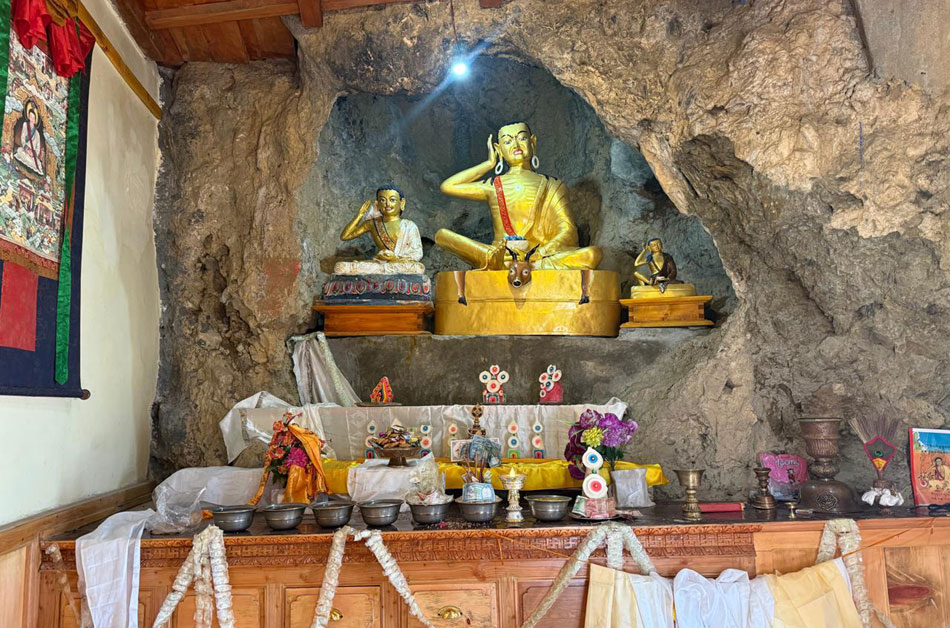
That distinction matters in Tsum because Mu Gompa, at around 3,700 meters, can be handled differently depending on the itinerary. Some routes include an overnight around the upper valley, while others visit Mu Gompa from a lower sleeping point and return. Two itineraries can therefore advertise a similar maximum altitude while giving trekkers different amounts of overnight exposure at elevation.
The approach through Chumling and Chhokang Paro also means that trekkers normally spend several days gaining elevation before reaching Nile and the upper valley. Tsum is not suddenly jumping from the low Budhi Gandaki corridor to Mu Gompa in one day.
Even so, we would not describe Tsum as a trek where altitude can be ignored. People respond differently once they begin sleeping higher, and being young, strong or experienced at lower elevations does not predict exactly how someone will feel in the upper valley. Changes in headache, appetite, sleep, energy and coordination need more attention than the pace somebody maintained earlier in the trek.
The Manaslu Circuit has a more consequential sleeping-altitude progression. After the lower route, trekkers reach Samagaon at around 3,530 meters, continue to Samdo at roughly 3,875 meters, and eventually sleep at Dharmasala at about 4,460 meters before attempting Larkya La.
That sequence is one of the main reasons we are cautious about very short Manaslu itineraries.
Samagaon should not be viewed simply as another overnight stop. On a properly paced circuit, spending an additional night here gives the body more time at roughly the same sleeping elevation before the route moves higher. Trekkers can still walk during the day, but they return to sleep lower rather than immediately carrying their sleeping altitude upward again.
Samdo deserves similar attention when evaluating an itinerary. From here, Dharmasala looks relatively close on a route map, but there is little benefit in reaching the lodge below the pass earlier than necessary if doing so means removing useful acclimatization time from the preceding days.
This is where comparing Manaslu itineraries only by total duration can be misleading. A shorter itinerary may save a day on paper, but where that day has been removed matters far more than the fact that the trek is one day shorter. Taking time from a lower section is not equivalent to removing time around Samagaon or Samdo.
The guide's role also changes as the group gets higher. Lower in the valley, conversations tend to revolve around walking pace, meals and the next lodge. Higher up, we pay much closer attention to how each trekker is eating, sleeping, communicating and recovering from the previous day. A person arriving first does not necessarily mean that person is adjusting best.
Which Trek Has a Higher Risk of Altitude Problems?
The Manaslu Circuit has greater altitude exposure than Tsum Valley. Trekkers sleep higher for several consecutive nights and must continue above 5,000 meters to cross Larkya La, whereas the standard Tsum route remains substantially lower.
For someone specifically concerned about spending several nights at high altitude, Tsum Valley is therefore the more conservative choice of the two. That should not be interpreted as zero altitude risk; individual responses vary, and symptoms in the upper valley still need to be taken seriously.
When comparing Tsum Valley and Manaslu Circuit itineraries, we would look at three things before being impressed by the advertised maximum altitude:
Where will you sleep? How quickly do the sleeping elevations rise? Where has the itinerary deliberately allowed time before going higher?
Those three answers reveal much more about the quality of the acclimatization plan than the maximum elevation printed beside the trek name.
What Kind of Rooms Are Available on Tsum Valley and Manaslu Circuit?
Twin-sharing teahouse rooms are the standard accommodation on both Tsum Valley and the Manaslu Circuit. A typical room has two separate single beds with mattresses, pillows and blankets, with enough floor space for trekking bags. Bedrooms are generally unheated; the dining room is usually the warmer place to sit in the evening.
Single rooms can sometimes be arranged when a lodge has enough space, but we would not promise one at every overnight stop. This becomes particularly important during the busy trekking seasons and in smaller villages where the total number of rooms is limited.
Tsum Valley has mostly simple twin rooms in locally run teahouses and guesthouses. As you travel farther from the main Manaslu trail, accommodation choices decrease and rooms remain functional rather than comfortable. In parts of the upper valley, some itineraries may also use small local lodges or homestay-style accommodation rather than the more established trekking lodges found on Nepal's busier routes.
Private attached bathrooms should not be expected as the normal standard in Tsum. Shared toilets are much more common, particularly farther into the valley.
The Manaslu Circuit has a wider range of rooms, but the standard changes considerably from village to village. Lower and more established stops can have simple twin rooms as well as a limited number of better rooms with attached toilets or bathrooms. Around Namrung, Lho and Samagaon, some lodges have improved enough that an attached-bathroom room may be available, although availability varies and these rooms can fill quickly during the main season.
The situation changes as you continue higher. Samdo has fewer choices, and Dharmasala should be approached with the simplest expectations of the entire circuit. Accommodation there exists primarily because trekkers need somewhere to sleep before crossing Larkya La. Rooms and beds are limited, bathrooms are shared, and depending on capacity and conditions, accommodation can be considerably less private than at the established villages lower down.
After crossing the pass, Bimthang generally brings a return to more conventional teahouse accommodation, with greater comfort and choice than Dharmasala.
For either trek, a warm sleeping bag remains important even when blankets are supplied. Having a bed and blanket does not mean the bedroom itself will be warm. Teahouse bedrooms generally do not have individual heating, particularly higher on the routes.
So if room comfort is part of your decision between the two treks, the practical difference is straightforward: Manaslu gives you more opportunities for upgraded rooms at selected villages, while Tsum is more consistently basic. Neither route should be chosen with the expectation of having a private bathroom every night.
Food, Wi-Fi and Charging on Tsum Valley vs Manaslu Circuit
Food is broadly similar on Tsum Valley and the Manaslu Circuit, but the range of choices usually narrows as you move farther from the main supply route. Manaslu generally offers better opportunities for Wi-Fi and charging in its larger villages, while Tsum requires more preparation for stretches where connectivity and electricity may be limited or unavailable.
What Food Is Available on Tsum Valley and Manaslu Circuit?
Teahouses on both routes serve the familiar meals found on remote treks in Nepal: dal bhat, noodles, fried rice, potatoes, soups, eggs, porridge, Tibetan bread and simple pasta dishes. Larger villages normally have longer menus, while smaller settlements may offer fewer choices or be temporarily missing ingredients printed on the menu.
That last point matters more than the number of dishes listed. Food has to move along the same access routes used by the trekking communities, and supply becomes slower and more expensive as you travel farther from the road. A ten-page menu therefore does not mean every dish is equally practical to order.
Dal bhat is one of the meals we rely on most during both treks. Rice, lentils and vegetables make a substantial meal after walking, it is prepared regularly in teahouse kitchens, and refills are commonly available. Guides and porters eating dal bhat repeatedly is not simply tradition; on a long trek, familiar food that the kitchen prepares every day is often the most dependable choice.
In upper Tsum, the difference in supply becomes easier to notice. By the time you are staying around Nile and the upper settlements, expecting the same ingredient choice available on the lower shared trail is unrealistic. Potatoes and other ingredients that can be sourced or stored locally become more prominent, while imported or perishable ingredients are less dependable.
The Manaslu Circuit follows a similar pattern but has more established trekking stops along its main corridor. Namrung, Lho and Samagaon normally give trekkers more choice than the highest part of the route. At Samdo and especially Dharmasala, we are much less interested in how extensive the menu looks; a warm, freshly prepared meal that is easy to eat before the next day's walk matters more.
Vegetarian travelers generally have plenty of workable choices on both routes. Vegan trekking is also possible, but it requires more attention because apparently simple dishes can contain milk, butter or egg. Explaining dietary requirements clearly before the trek gives the guide time to communicate them with lodge kitchens rather than trying to solve the same problem at every meal.
We are also cautious with meat in the more remote and higher settlements. Cold storage and transportation are not comparable with Kathmandu, and meat may have travelled for some distance before reaching the lodge. Many guides and experienced trekkers naturally prefer freshly cooked vegetarian meals higher on the route.
Is Wi-Fi Available on Tsum Valley and Manaslu Circuit?
Wi-Fi and mobile internet are available in some settlements, but neither trek offers reliable connectivity every day.
The Manaslu Circuit generally provides better opportunities to connect in larger villages along the established trekking route. Even there, internet quality can change quickly. Electricity problems, weather, network interruptions or the number of people trying to connect can turn a usable connection one evening into no connection the next.
This is even more important in Tsum Valley, where connectivity becomes less dependable as you travel farther from the main corridor. There can be a big difference between having enough signal to send a short message and having enough bandwidth for photographs, cloud uploads or a video call.
We therefore avoid telling trekkers, “You will have Wi-Fi at this lodge.” A connection that worked for our previous group is useful information, but it is not something we can guarantee for the next departure.
If staying in contact with family is important, tell them before leaving Kathmandu that a day or two without a message does not necessarily indicate a problem. Agreeing on that expectation before entering the mountains is much better than spending an evening walking around a village trying to find enough signal to send an update.
Neither route is suitable for someone who must have dependable internet access every evening for remote work or scheduled video meetings.
Can You Charge Phones, Cameras and Power Banks?
Charging is possible at many teahouses on both routes, usually for an additional fee, but you should not depend on finding an available socket every night.
Electricity may come from local hydropower, solar power or another limited local system. In some lodges there are sockets in rooms or the dining area; in others, devices are collected and charged from one shared point.
That becomes noticeable when a lodge is busy. Ten trekkers can easily arrive carrying ten phones plus watches, camera batteries and power banks, while the lodge may have only a few usable charging points. Having electricity and having enough charging capacity for everyone are two different things.
For Tsum Valley, carrying enough power-bank capacity to manage several trekking days gives you more flexibility if electricity is unavailable or charging points are already occupied.
The same applies on the upper Manaslu Circuit. A good charging opportunity in Samagaon should not be interpreted as a guarantee that the same facilities will be available at Samdo or Dharmasala.
Cold weather can also shorten usable battery life, particularly higher on Manaslu. Keep phones, camera batteries and power banks insulated from the cold when they are not being used, and start the trek with unnecessary background activity and battery-heavy functions switched off if power conservation matters to you.
For either trek, our approach is simple: charge when you have a good opportunity rather than waiting until the battery is almost empty.
Overall, the Manaslu Circuit has a slight advantage for food choice, connectivity and electricity because several of its villages have more developed trekking infrastructure. Tsum is more limited, particularly farther into the valley, but these limitations are straightforward to manage with realistic expectations, spare battery capacity and some flexibility around meals.
On both routes, food can be planned; Wi-Fi cannot be promised; and charging should be used when available rather than assumed for later.
Tsum Valley vs Manaslu Circuit Trek Duration: How Many Days Do You Need?
When comparing the Tsum Valley and Manaslu Circuit trek duration, the number of days shown in the package title tells only part of the story. Both routes can be shortened by changing transport, combining walking stages or removing additional days, but those changes do not have the same effect on the trekking experience.
A standalone Tsum Valley Trek commonly takes roughly 12 to 15 days when Kathmandu travel and the normal approach and return are included, although shorter and longer versions exist. The Manaslu Circuit is commonly completed in roughly 12 to 14 days from Kathmandu on modern itineraries using the current road access. In both cases, the better way to compare two itineraries is to look at where the nights are spent rather than assuming that the itinerary with more days must automatically be better.
How Many Days Do You Need for Tsum Valley?
Tsum Valley deserves enough time to reach the upper settlements without turning every day into a race for the next teahouse. Most itineraries follow the shared lower approach before leaving the main Manaslu route, continuing through Chumling and Chhokang Paro toward the upper valley, Nile and Mu Gompa, and eventually returning toward the Budhi Gandaki corridor.
Because the route returns through part of the same valley, it is relatively easy to make a Tsum itinerary look shorter on paper. Two moderate walking stages can be combined, time around an intermediate village can disappear, or the return can be pushed into longer days because the trail is already familiar.
We would look more carefully at what that saved day costs the trekker.
For example, arriving at Chhokang Paro toward the end of the afternoon and leaving early the following morning technically gives you an overnight there, but very little time to look around the settlement. The same problem occurs higher in the valley if Mu Gompa becomes nothing more than a point that has to be reached before immediately beginning the return.
This matters more in Tsum than travelers sometimes expect because the villages and monasteries are not simply stops between major mountain objectives. Time spent around Chhokang Paro, Rachen Gompa, Nile and the upper valley is part of what makes the route worth taking. An itinerary can therefore reach exactly the same geographical turnaround point as another itinerary and still provide a noticeably thinner Tsum experience.
That does not mean adding days automatically improves the trek. An extra night with no clear purpose is just an extra night. What we want is enough time that normal delays, a longer monastery visit, a slow lunch or an interesting stop in a village do not immediately put the group behind schedule.
For most trekkers, that is a better measure of a Tsum itinerary than trying to find the shortest version available.
How Many Days Do You Need for the Manaslu Circuit?
Modern Manaslu Circuit itineraries commonly take around 12 to 14 days from Kathmandu, although the route has been operated in both shorter and considerably longer forms. Road development has changed where trekking begins and ends, so comparing today's itinerary length with an older Manaslu itinerary is not always meaningful.
The important question is where a shorter itinerary saves its time.
Saving several hours through a different road transfer at the beginning or end of the trip does not affect the mountain section in the same way as removing an overnight higher on the circuit. Likewise, combining two manageable lower-valley stages is a different decision from compressing the progression through Samagaon and Samdo.
When we compare Manaslu itineraries, Samagaon is one of the first places we check. If a 12-day itinerary has reached that duration through efficient transport and sensible lower stages while still protecting the important upper pacing, the shorter trip can work well. If it has become shorter mainly by pushing the higher section faster, the attractive package length is less convincing.
The same applies to Samdo. It is tempting to look at the distance between overnight stops and decide that another day can easily be removed, but the upper circuit should not be planned using distance alone. By this stage, the itinerary has a different purpose from the lower Budhi Gandaki days, and simply combining stages because the kilometer count looks manageable can change the quality of the schedule.
This is why we would never say that a 14-day Manaslu Circuit is automatically better than a 12-day Manaslu Circuit. A poorly arranged 14-day trek can waste time in places where another night adds little, while a carefully planned 12-day itinerary can use the available days efficiently. The sequence matters more than the headline duration.
Does a Shorter Itinerary Save Much Money?
A shorter trek can reduce the cost of guide services, accommodation and meals, but saving one trekking day should not be treated as an important financial victory if it creates an unnecessarily rushed itinerary.
For an international traveler who has already paid for flights to Nepal, permits, transport, trekking staff and equipment, the saving from removing a single teahouse night is relatively small compared with the value of having the right amount of time on the route.
On Tsum, excessive compression usually costs time inside the valley. You may still reach the same places, but there is less room to stop when something interesting is happening or spend longer around a monastery or village.
On Manaslu, the concern is different. Saving time through road logistics or the lower route may be perfectly reasonable, whereas removing time from the upper progression deserves much more scrutiny.
This is the practical difference between making an itinerary efficient and simply making it short.
Which Trek Is Better If You Have Limited Time?
If you have limited holiday time, start by calculating how many complete days you actually have in Nepal rather than comparing package titles alone. Arrival time in Kathmandu, road travel to the trail, the return journey and some margin before an international flight all need to fit around the trekking days.
For Tsum Valley, we would want enough time remaining for the upper valley to feel like the purpose of the trip rather than somewhere you reach briefly before turning around. If every village visit has to be shortened simply to keep the schedule moving, choosing a shorter Nepal trek may provide a better experience.
For the Manaslu Circuit, we would examine whether the available itinerary still preserves a sensible progression through the upper route. Cutting a transport day through better logistics is one thing; repeatedly pushing the mountain stages together to fit a fixed flight date is another.
This becomes particularly important when travelers try to use every available holiday day for trekking and plan to reach Kathmandu immediately before an international departure. Mountain roads, weather and trail conditions do not work to airline schedules, so keeping some buffer after either trek is more useful than squeezing one additional trekking day into an already tight holiday.
If your available time forces either route to be rushed from beginning to end, we would choose a different trek rather than sell Tsum Valley or the Manaslu Circuit as something that simply needs to be completed faster.
The right duration is therefore not the shortest itinerary that can physically reach the destination. It is the shortest itinerary that still preserves the parts of the route you travelled to Nepal to experience.
Best Time for Tsum Valley vs Manaslu Circuit Trek
Spring from March to May and autumn from September to November are the main trekking seasons for both Tsum Valley and the Manaslu Circuit, but choosing between them requires more than looking for the month with the clearest weather. Manaslu becomes increasingly dependent on conditions around Larkya La as the season moves toward winter, whereas Tsum reaches its upper valley without requiring a 5,000-meter pass crossing. That difference matters most in early spring, late autumn and winter, when two departures only a few weeks apart can encounter very different conditions higher in the mountains.
If we had complete freedom to choose dates, April, October and the first part of November would normally sit near the top of our list for either route. March and later November can also be excellent, but at those edges of the season we would pay much more attention to recent snowfall, overnight temperatures and reports from the upper trail than to the month printed on the itinerary.
Tsum Valley vs Manaslu Circuit in Spring
Spring develops gradually in these valleys, which is why a March departure should not be planned as though winter conditions have already disappeared from the upper route. Kathmandu may be warming and the lower Budhi Gandaki may feel comfortable during the day while shaded ground, frozen water and old snow remain several days ahead at higher elevations.
This difference is more important on the Manaslu Circuit because the trek eventually has to continue beyond Samdo to Dharmasala and across Larkya La. When a group is approaching that section in early spring, we are interested in what has happened on the pass recently, not simply whether the forecast shows sunshine over the lower valley. A spell of clear weather after snowfall can still leave compacted snow or ice on sections of the crossing, while strong wind can make an otherwise clear morning considerably more demanding.
Tsum is not automatically warm or snow-free at the same time of year. The upper valley around Nile and Mu Gompa can remain very cold, particularly overnight and in shaded areas, but the itinerary has a different margin for adjustment because it does not have to cross Larkya La in order to complete the trek. If conditions farther up the valley are unsuitable, the route can be reconsidered without leaving a group committed to completing a high-pass circuit.
By April, both treks normally feel much more settled into spring. The lower approach becomes greener, daylight is longer, and the contrast between the forested Budhi Gandaki section and the increasingly open upper valleys becomes more pronounced. On Manaslu, this is a particularly rewarding period for moving through Lho and Shyala toward Samagaon before eventually approaching the pass.
May requires a slightly different expectation. The first half can still produce excellent trekking days, but as pre-monsoon weather develops, afternoon cloud and occasional showers become more relevant. On days when mountain visibility matters, we would rather have the group moving early and use a clear morning well than build the day's plan around the hope that the mountains will remain open throughout the afternoon.
Tsum Valley vs Manaslu Circuit in Autumn
Autumn is the easiest season to recommend to someone choosing either trek for the first time, particularly after the monsoon has withdrawn and the trails have had time to settle. October normally provides one of the strongest combinations of mountain visibility, workable temperatures and dependable trail conditions, but it is also when the difference in trekking traffic between the two routes becomes easiest to notice.
On the shared lower trail, Tsum and Manaslu trekkers may still be moving through the same villages. After the turn toward Lokpa and the Tsum Valley, however, groups leave the main circuit corridor and the trail usually becomes noticeably quieter. For someone who can travel only in October but is concerned about meeting many trekking groups, that is a practical reason to consider Tsum rather than abandoning the autumn season altogether.
October creates a different operational concern on Manaslu. Groups progressing through Samagaon and Samdo often reach the limited accommodation around Dharmasala on similar schedules before Larkya La. The weather may be excellent, yet room availability and the number of trekkers preparing for the pass can make that night feel much busier than the quieter sections experienced earlier in the circuit.
By November, the number of trekkers usually begins to decrease, while cold becomes a more important part of the daily routine. The change is particularly noticeable on Manaslu because the Larkya La crossing begins before sunrise. A temperature that appears manageable in a daytime forecast can feel very different when the group leaves Dharmasala in darkness and spends the first hours walking before direct sunlight reaches the trail.
This is one reason we distinguish early November from late November instead of describing the entire month with one weather label. A departure during the first week and one during the final week may both be called “autumn Manaslu,” yet the amount of daylight, overnight cold and possibility of fresh snow can be quite different.
Upper Tsum also becomes cold as November progresses, especially around Nile and toward Mu Gompa, but there is no equivalent morning when the success of the route depends on getting an entire group across a high pass. For travelers choosing between the two toward the end of autumn, that difference deserves more weight than a generic monthly temperature range.
Winter and Monsoon: Which Trek Gives You More Flexibility?
Winter trekking is possible in these regions under suitable conditions, but Tsum Valley gives an itinerary more flexibility because there is no Larkya La crossing required to complete the standard route. That makes it the more practical of the two to consider for travelers deliberately planning outside the main season, although it does not turn Tsum into an easy winter trek.
The upper valley can be extremely quiet in December, January and February, and that quietness comes with practical consequences. Some lodges may operate differently when there are very few trekkers, water can freeze overnight, sunny and shaded sides of the valley can feel surprisingly different, and services that are easy to find during October should not automatically be expected in midwinter.
For the Manaslu Circuit, we would want recent information about Larkya La before treating a winter departure as a normal circuit. Snowfall can make the crossing substantially slower or temporarily impractical, and conditions higher on the route cannot be judged reliably from what is happening in Kathmandu or even from the first few days beside the Budhi Gandaki. A trail may not be officially closed, yet the combination of pass conditions, lodge operation and recent snowfall can still determine whether completing the normal circuit is sensible at that particular time.
From roughly June through August, the concern changes from snow and cold to the effect of prolonged rain on the approach and lower trail. Both routes begin with road travel followed by lower-valley trekking, and monsoon rain can affect road conditions, create muddy or damaged trail sections, raise streams and introduce delays before a group reaches the upper valleys.
Persistent cloud also affects the value of the two journeys differently. Someone choosing Manaslu primarily to watch the landscape open around Lho, Shyala and Samagaon before eventually crossing Larkya La loses an important part of the reason for choosing the circuit if the mountains remain hidden for several days.
Tsum retains more of its character at ground level. Chumling, Chhokang Paro, the cultivated valley, monasteries and upper settlements remain part of the journey even when cloud covers the highest peaks. That does not make Tsum a route we would actively recommend for the monsoon, because access and trail conditions still matter, but poor mountain visibility does not remove as much of its central purpose.
For someone asking us to choose rather than simply list seasons, April and October are the easiest months to recommend across both routes, with early November also particularly strong when colder mornings are acceptable. Tsum gains a slight advantage toward the edges of the normal season because completing the valley does not depend on Larkya La, while Manaslu remains the stronger choice when the pass is in good condition and the purpose of the journey is the full high-mountain circuit.
We would therefore never choose a departure date from a weather table alone. Close to winter, we want recent information from the upper trail; after prolonged rain, we also want to know what has happened to the approach road and lower sections. A monthly climate average cannot tell us whether snow fell on Larkya La three days ago or whether overnight rain has delayed vehicles below the trailhead.
The season gets you into the right general window; recent conditions tell you what trek you are actually going to find when you arrive.
If you are considering both routes in one journey, our guide to the best time to trek Manaslu Circuit with Tsum Valley looks more closely at seasonal conditions across the combined route.
Tsum Valley vs Manaslu Circuit Permits and Guide Requirements
Although Tsum Valley and the Manaslu Circuit share part of the same approach through the Budhi Gandaki Valley, they are treated as separate restricted areas for trekking permits. A traveler entering Tsum therefore needs the permit arrangement for Tsum Valley, while someone continuing around Manaslu needs the permits covering the Manaslu Circuit. If you plan to combine both, the paperwork has to be prepared for the complete route rather than assuming one restricted-area permit opens every trail in the region.
For trekkers, this sounds more complicated than it normally is. The agency handles the permit application before departure, while the traveler provides the required passport and trip information. Where the distinction becomes important is when someone wants to change the route after the paperwork has already been prepared.
What Permits Do Tsum Valley and Manaslu Circuit Require?
A standard Manaslu Circuit requires the Manaslu Restricted Area Permit (RAP) for the restricted section, together with the conservation-area permits needed as the route continues through the Manaslu and Annapurna conservation areas. Tsum Valley has its own Restricted Area Permit, which is separate from the permit used for the main Manaslu restricted area.
That difference is easy to miss when looking at a trekking map. Both journeys initially use the same general approach, and from the trail the Tsum route can appear to be simply another valley branching away from the main corridor. From the permit side, however, entering Tsum means entering a separately regulated restricted area for which the correct permission needs to have been arranged.
For a standalone Tsum journey, the permit application is prepared around the Tsum itinerary. For a standard circuit, it is prepared around Manaslu. If the traveler intends to enter Tsum, return toward the shared trail and then continue around Manaslu, the trip needs to be organized as a combined route rather than assuming the paperwork for one trek automatically covers the other.
On the trail, the guide deals with permit checks as the group progresses. For most trekkers this is simply a short pause while documents are presented, but from the operator's side it is one reason we want the intended route settled before leaving Kathmandu.
There is still room to adjust normal trekking days when weather, pace or another practical issue requires it. Spending an additional night in a village already on the route, however, is not the same as deciding to enter another restricted valley. A Manaslu Restricted Area Permit should therefore never be interpreted as permission to trek anywhere within the wider Manaslu region.
This distinction is also useful when comparing packages. A standard Manaslu Circuit and a Manaslu Circuit with Tsum Valley may share several trail sections, but the combined trek changes both the number of walking days and the restricted areas being entered. When an operator says that “all permits are included,” the useful question is whether those permits correspond to the exact itinerary being sold.
Can You Trek Independently or Change the Route After Starting?
Tsum Valley and Manaslu are restricted trekking areas, so foreign trekkers should not plan them in the same way as an unrestricted teahouse route where they simply arrive at the trailhead and walk independently. Restricted-area permits are arranged through an authorized trekking agency, and the guide remains involved with the group's documents and movement through the permitted route.
On the ground, that role extends beyond carrying a permit folder. The guide handles checkpoints, communicates with lodges and responds when weather, trail conditions or a trekker's pace requires an adjustment. On a combined journey, the group enters Tsum, returns toward the shared corridor and then continues north through the Manaslu villages, so the person leading the trek needs to understand how that movement corresponds with the itinerary arranged before departure.
The question becomes particularly important when someone starts the Manaslu Circuit and later decides that they would like to add Tsum. Geographically, the idea can look straightforward because the trails connect, but an existing Manaslu permit should not be assumed to provide permission to walk into Tsum Valley.
If Tsum is something you are seriously considering, tell the trekking company before the restricted-area permits are processed. Organizing the combined route correctly in Kathmandu is much more straightforward than reaching the lower trail and then trying to turn a Manaslu-only itinerary into a different restricted-area journey.
The same principle works in reverse. A traveler visiting Tsum should not assume that returning to the shared corridor gives them permission to continue north and complete the Manaslu Circuit.
For the traveler, none of this is a reason to choose one trek over the other. A properly arranged standalone Tsum trek and a properly arranged Manaslu Circuit both have straightforward permit procedures from the client's side. The important decision needs to be made earlier: Are you trekking Tsum, completing the Manaslu Circuit, or genuinely planning to combine both?
Once that is clear, the paperwork is normally the straightforward part. The mistake is assuming that because the trails connect on the map, the restricted-area permits are interchangeable.
Tsum Valley vs Manaslu Circuit Trek Cost: Which Is More Expensive?
There is no reliable rule that Tsum Valley is always cheaper than the Manaslu Circuit because the final cost depends on the itinerary length, group size, transport arrangement, porter support and permits required for the route actually being trekked. A shorter standalone Tsum itinerary can cost less than a complete Manaslu Circuit, while a longer Tsum journey with additional time in the upper valley can come surprisingly close. Once Tsum and Manaslu are combined into one trek, the total cost naturally becomes higher because the guide and trekking crew remain on the trail for considerably longer and the trip enters both restricted areas.
Solo travelers who prefer to share the trail experience can also check our Manaslu Circuit Group Join Trek for scheduled departures, the group itinerary and what is included.
When we compare quotations, the number of trekking days is the first detail we look at rather than the headline price. Two operators can advertise the same trek name while selling itineraries of different lengths, and every additional day affects guide wages, accommodation, meals and, when used, porter costs. On Tsum this difference often comes from how much time the itinerary allows in the upper valley, whereas on Manaslu it may come from the lower approach, acclimatization schedule or the way the journey is completed after crossing Larkya La.
Transport can create an equally noticeable difference. Tsum and Manaslu use the same general approach from Kathmandu before their walking routes separate, but reaching the trail by local transport, a shared jeep or a private jeep produces very different per-person costs. A private vehicle is particularly noticeable in a quotation for one or two trekkers because almost the entire vehicle cost is being carried by those travelers; with five or six people in the jeep, the same expense is divided across the group.
We see the same effect with guides. A guide leading one private traveler still has to be paid for each day of the trek, while a group of several trekkers can divide that cost. This is one reason a confirmed group departure on the Manaslu Circuit can sometimes have a lower per-person price than a private Tsum Valley trek, even though Manaslu includes the high-pass section and may have a similar or longer overall itinerary.
Porter support needs to be checked in the same way. One package may include a porter within the advertised price, another may make porter service optional, and a third may calculate the number of porters after the final group size is known. Comparing those three headline prices without checking the porter arrangement can make the cheapest package appear better value when it is simply providing less support.
Season also changes part of the calculation because restricted-area permit fees vary according to the trekking period, but we would not expect the entire trek to become dramatically cheaper just because it operates outside the busiest months. Guides and porters still need to be paid, vehicles still have operating costs, and the group still needs accommodation and meals. In quieter periods, reduced transport frequency or limited lodge operation can occasionally make logistics less convenient rather than cheaper.
Small expenses encountered in the teahouses should be kept in perspective. Charging, Wi-Fi where available, hot showers, snacks and additional drinks can add to personal spending, but these are normally not what creates a major difference between two package quotations. If one Manaslu trek is several hundred dollars more expensive than another, we would first compare trip length, private transport, group size, porter support and included services before looking at whether one company includes a few minor lodge expenses.
Is Combining Tsum Valley and Manaslu Circuit Better Value?
A combined Tsum Valley and Manaslu Circuit trek costs more than choosing either route alone, but it can make very good financial sense for someone who genuinely wants to experience both.
The efficiency comes from the geography of the journey. Once you have travelled from Kathmandu into the Budhi Gandaki corridor, you can leave the main route for Tsum, explore the valley, return toward the shared trail and then continue north around Manaslu. You are paying for additional trekking days and the permits required for the combined route, but you are not returning to Kathmandu and later paying for another complete journey back into the same region.
That distinction matters when deciding whether the longer trek represents good value. If you already know that you want Tsum's villages and monasteries as well as the high-mountain progression and Larkya La crossing of Manaslu, combining them is usually more logical than treating them as two separate Nepal trips.
If only one of those experiences interests you, the calculation changes. Someone whose priority is the inhabited valley and monastery experience does not gain better value merely by adding the entire Manaslu Circuit, while a trekker coming specifically for the circuit and Larkya La should not add several Tsum days simply because a longer itinerary appears to offer more for the money.
The best-value itinerary is therefore the one in which the additional days are spent on something you actually came to Nepal to experience, rather than the one with the lowest mathematical cost per trekking day.
How Should You Compare Trek Prices Before Booking?
When two Tsum or Manaslu quotations look very different, compare what is behind the price before comparing the price itself. We would put the itineraries beside each other and check the total trekking days, route and permits, group size, guide and porter arrangement, trailhead transport, accommodation and meals, and any major service that has been moved into the exclusion list.
This becomes particularly important with unusually inexpensive packages. A low price does not automatically indicate poor service; a company may be using shared transport efficiently, operating a confirmed group departure or selling a genuinely shorter itinerary. What matters is whether the reason for the lower price is visible.
The same applies to an expensive quotation. Private road transport, a dedicated guide, porter support and additional trekking days all have real operating costs, so a higher price can be completely reasonable when those services are genuinely included.
For that reason, we would not choose between Tsum Valley and the Manaslu Circuit by asking only “Which trek is cheaper?” A more useful question is: “If I put these two itineraries side by side, what am I actually receiving for the difference in price?”
That comparison usually tells you far more about value than the headline figure on the package page.
Tsum Valley vs Manaslu Circuit: Which Is Better for First-Time Trekkers?
For most first-time trekkers in Nepal, Tsum Valley is the more forgiving choice, while the Manaslu Circuit is better suited to someone who already has strong multi-day hiking experience and specifically wants a high-pass journey. Being new to trekking in Nepal does not automatically make Manaslu unsuitable; what matters more is whether you are also new to consecutive mountain days, basic teahouse living and walking at high elevation.
We have met trekkers arriving in Nepal for the first time who are already comfortable spending a week or more hiking in the Alps, Andes or other mountain regions. For them, the unfamiliar part may be Nepal's teahouse system, road journey and daily trekking routine rather than the physical act of walking for several hours. A well-paced Manaslu Circuit can still be a realistic first Himalayan trek for someone with that background.
The situation is different for a traveler whose longest previous experience is an occasional day hike. On both routes, waking up and walking again after five or six consecutive days feels different from completing one difficult hike and recovering at home the next morning. By the middle of the trek, small things such as how much you carried in your daypack, whether your boots created a hot spot, how well you slept and whether you ate enough at breakfast begin to influence the following day's pace.
Tsum gives a first-time trekker more room to learn that rhythm without having the whole journey build toward Larkya La. The trail still asks for sustained effort, remote accommodation and several days away from road access, but a slower day does not carry the same consequence as it can when a Manaslu group is progressing through the final upper stages toward a high-pass crossing.
That difference is why we would not decide between these treks from fitness alone.
When Is Tsum Valley the Better First Trek?
Tsum is particularly well suited to someone who wants their first Nepal trek to feel like a journey through a living Himalayan valley rather than a challenge organized around reaching a high pass. There is still plenty of walking, and the repeated climbs between settlements can surprise people who imagine a valley trek will remain beside a flat river, but the physical demands are distributed more evenly through the journey.
It also gives a new trekker time to become familiar with the routines that experienced Nepal trekkers barely think about anymore: packing before breakfast, keeping rain and warm layers accessible rather than buried inside the duffel, filling water before leaving the lodge, eating when appetite is available and starting slowly instead of trying to match the fastest person during the first hour.
Those details sound small in Kathmandu. After a week on the trail, they are often what separate a comfortable trekking routine from a group that spends every morning searching through bags and every afternoon trying to recover from starting too quickly.
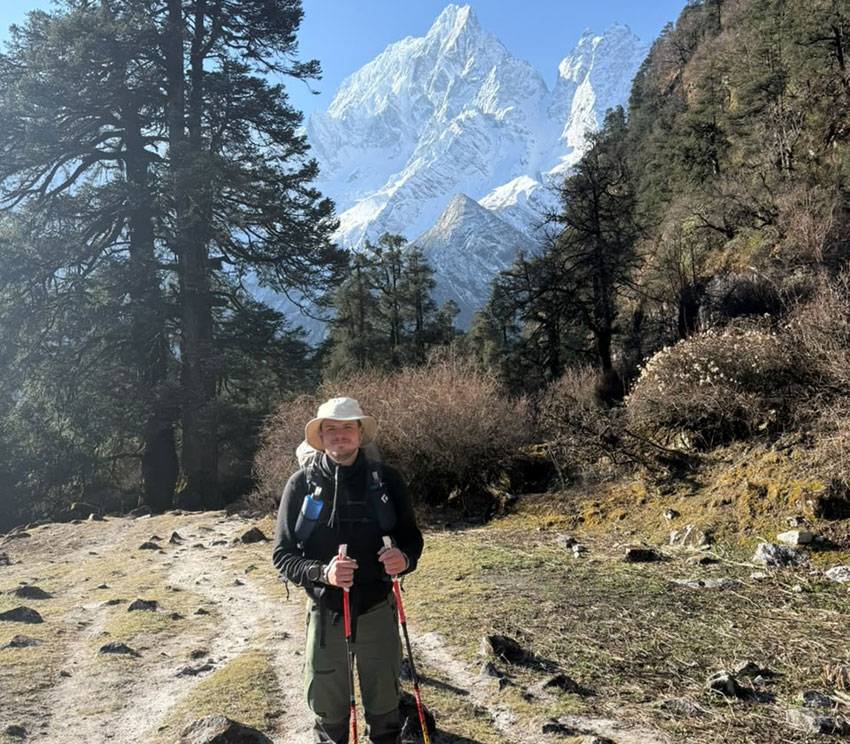
Tsum also gives more freedom to stop for reasons that have nothing to do with walking performance. If a monastery visit takes longer than expected, somebody begins talking with the group in a village, or lunch simply takes time to arrive, the day does not feel as though every delay is stealing minutes from preparation for a major pass.
For a first-time trekker who is more interested in the experience of travelling through the mountains than proving they can complete the hardest possible itinerary, that makes Tsum a very sensible introduction to trekking in Nepal.
When Can Manaslu Be a Good First Nepal Trek?
We would not discourage someone from Manaslu simply because it is their first visit to Nepal. We would instead ask what they have done before.
A person who regularly hikes long mountain days, has completed multi-day routes carrying a pack and understands how their body responds when several demanding days are placed together may be much better prepared for Manaslu than someone who has previously visited Nepal but rarely walks.
What changes on the Manaslu Circuit is that the trek becomes less forgiving of poor habits as the route moves higher. Starting too quickly, skipping meals because breakfast does not look appealing, carrying unnecessary weight or treating every walking day as a competition may cause little trouble beside the lower Budhi Gandaki, but those habits become harder to hide once the group reaches the upper circuit.
A first-time Manaslu trekker should also be comfortable with the fact that Larkya La is not an optional viewpoint visited only if everybody feels energetic that morning. It is the passage that takes the circuit from the Manaslu side toward Bimthang. By the time the group reaches Dharmasala, the previous days have been preparing for that crossing, which gives the journey a different commitment from walking into Tsum and returning through the valley.
For the right person, that is exactly why Manaslu can make such a memorable first trek in Nepal. The route develops gradually, the surroundings change dramatically as you move north, and the pass gives the journey a clear physical objective rather than simply a turnaround point.
For the wrong person, choosing Manaslu because it sounds more adventurous can turn the final part of the trek into something to endure rather than enjoy.
Our decision would therefore be straightforward: choose Tsum Valley if you want the more forgiving introduction to remote trekking in Nepal; choose the Manaslu Circuit if you already trust your multi-day hiking ability and specifically want the commitment of a high Himalayan circuit.
Your passport may say it is your first trek in Nepal. Your previous days in the mountains tell us much more about which of these two routes is right for you.
Can You Combine Tsum Valley and Manaslu Circuit?
Yes. Tsum Valley and the Manaslu Circuit can be combined into one continuous trek, and for travelers who genuinely want both the cultural depth of Tsum and the high-mountain journey around Manaslu, combining them makes more sense than visiting the region twice. The routes share the lower Budhi Gandaki approach before Tsum branches away from the main Manaslu corridor, allowing the valley to be explored first and the circuit to continue afterward.
On the trail, the combined journey does not feel like completing one trek and starting another. You follow the Budhi Gandaki into the region, leave the main corridor toward Lokpa and enter Tsum, travel through the valley toward its upper settlements, and then retrace part of that route until you reconnect with the trail used for the Manaslu Circuit.
From there, the character of the journey changes. Instead of returning toward the road after Tsum, you continue north through the Manaslu villages, eventually reaching Lho, Shyala and Samagaon before moving higher toward Samdo, Dharmasala and Larkya La. After the pass, the descent toward Bimthang takes you onto the western side of the circuit.
If you already know that you want both experiences, see our Tsum Valley and Manaslu Circuit Trek for the complete combined route and day-by-day itinerary.
That transition is what makes the combination interesting. Tsum does not simply add more days to Manaslu; it adds a different kind of journey before the high-mountain section begins. The first part gives considerably more time to villages, cultivated landscapes, monasteries and the upper Tsum Valley, while the second gradually shifts the emphasis toward altitude, larger mountain scenery and eventually the pass crossing.
There is also a practical advantage. Because both routes use the same general approach, combining them avoids travelling from Kathmandu into the region for a Tsum trek, returning to the city, and then making another long road journey back toward the Manaslu trail. You still pay for the additional trekking days and the arrangements required for both restricted areas, but the geography makes a single continuous journey much more logical than treating them as two completely separate trips.
How Many Days Do You Need for Tsum Valley and Manaslu Together?
A combined trek needs more time than simply adding a quick Tsum detour to a normal Manaslu itinerary. The purpose of going into Tsum is lost if the valley is compressed into a race to the uppermost point and back simply so the group can rejoin the circuit as quickly as possible.
This is where we would be careful with a very short combined itinerary. The first days can feel manageable because the route is still relatively low, and it can be tempting to save time by joining stages together. The problem is that the trek eventually has to continue into the higher Manaslu section, where the pace should become more deliberate rather than more aggressive.
By the time a group returns from Tsum and begins progressing toward Samagaon and Samdo, the legs have already accumulated many days of walking. That does not automatically make the second half too difficult, but it changes how we judge the itinerary. A walking day that looks ordinary on paper may feel different after the group has already spent well over a week on the trail.
For most travelers, roughly three weeks or slightly longer is a more natural framework for combining Tsum Valley with the complete Manaslu Circuit, although the exact number of days depends on where the trek begins and ends, transport arrangements, time spent in Tsum and the acclimatization schedule used on Manaslu.
We would protect the important upper Manaslu pacing rather than shorten it simply because several days have already been spent in Tsum. If days need to be saved, it makes more sense to examine the road transfers and lower walking stages first than to remove the time that helps the group arrive at the higher section properly prepared.
Who Should Combine Tsum Valley and Manaslu Circuit?
The combined route works best for someone who looks at the comparison between Tsum and Manaslu and thinks, “Those are exactly the two experiences I want from the trip.”
If monasteries, traditional settlements and the quieter upper valley are important to you, but you also want the progression through Samagaon and Samdo and the experience of crossing Larkya La, choosing only one route inevitably means giving up a major part of the other. With enough time, the combined trek removes that compromise.
It also suits travelers who prefer one substantial Himalayan journey over several shorter treks. Once you have adjusted to the daily rhythm of walking, lodge life and travelling with the same trekking crew, continuing into Manaslu can feel more natural than returning to Kathmandu just as you have settled into life on the trail.
The combination is less convincing when it is chosen simply because a longer itinerary appears more impressive. Someone whose real interest is Tsum's villages and monasteries does not need to cross Larkya La to make the journey complete, while someone primarily dreaming about the Manaslu Circuit may prefer to keep the trek focused rather than add a week or more in a valley they were not particularly interested in visiting.
Time matters as well. We would rather see someone trek one of these routes properly than combine both by removing the days that give each journey its character. Tsum needs enough time that its villages and monasteries do not become checkpoints on a schedule, while Manaslu needs a sensible progression into the upper circuit rather than a rushed approach to the pass.
For the traveler who has the time and genuinely wants both experiences, however, Tsum Valley with the Manaslu Circuit is not merely a longer version of either trek. It is one continuous journey that begins with the inhabited, culturally rich valleys east of the main corridor and finishes with the high-altitude commitment of crossing Larkya La toward Bimthang.
That is the strongest reason to combine them: not because doing both gives you a longer trekking résumé, but because the character of the journey changes as you move through it, and you experience both sides of the Tsum versus Manaslu decision instead of having to choose between them.
Tsum Valley vs Manaslu Circuit: Which Trek Is Right for You?
Choose Tsum Valley if the part of trekking you value most is time spent inside traditional villages, around monasteries and seeing how people live in a remote Himalayan valley. Choose the Manaslu Circuit if you want the landscape to become progressively bigger and higher until the journey reaches Larkya La and crosses to the other side of the mountains. If both experiences matter equally and you have roughly three weeks or slightly longer, combining Tsum and Manaslu allows you to experience both in one journey.
When someone asks us which of these treks is better, we normally try to understand what they imagine when they think about their trip to Nepal. If the first thing they describe is standing beneath enormous mountains, reaching high alpine terrain and completing a Himalayan pass, we would usually point them toward Manaslu. Tsum has beautiful mountain surroundings, but choosing it while secretly wishing for the scale and progression of the Manaslu Circuit can leave the trekker feeling that an important part of the journey was missing.
Sometimes a traveler initially asks us about Manaslu, but once we discuss what they actually want from the trek, they describe quiet walking, traditional settlements, Buddhist monasteries and enough time to notice life along the trail rather than a journey built around a high pass. For that person, Tsum may be the better trek even though it does not reach the same altitude or deliver the same mountain scale.
Time can settle the decision quickly. If your Nepal schedule comfortably fits only one route, we would rather match that route properly to your interests than squeeze Tsum and Manaslu together and remove the days that make the combined journey work. If you have enough time for both, the question becomes whether the additional days in Tsum are days you genuinely want rather than days added simply because a longer itinerary looks more impressive.
Your attitude toward uncertainty higher in the mountains matters too. Some trekkers enjoy knowing that the route is gradually leading toward a major crossing and accept that snow, wind, cold and the condition of the pass may influence an important day. That commitment is part of the attraction of Manaslu. Others want a remote Himalayan journey but would prefer not to have its completion tied to crossing Larkya La. Tsum gives them that option without turning the trip into a short or easy walk.
We would also think about what you have enjoyed on previous trips. A traveler who repeatedly talks about mountain passes, long walking days and the satisfaction of reaching the other side of a range is giving us a strong clue toward Manaslu. Someone who remembers the family they met in a village, an unexpected monastery visit or an afternoon spent watching daily life is often describing exactly the kind of experience Tsum provides more consistently.
There is no need to choose Manaslu simply because it is physically harder, and there is no reason to choose Tsum simply because it is quieter. The better trek is the one whose strongest part matches the reason you are travelling to this region in the first place.
If we had to reduce the entire comparison to one decision, it would be this:
Choose Tsum Valley if you want the journey to become more focused on villages, monasteries and life in the upper valley as you move farther in. Choose the Manaslu Circuit if you want the journey to become higher and more alpine as you approach Larkya La. Choose both when you have enough time and genuinely want to experience that change from one style of trekking into the other.
That is a more useful way to choose than asking which trek is more famous, which reaches the higher altitude or which one looks harder on paper. Several weeks after returning home, those numbers are unlikely to be what you remember most. The better choice is the route whose days on the trail are closest to the experience you wanted when you decided to trek in Nepal.
Once you know which style of journey fits you, compare the full Tsum Valley Trek and Manaslu Circuit Trek itineraries before deciding how many days to allow.
Tsum Valley vs Manaslu Circuit Trek FAQs
1. Should I choose Tsum Valley or the Manaslu Circuit?
Choose Tsum Valley if traditional villages, Buddhist monasteries, quieter trails and time inside an inhabited Himalayan valley matter most to you. Choose the Manaslu Circuit if your priority is bigger mountain scenery, increasingly alpine terrain and crossing Larkya La. If you genuinely want both experiences and have roughly three weeks or slightly longer, the two routes can be combined into one continuous trek.
2. Which is harder, Tsum Valley or the Manaslu Circuit?
The Manaslu Circuit is harder overall. Tsum still involves consecutive walking days, stone steps and repeated climbs and descents, but Manaslu takes you much higher and eventually requires the Larkya La crossing. The early departure from Dharmasala, prolonged time at high elevation and long descent toward Bimthang make the pass day something Tsum does not have an equivalent to.
3. Which has better mountain views, Tsum Valley or Manaslu?
Choose the Manaslu Circuit if big mountain scenery is one of your main reasons for trekking in Nepal. The landscape opens considerably around Lho, Shyala and Samagaon before becoming increasingly alpine toward Samdo, Dharmasala and Larkya La. Tsum has beautiful Himalayan surroundings too, but its scenery is more closely connected with villages, cultivated slopes, monasteries and the shape of the inhabited valley.
4. Is Tsum Valley less crowded than the Manaslu Circuit?
Generally, yes. The difference becomes clearer after the Tsum route leaves the main Manaslu corridor and continues toward Chumling and Chhokang Paro. During busy trekking months, Manaslu groups can begin to converge again around Samagaon, Samdo and particularly Dharmasala before the pass, while Tsum normally retains a quieter village-to-village rhythm.
5. Is Tsum Valley or Manaslu better for a first-time Nepal trekker?
For most first-time Nepal trekkers, Tsum Valley is the more forgiving choice, but previous hiking experience matters more than whether it is your first visit to Nepal. Someone already comfortable with consecutive mountain days and long hikes may be ready for Manaslu. If you are also new to multi-day trekking, Tsum gives you more room to settle into trail life without the journey eventually depending on a major high-pass crossing.
6. How many days do you need for Tsum Valley and the Manaslu Circuit?
A standalone Tsum Valley journey commonly takes around 12 to 15 days, while modern Manaslu Circuit itineraries are often around 12 to 14 days, depending on road access, walking stages and acclimatization. If you want to combine Tsum with the complete Manaslu Circuit, roughly three weeks or slightly longer gives the journey a much more natural rhythm than trying to squeeze both routes into a standard circuit schedule.
7. Do Tsum Valley and the Manaslu Circuit use the same trekking permit?
No. Tsum Valley and the main Manaslu restricted area have separate restricted-area permit arrangements. The routes share part of the lower approach, but that does not make their permits interchangeable. If you plan to visit Tsum and then continue around Manaslu, the complete route should be arranged before departure so the required permits correspond with where you actually intend to trek.
8. Can you trek Tsum Valley without crossing Larkya La?
Yes. A standalone Tsum Valley trek does not require crossing Larkya La. You enter Tsum, travel through the valley toward settlements such as Chumling, Chhokang Paro and Nile and continue toward Mu Gompa before returning through the valley. This makes Tsum the clear choice if you want a remote journey in the Manaslu region without making a major high-altitude pass part of the trek.
9. What is the best time for Tsum Valley and the Manaslu Circuit?
Spring from March to May and autumn from September to November are the main seasons for both treks, with April and October among the easiest months to recommend. Toward the edges of the season, the difference between the routes becomes more important. Recent snow and conditions around Larkya La carry greater weight on Manaslu, while Tsum has more flexibility because completing the valley does not depend on crossing the pass.
10. Is it worth combining Tsum Valley with the Manaslu Circuit?
Yes, if you genuinely want what both routes offer and have enough time to experience them without rushing. Tsum adds more time among traditional settlements, monasteries and the upper valley, while continuing around Manaslu brings the increasingly alpine terrain and Larkya La crossing. Because the routes share the same general approach, combining them into one continuous journey is also more logical than making two separate trips into the region.